Let $n_P$ and $n_e$ be the number of holes and conduction electrons respectively in a semiconductor. Then
[MP PET 1995]


Download our appand get started for free
Experience the future of education. Simply download our apps or reach out to us for more information. Let's shape the future of learning together!No signup needed.*
Similar Questions
- 1View SolutionThe energy band gap is maximum in
- 2View SolutionThe unit of mutual conductance of a triode valve is
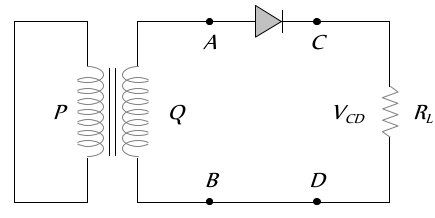
- 3In the half-wave rectifier circuit shown. Which one of the following wave forms is true for $V_{C D}$, the output across $C$ and $D$ ?View Solution
- 4Following is the relation between current and charge $I=A T^2 e^{q t / V_L}$ then value of $V$ will beView Solution
- 5View SolutionThe part of a transistor which is heavily doped to produce a large number of majority carriers, is
- 6View SolutionEnergy bands in solids are a consequence of
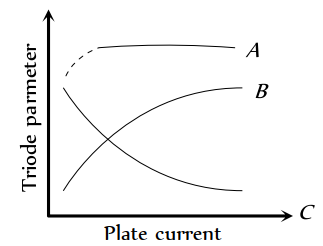
- 7The figure represents variation of triode parameter ( $\mu$ or $r$ or $g$ ) with the plate current. The correct variation of $\mu$ and $r$ are given, respectively by the curvesView Solution
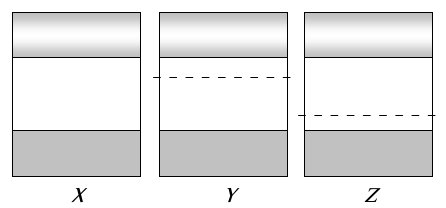
- 8View SolutionThe energy band diagrams for three semiconductor samples of silicon are as shown. We can then assert that
- 9If the two ends $P$ and $N$ of a $P-N$ diode junction are joined by a wireView Solution
- 10View SolutionHoles are charge carriers in