MCQ
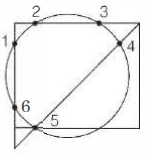
Let $R$ be a rectangle, $C$ be a circle, and $T$ be a triangle in the plane. The maximum possible number of points common to the perimeters of $R, C$ and $T$ is
  • A
    $3$
  • B
    $4$
  • C
    $5$
  • $6$

Answer

Correct option: D.
$6$
d
(d)
Maximum possible number of points common to the perimeter of rectangle, circle and triangle is $6$.

Need a full question paper?

Generate a complete, print-ready paper with questions like this in minutes — across 16+ boards, with answer keys.

Start Generating Free

Similar questions

Choose the correct answers from the given four option: If X = {8n - 7n - 1 | n $\in$ N} and Y = {49n - 49 | n $\in$ N}. Then
If $n$ is even positive integer, then the condition that the greatest term in the expansion of ${(1 + x)^n}$ may have the greatest coefficient also, is
Let $a_1, a_2, a_3, \ldots$ be an arithmetic progression with $a_1=7$ and common difference $8$ . Let $T_1, T_2, T_3, \ldots$ be such that $T_1=3$ and $T_{n+1}-T_n=a_n$ for $n \geq 1$. Then, which of the following is/are $TRUE$ ?

$(A)$ $T_{20}=1604$

$(B)$ $\sum_{ k =1}^{20} T_{ k }=10510$

$(C)$ $T_{30}=3454$

$(D)$ $\sum_{ k =1}^{30} T_{ k }=35610$

If $p_1$ and $p_2$ are the lengths of the perpendiculars from the origin upon the lines $\text{x} \sec \theta + \text{y} \text{cosec}\theta = \text{a}$ and $\text{x} \cos \theta - \text{y} \sin \theta = \text{a} \cos 2 \theta$ respectively, then:
$\sum\limits_{n = 0}^4 {{{\left( {1009 - 2n} \right)}^4}\left( \begin{gathered}
  4 \hfill \\
  n \hfill \\ 
\end{gathered}  \right)} {\left( { - 1} \right)^n}$   is
The sum of the series $1.2.3 + 2.3.4 + 3.4.5 + .......$ to $n$ terms is
The sum of the solutions $x \in \mathbb{R}$ of the equation $\frac{3 \cos 2 x+\cos ^3 2 x}{\cos ^6 x-\sin ^6 x}=x^3-x^2+6$ is
Let $n$ be a positive integer such that $\sin \frac{\pi }{{{2^n}}} + \cos \frac{\pi }{{{2^n}}} = \frac{{\sqrt n }}{2}.$ Then
If $z = \frac{{\sqrt 3 + i}}{{ - 2}}$, then ${z^{69}}$ is equal to
If the circles $x^2 + y^2 + 5Kx + 2y + K = 0$ and $2(x^2 + y^2) + 2Kx + 3y -1 = 0 $, $(K \in R)$, intersect at the points $P$ and $Q$,then the line $4x + 5y -K = 0 $ passes through $P$ and $Q$ for