MCQ
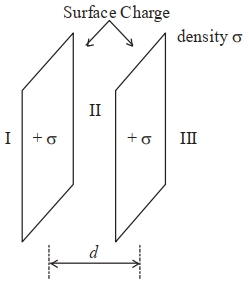
Let $\sigma$ be the uniform surface charge density of two infinite thin plane sheets shown in figure. Then the electric fields in three different region $E_{ I }, E_{ II }$ and $E_{III}$ are
  • A
    $\vec{E}_{ I }=\frac{2 \sigma}{\in_0} \hat{n}, \vec{E}_{ II }=0, \vec{E}_{ III }=\frac{2 \sigma}{\in_0} \hat{n}$
  • B
    $\vec{E}_{ I }=0, \vec{E}_{ II }=\frac{\sigma}{\in_0} \hat{n}, \vec{E}_{ III }=0$
  • C
    $\vec{E}_{ I }=\frac{\sigma}{2 \in_0} \hat{n}, \vec{E}_{\text {II }}=0, \vec{E}_{ III }=\frac{\sigma}{2 \in_0} \hat{n}$
  • $\vec{E}_{ I }=-\frac{\sigma}{\in_0} \hat{n}, \vec{E}_{\text {II }}=0, \vec{E}_{\text {III }}=\frac{\sigma}{\in_0} \hat{n}$
Answer

Correct option: D.
$\vec{E}_{ I }=-\frac{\sigma}{\in_0} \hat{n}, \vec{E}_{\text {II }}=0, \vec{E}_{\text {III }}=\frac{\sigma}{\in_0} \hat{n}$
d
Assuming RHS to be $\hat{n}$

$\vec{E}_{ I }=\frac{\sigma}{2 \in_0}(-\hat{n})+\frac{\sigma}{2 \in_0}(-\hat{n})=-\frac{\sigma}{\in_0} \hat{n}$

$\vec{E}_{I I}=0$,

$\vec{E}_{I I I}=\frac{\sigma}{2 \in_0}(\hat{n})+\frac{\sigma}{2 \in_0}(\hat{n})=\frac{\sigma}{\in_0}(\hat{n})$

Need a full question paper?

Generate a complete, print-ready paper with questions like this in minutes — across 16+ boards, with answer keys.

Start Generating Free

Similar questions

A transformer has turn ratio $100/1$. If secondary coil has $4 \,amp$ current then current in primary coil is......$A$
Dielectric constant is the:
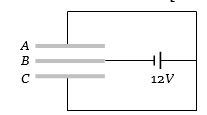
Three plates $A,\;B,\;C$each of area $50\,c{m^2}$ have separation $3\,mm$ between $A$ and $B$ and $3\,mm$ between $B$ and $C$. The energy stored when the plates are fully charged is
Assertion : Photosensitivity of a metal is high if its work function is small.
Reason : Work function = $\mathrm{hf}_0$ where $\mathrm{f}_0$ is the threshold frequency.
In the absence of an electric field, the mean velocity of free electrons in a conductor at absolute temperature $(T)$ is:
Displacement current is continuous:
The mutual inductance between two coils is $1.25$ $henry$. If the current in the primary changes at the rate of $80$ $ampere/second,$ then the induced $e.m.f$ in the secondary is......$V$
The electric field $E$ is measured at a point $P (0,0, d )$ generated due to various charge distributions and the dependence of $E$ on $d$ is found to be different for different charge distributions. List-$I$ contains different relations between $E$ and $d$. List-$II$ describes different electric charge distributions, along with their locations. Match the functions in List-$I$ with the related charge distributions in List-$II$.

 List-$I$  List-$II$
$E$ is independent of $d$ A point charge $Q$ at the origin
$E \propto \frac{1}{d}$ A small dipole with point charges $Q$ at $(0,0, l)$ and $- Q$ at $(0,0,-l)$. Take $2 l \ll d$.
$E \propto \frac{1}{d^2}$ An infinite line charge coincident with the x-axis, with uniform linear charge density $\lambda$
$E \propto \frac{1}{d^3}$ Two infinite wires carrying uniform linear charge density parallel to the $x$-axis. The one along ( $y=0$, $z =l$ ) has a charge density $+\lambda$ and the one along $( y =0, z =-l)$ has a charge density $-\lambda$. Take $2 l \ll d$
  plane with uniform surface charge density


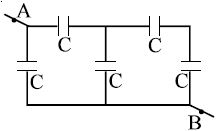
What is the equivalent capacitance of the system of capacitors between $A$ $\&$ $B$ 
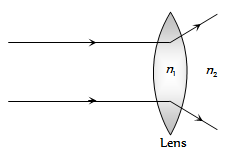
The relation between $n_1$ and $n_2$, if behaviour of light rays is as shown in figure is