Question
Let $\text{A}=\begin{bmatrix}1&0\\2&1\end{bmatrix},$ and $U_1, U_2$ are e first and second columns respectively of a $2 \times 2$ matrix $U$. Also, let the column matrices $U_1$ and $U_2$ satisfying $\text{AU}_1=\begin{bmatrix}1\\0\end{bmatrix}$ and $\text{AU}_2=\begin{bmatrix}2\\3\end{bmatrix}.$
Based on the above information, answer the following questions.
  1. The matrix $U_1 + U_2$ is equal to:
  1. $\begin{bmatrix}1\\-1\end{bmatrix}$
  2. $\begin{bmatrix}2\\-2\end{bmatrix}$
  3. $\begin{bmatrix}3\\-3\end{bmatrix}$
  4. $\begin{bmatrix}4\\-4\end{bmatrix}$
  1. The value of $|U|$ is:
  1. $2$
  2. $-2$
  3. $3$
  4. $-3$
  1. If $\text{X}=\begin{bmatrix}3&2\end{bmatrix}\text{U}\begin{bmatrix}3\\2\end{bmatrix},$ then the value of |X| =
  1. $3$
  2. $-3$
  3. $-5$
  4. $5$
  1. The minor of element at the position $a_{22}$ in $U$ is:
  1. $1$
  2. $2$
  3. $-2$
  4. $-1$
  1. If $\text{U}=[\text{a}_\text{ij}]_{2\times2},$ then the value of $a_{11}A_{11}+ a_{12}A_{12},$ where $A_{ij} $ denotes the cofactor of $a_{ij},$ is:
  1. $1$
  2. $2$
  3. $-3$
  4. $3$

Answer

  1. (c) $\begin{bmatrix}3\\-3\end{bmatrix}$
Solution:
We have, $\text{A}=\begin{bmatrix}1&0\\2&1\end{bmatrix}$
Let $\text{U}_1=\begin{bmatrix}\text{a}\\\text{b}\end{bmatrix}$ and $\text{AU}_1=\begin{bmatrix}1\\0\end{bmatrix}$
$\Rightarrow\begin{bmatrix}1&0\\2&1\end{bmatrix}\begin{bmatrix}\text{a}\\\text{b}\end{bmatrix}=\begin{bmatrix}1\\0\end{bmatrix}\Rightarrow\begin{bmatrix}\text{a}\\2\text{a}+\text{b}\end{bmatrix}=\begin{bmatrix}1\\0\end{bmatrix}$
$⇒ a = 1$ and $2a + b = 0 ⇒ a = 1$ and $b = -2.$
Let $\text{U}_2=\begin{bmatrix}\text{c}\\\text{d}\end{bmatrix}$ then $\text{AU}_2=\begin{bmatrix}2\\3\end{bmatrix}$
$\Rightarrow\begin{bmatrix}1&0\\2&1\end{bmatrix}\begin{bmatrix}\text{c}\\\text{d}\end{bmatrix}=\begin{bmatrix}2\\3\end{bmatrix}\Rightarrow\begin{bmatrix}\text{c}\\2\text{c}+\text{d}\end{bmatrix}=\begin{bmatrix}2\\3\end{bmatrix}$
$⇒ c = 2$ and $2c + d = 3$
$⇒ c = 2$ and $d = 3 - 4= -1$
Thus, $\text{U}_1+\text{U}_2=\begin{bmatrix}1\\-2\end{bmatrix}+\begin{bmatrix}2\\-1\end{bmatrix}=\begin{bmatrix}3\\-3\end{bmatrix}$
  1. (c) $3$
Solution:
Clearly, $\text{U}=\begin{bmatrix}1&2\\-2&-1\end{bmatrix}$
$\therefore|\text{U}|=\begin{vmatrix}1&2\\-2&-1\end{vmatrix}=-1+4=3$
  1. (d) $5$
Solution:
We have, $\text{X}=\begin{bmatrix}3&2\end{bmatrix}\begin{bmatrix}1&2\\-2&-1\end{bmatrix}\begin{bmatrix}3\\2\end{bmatrix}$
$=\begin{bmatrix}3&2\end{bmatrix}\begin{bmatrix}7\\-8\end{bmatrix}=[21-16]=[5]$
$\therefore|\text{X}|=5$
  1. (a) $1$
Solution:
$a_{22}$ in U is $-1$ and its minor is $1.$
  1. (d) $3$
Solution:
Since, the sum of products of elements of any row (or column) with their corresponding cofactors is equal to the value of determinant.
$\therefore a_{11}A_{11} + a_{12}A_{12} = |U| = 3$

Need a full question paper?

Generate a complete, print-ready paper with questions like this in minutes — across 16+ boards, with answer keys.

Start Generating Free

Similar questions

Read the following text carefully and answer the questions that follow:
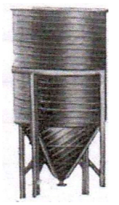
A tank, as shown in the figure below, formed using a combination of a cylinder and a cone, offers better drainage as compared to a flat bottomed tank.
Image

A tap is connected to such a tank whose conical part is full of water. Water is dripping out from a tap at the
bottom at the uniform rate of $2 \ cm^3 / s$. The semi $-$ vertical angle of the conical tank is $45^{\circ}$.
$i$. Find the volume of water in the tank in terms of its radius $r. \ (1)$
$ii$. Find rate of change of radius at an instant when $r =2 \sqrt{2} \ cm. (1)$
$iii$. Find the rate at which the wet surface of the conical tank is decreasing at an instant when radius $r =2 \sqrt{2} \ cm.(2)$
OR
Find the rate of change of height h at an instant when slant height is $4 \ cm. (2)$
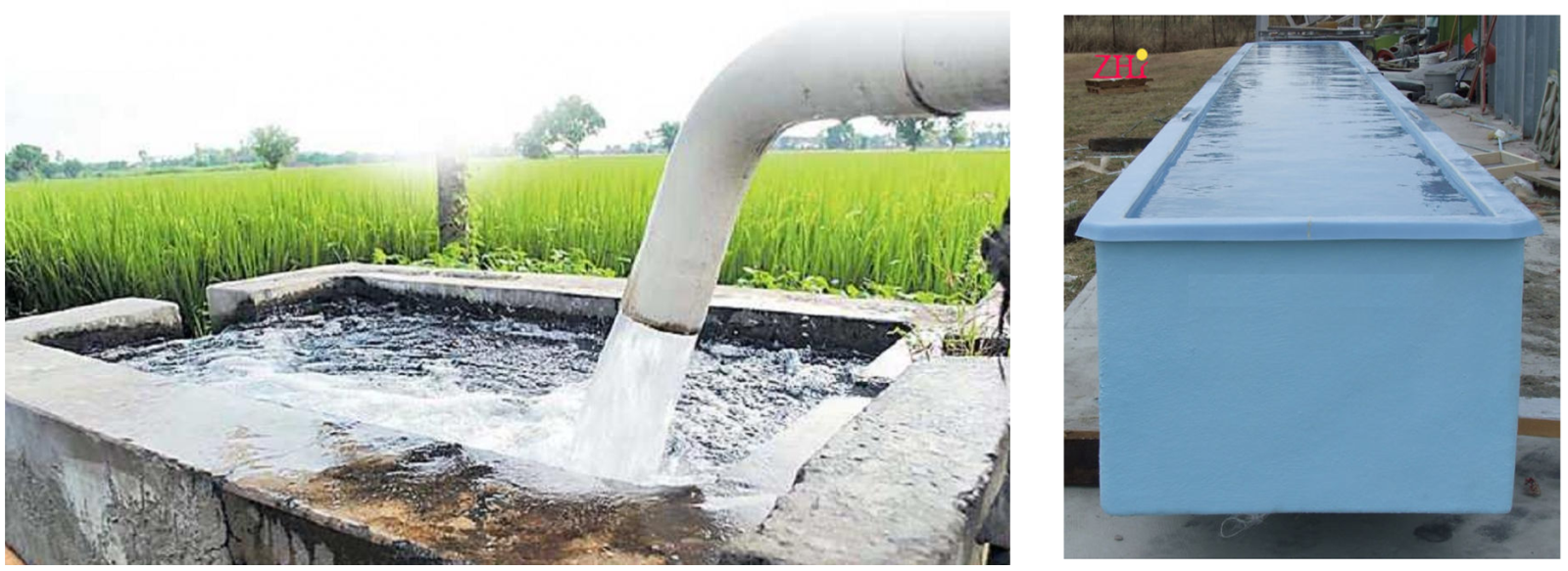
An open water tank of aluminium sheet of negligible thickness, with a square base and vertical sides, is to be constructed in a farm for irrigation. It should hold $32000$ l of water, that comes out from a tube well.

Based on above information, answer the following questions.
  1. If the length, width, and height of the open tank be $x, x$ and $y$ $m$ respectively, then total surface area of tank is.
  1. $(x^2 + 2xy)m^2$
  2. $(2x^2 + 4xy)m^2$
  3. $(2x^2 + 2xy)m^2$
  4. $(2x^2 + 8xy)m^2$
  1. The relation between $x$ and $y$ is.
  1. $x^2y = 32$
  2. $xy^2 = 32$
  3. $x^2y^2 = 32$
  4. $xy = 32$
  1. The outer surface area of tank will be minimum when depth of tank is equal to.
  1. Half of its width.
  2. Its width.
  3. $\big(\frac{1}{4}\big)^\text{th}$ of its Width
  4. $\big(\frac{1}{3}\big)^\text{rd}$ of its Width
  1. The cost of material will be least when width of tank is equal to.
  1. Half of its depth
  2. Twice of its depth
  3. $\big(\frac{1}{4}\big)^\text{th}$ of its depth
  4. Thrice of its depth
  1. If cost of aluminium sheet is $ ₹ \frac{360}{\text{m}^2}$ then the minimum cost for the construction of tank will be.
  1. $₹\ 15, 000$
  2. $₹\ 16, 280$
  3. $₹\ 17, 280$
  4. $₹\ 18, 280$
To hire a marketing manager, it's important to find a way to properly assess candidates who can bring radical changes and has leadership experience. Ajay, Ramesh and Ravi attend the interview for the post of a marketing manager.
Ajay, Ramesh and Ravi chances of being selected as the manager of a firm are in the ratio $4: 1: 2$ respectively. The respective probabilities for them to introduce a radical change in marketing strategy are $0.3,0.8$, and 0.5 . If the change does take place.

Image

(i) Find the probability that it is due to the appointment of Ajay (A).

(ii) Find the probability that it is due to the appointment of Ramesh (B).

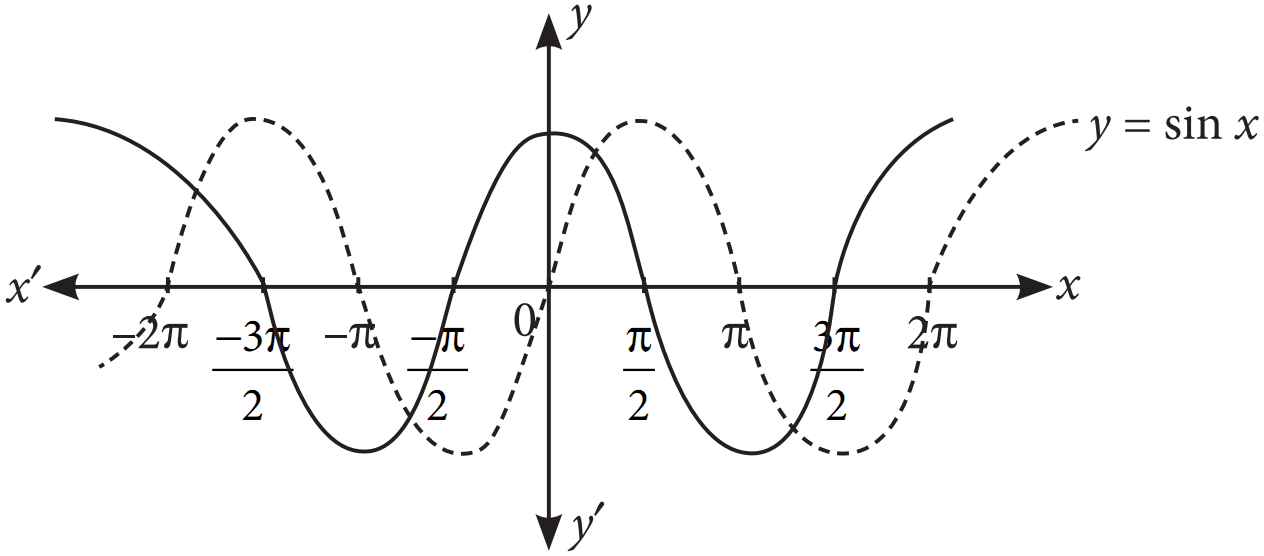
In a classroom, teacher explains the properties of a particular curve by saying that this particular curve has beautiful up and downs. It starts at 1 and heads down until $\pi$ radian, and then heads up again and closely related to sine function and both follow each other, exactly $\frac{\pi}{2}$ radians apart as shown in figure.

Based on the above information, answer the following questions.
  1. Name the curve, about which teacher explained in the classroom.
  1. Cosine
  2. Sine
  3. Tangent
  4. Cotangent
  1. Area of curve explained in the passage from 0 to $\frac{\pi}{2}$ is.
  1. $\frac{1}{3}\text{ sq.unit}$
  2. $\frac{1}{2}\text{ sq.unit}$
  3. ${1}\text{ sq.unit}$
  4. ${2}\text{ sq.units}$
  1. Area of curve discussed in classroom from $\frac{\pi}{2}$ to $\frac{3\pi}{2}$ is.
  1. -2 sq. units
  2. 2 sq. units
  3. 3 sq. units
  4. -3 sq. units
  1. Area of curve discussed in classroom from $\frac{3\pi}{2}$ to $2\pi$ is.
  1. 1 sq. unit
  2. 2 sq. units
  3. 3 sq. units
  4. 4 sq. units
  1. Area of explained curve from 0 to $2\pi$ is.
  1. 1 sq. unit
  2. 2 sq. units
  3. 3 sq. units
  4. 4 sq. units
A real estate company is going to build a new residential complex. The land they have purchased can hold at most $4500$ apartments. Also, if they make x apartments, then the monthly maintenance cost for the whole complex would be as follows: Fixed cost $= ₹ 50,00,000$. Variable cost $= (160x - 0.04x^2)$

Based on the above information, answer the following questions.
  1. The maintenance cost as a function of $x$ will be.
  1. $160x - 0.04x^2$ 
  2. $5000000$
  3. $5000000 + 160x - 0.04x^2$ 
  4. None of these
  1. If $C(x)$ denote the maintenance cost function, then maximum value of $C(x)$ occur at $x =$
  1. $0$
  2. $2000$
  3. $4500$
  4. $5000$
  1. The maximum value of $C(x)$ would be.
  1. $₹\ 5225000$
  2. $₹\ 5160000$
  3. $₹\ 5000000$
  4. $₹\ 4000000$
  1. The number of apartments, that the complex should have in order to minimize the maintenance cost, is.
  1. $4500$
  2. $5000$
  3. $1750$
  4. $3500$
  1. If the minimum maintenance cost is attain, then the maintenance cost for each apartment would be.
  1. $₹\ 1091.11$
  2. $₹\ 1200$
  3. $₹\ 1000$
  4. $₹\ 2000$
Western music concert is organised every year in the stadium that can hold 36000 spectators. With ticket price of ₹ 10, the average attendance has been 24000. Some financial expert estimated that price of a ticket should be determined by the function.
$\text{p}(\text{x})=15-\frac{\text{x}}{3000}$ where x is the number of tickets sold.

Based on the above information, answer the following questions.
  1. The revenue, R as a function of x can be represented as.
  1. $15\text{x}-\frac{\text{x}^2}{3000}$
  2. $15-\frac{\text{x}^2}{3000}$
  3. $15\text{x}-\frac{1}{3000}$
  4. $15\text{x}-\frac{\text{x}}{3000}$
  1. The range of x is.
  1. [24000, 36000]
  2. [0, 24000]
  3. [0, 36000]
  4. None of these
  1. The value of x for which revenue is maximum, is.
  1. 20000
  2. 21000
  3. 22500
  4. 25000
  1. When the revenue is maximum, the price of the ticket is.
  1. ₹ 5
  2. ₹ 5.5
  3. ₹ 7
  4. ₹ 7.5
  1. How many spectators should be present to maximize the revenue?
  1. 21500
  2. 21000
  3. 22000
  4. 22500
Read the following passage and answer the questions given below: In an Office three employees James, Sophia and Oliver process incoming copies of a certain form. James processes $50\%$ of the forms, Sophia processes $20\%$ and Oliver the remaining $30\%$ of the forms. James has an error rate of $0.06,$ Sophia has an error rate of $0.04$ and Oliver has an error rate of $0.03.$ Based on the above
Image
information, answer the following questions.
(i) Find the probability that Sophia processed the form and committed an error.
(ii) Find the total probability of committing an error in processing the form.
(iii) The manager of the Company wants to do a quality check. During inspection, he selects a form at random from the days output of processed form. If the form selected at random has an error, find the probability that the form is not processed by James.
OR
(iii) Let E be the event of committing an error in processing the form and let 12 ,EEand 3 Ebe the events that James, Sophia and Oliver processed the form. Find the value of$\sum_{i=1}^3 P\left(E_i \mid E\right)$
A football match is organised between students of class XII of two schools, say school A and school B. For which a team from each school is chosen. Remaining students of class XII of school A and Bare respectively sitting
on the plane represented by the equation$ \vec{\text{r}}.(\hat{\text{i}}+\hat{\text{j}}+\hat{2\text{k}})=5$ and $ \vec{\text{r}}.(\hat{2\text{i}}-\hat{\text{j}}+\hat{\text{k}})=6$ to cheer up the team of their respective schools.
Based on the above information, answer the following questions.
  1. The cartesian equation of the plane on which students of school A are seated is:
  1. 2x - y + z = 8
  2. 2x + y + z = 8
  3. x + y + 2z = 5
  4. x + y + z = 5
  1. The magnitude of the normal to the plane on which students of school Bare seated, is:
  1. $\sqrt{5}$
  2. $\sqrt{6}$
  3. $\sqrt{3}$
  4. $\sqrt{2}$
  1. The intercept form of the equation of the plane on which students of school Bare seated is:
  1. $\frac{\text{x}}{6}+\frac{\text{y}}{6}+\frac{\text{z}}{6}=1$
  2. $\frac{\text{x}}{3}+\frac{\text{y}}{(-6)}+\frac{\text{z}}{6}=1$
  3. $\frac{\text{x}}{3}+\frac{\text{y}}{6}+\frac{\text{z}}{6}=1$
  4. $\frac{\text{x}}{3}+\frac{\text{y}}{6}+\frac{\text{z}}{3}=1$
  1. Which of the following is a student of school B?
  1. Mohit sitting at (1, 2, 1)
  2. Ravi sitting at (0, 1, 2)
  3. Khushi sitting at (3, 1, 1)
  4. Shewta sitting at (2, -1, 2)
  1. The distance of the plane, on which students of school Bare seated, from the origin is:
  1. 6 units
  2. $\frac{1}{\sqrt{6}}\text{ units}$
  3. $\frac{5}{\sqrt{6}}\text{ units}$
  4. $\sqrt{6}\text{ units}$
DETERMINANTS: A determinant is a square array of numbers (written within a pair of vertical lines) which represents a certain sum of We can solve a system of equations using determinants, but it becomes very tedious for large systems. We will only do 2 × 2 and 3 × 3 systems using determinants. Using the properties of determinants solve the problem given below and answer the questions that follow:
Three shopkeepers Ram Lal, Shyam Lal, and Ghansham are using polythene bags, handmade bags (prepared by prisoners), and newspaper's envelope as carry bags. It is found that the shopkeepers Ram Lal, Shyam Lal, and Ghansham are using (20, 30, 40), (30, 40, 20), and (40, 20, 30) polythene bags, handmade bags, and newspapers envelopes respectively. The shopkeepers Ram Lal, Shyam Lal, and Ghansham spent ₹250, ₹270, and ₹200 on these carry bags respectively.
  1. What is the cost of one polythene bag?
  1. ₹ 1
  2. ₹ 2
  3. ₹ 3
  4. ₹ 5
  1. What is the cost of one handmade bag?
  1. ₹1
  2. ₹2
  3. ₹3
  4. ₹5
  1. What is the cost of one newspaper bag?
  1. ₹1
  2. ₹2
  3. ₹3
  4. ₹5
  1. Keeping in mind the social conditions, which shopkeeper is better?
  1. Ram Lal
  2. Shyam Lal
  3. Ghansham
  4. None of these
  1. Keeping in mind the environmental conditions, which shopkeeper is better?
  1. Ram Lal
  2. Shyam Lal
  3. Ghansham
  4. None of these
Order: The order of a differential equation is the order of the highest order derivative appearing in the differential equation.
Degree: The degree of differential equation is the power of the highest order derivative, when differential coefficients are made free from radicals and fractions. Also, differential equation must be a polynomial equation in derivatives for the degree to be defined.
Based on the above information, answer the following questions.
  1. Find the degree of the differential equation $2\frac{\text{d}^2\text{y}}{\text{dx}^2}+3\sqrt{1-\Big(\frac{\text{dy}}{\text{dx}}\Big)^2-\text{y}=0}.$
  1. $3$
  2. $4$
  3. $3$
  4. $1$
  1. Order and degree of the differential equation $\text{y}\frac{\text{dy}}{\text{dx}}=\frac{\text{x}}{\frac{\text{dy}}{\text{dx}}+\Big(\frac{\text{dy}}{\text{dx}}\Big)^3}$ are respectively.
  1. $1, 1$
  2. $1, 2$
  3. $1, 3$
  4. $1, 4$
  1. Find order and degree of the equation $y'" + y^2 + e^{y'} = 0.$
  1. Order $= 3,$ degree $=$ undefined.
  2. Order $= 1,$ degree $= 3.$
  3. Order $= 2,$ degree $=$ undefined.
  4. Order $= 1,$ degree $= 2.$
  1. Determine degree of the differential equation $(\sqrt{\text{a+x}})\times\Big(\frac{\text{dy}}{\text{dx}}\Big)+\text{x}=0.$
  1. $3$
  2. Not defined
  3. $1$
  4. $2$
  1. Order and degree of the differential equation $\Bigg(1+\Big(\frac{\text{dy}}{\text{dx}}\Big)^3\Bigg)^\frac{7}{3}=7\frac{\text{d}^2\text{y}}{\text{dx}^2}$ are respectively.
  1. $2, 1$
  2. $2, 3$
  3. $1, 3$
  4. $1,\ \frac{7}{3}$