MCQ
Let the function $f: R \rightarrow R$ be defined by

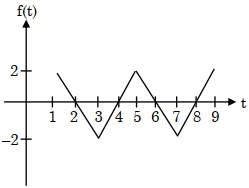
$f(t)=\left\{\begin{array}{cc}(-1)^{n+1} 2, & \text { if } t=2 n-1, n \in N , \\ \frac{(2 n+1-t)}{2} f(2 n-1)+\frac{(t-(2 n-1))}{2} f(2 n+1), & \text { if } 2 n-1 < t < 2 n+1, n \in N \end{array}\right.$

Define $g(x)=\int_1^x f(t) d t, x \in(1, \infty)$. Let $\alpha$ denote the number of solutions of the equation $g(x)=0$ in the interval $(1,8]$ and $\beta=\lim _{x \rightarrow 1+} \frac{g(x)}{x-1}$. Then the value of $\alpha+\beta$ is equal to. . . . . .

  • A
    $3$
  • B
    $4$
  • $5$
  • D
    $6$

Answer

Correct option: C.
$5$
c
$f ( t )=\left\{\begin{array}{ccc}2 & ; & t =1 \\ 4-2 t & ; & 1< t <3 \\ -2 & ; & t =3 \\ -8-2 t & ; & 3< t <5 \\ 2 & ; & t =5 \\ 12-2 t & ; & 5< t <7 \\ -2 & ; & t =7 \\ -16+2 t & ; & 7< t <9\end{array}\right.$

$g(x)=\int_1^x f(t) d t ; g^{\prime}(x)=f(x)$

$\text { for } x \in(1,8]$

$g(x)=0 \Rightarrow x=3,5,7 \therefore \alpha=3$

$\beta=\lim _{x \rightarrow 1^{+}} \frac{g(x)}{x-1}$

$\text { Apply L'pital }$

$=\frac{g^{\prime}\left(1^{+}\right)}{1}=f\left(1^{+}\right)$

$\beta=2$

$\therefore \alpha+\beta=5$

Need a full question paper?

Generate a complete, print-ready paper with questions like this in minutes — across 16+ boards, with answer keys.

Start Generating Free