MCQ
Let $ \vec a ,\vec b$  and $\vec c $ be three non-zero vectors such that no two of them are collinear and $\left( {\vec a \times \vec b} \right) \times \vec c = \frac{1}{3}\left| \vec b \right|\left| \vec c \right|\vec a$. If $\theta $ is the angle between vectors  $\vec b$ and $\vec c$ , then a value of  $\sin \theta $ is :
  • A
    $\frac{{ - 2\sqrt 3 }}{3}$
  • $\;\frac{{2\sqrt 2 }}{3}$
  • C
    $\;\frac{{ - \sqrt 2 }}{3}$
  • D
    $\frac{2}{3}$

Answer

Correct option: B.
$\;\frac{{2\sqrt 2 }}{3}$
b
$\left( {\vec a \times \vec b} \right) \times \vec c = \left( {\frac{1}{3}} \right)\left| {\vec b} \right|\left| {\vec c} \right|\vec a$

$ \Rightarrow  - \vec c \times \left( {\vec a \times \vec b} \right) = \left( {\frac{1}{3}} \right)\left| {\vec b} \right|\left| {\vec c} \right|\vec a$

$ \Rightarrow \left( {\vec c \cdot \vec a} \right)\vec b - \left( {\vec c.\vec b} \right)\vec a $$= \left( {\frac{1}{3}} \right)\left| {\vec b} \right|\left| {\vec c} \right|\vec a$

$\left( {\vec c \cdot \vec b} \right) = \left( { - \frac{1}{3}} \right)\left| {\vec b} \right|\left| {\vec c} \right|$

$ \Rightarrow \left| {\vec b} \right|\left| {\vec c} \right|\cos \theta  = \left( { - \frac{1}{3}} \right)\left| {\vec b} \right|\left| {\vec c} \right|$

$ \Rightarrow \cos \theta  =  - \frac{1}{3}$

$\sin \theta  = \sqrt {1 - {{\left( {\frac{1}{3}} \right)}^2}}  = \sqrt {\frac{8}{9}}  = \frac{{2\sqrt 2 }}{3}$
Need a full question paper?

Generate a complete, print-ready paper with questions like this in minutes — across 16+ boards, with answer keys.

Start Generating Free

Similar questions

Let $R=\left\{\left(\begin{array}{lll}\mathrm{a} & 3 & \mathrm{~b} \\ \mathrm{c} & 2 & \mathrm{~d} \\ 0 & 5 & 0\end{array}\right): \mathrm{a}, \mathrm{b}, \mathrm{c}, \mathrm{d} \in\{0,3,5,7,11,13,17,19\}\right\}$. Then the number of invertible matrices in $\mathrm{R}$ is
For real numbers $a, b (a> b >0)$, let Area $\left\{(x, y): x^{2}+y^{2} \leq a^{2}\right.$ and $\left.\frac{x^{2}}{a^{2}}+\frac{y^{2}}{b^{2}} \geq 1\right\}=30 \pi$ and  Area $\left\{(x, y): x^{2}+y^{2} \geq b^{2}\right.$ and $\left.\frac{x^{2}}{a^{2}}+\frac{y^{2}}{b^{2}} \leq 1\right\}=18 \pi$  Then the value of $(a-b)^{2}$ is equal to
If the coefficient of $x ^{10}$ in the binomial expansion of $\left(\frac{\sqrt{x}}{5^{\frac{1}{4}}}+\frac{\sqrt{5}}{x^{\frac{1}{3}}}\right)^{60}$ is $5^{ k } l$, where $l, k \in N$ and $l$ is coprime to $5$ , then $k$ is equal to
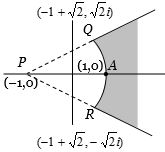
$PQ$ and $PR$ are two infinite rays. $QAR$ is an arc. Point lying in the shaded region excluding the boundary satisfies
A unit vector perpendicular to the vector $4i - j + 3k$ and $ - 2i + j - 2k$ is
The co-ordinates of a point which is equidistant from the points $(0,\,0,\;0),(a,\,0,\,0),(0,\,\,b,\,\,0)$ and $(0,\,0,\,c)$ are given by
The parabolas ${y^2} = 4x$ and ${x^2} = 4y$ divide the square region bounded by the lines $x = 4$, $y = 4$ and the coordinate axes. If ${S_1},{S_2},{S_3}$ are respectively the areas of these parts numbered from top to bottom, then ${S_1}:{S_2}:{S_3}$ is
The exact value of $\cos \frac{{2\pi }}{{28}}\,\cos ec\frac{{3\pi }}{{28}}\, + \,\cos \frac{{6\pi }}{{28}}\,\cos ec\frac{{9\pi }}{{28}} + \cos \frac{{18\pi }}{{28}}\cos ec\frac{{27\pi }}{{28}}$ is equal to


If the sum of the coefficients in the expansion of ${(x - 2y + 3z)^n}$ is $128$ then the greatest coefficient in the expansion of ${(1 + x)^n}$ is
The area $($in square units$)$ of the region bounded by the parabola $y^2=4(x-2)$ and the line $y = 2x - 8$