Answer

  1. $4^\frac13\text{W}$

Need a full question paper?

Generate a complete, print-ready paper with questions like this in minutes — across 16+ boards, with answer keys.
Start Generating Free

Similar questions

A body of mass ' ${m}$ ' dropped from a height ' ${h}$ ' reaches the ground with a speed of $0.8 \sqrt{{gh}}$. The value of workdone by the air-friction is $.....\,{mgh}$
In an adiabatic change, the pressure P and temperature T of a diatomic gas are related by the relation $\text{P}\propto\text{T}^\text{C}$ where C equals:
A stone of mass $0.3\,kg$ attached to a $1.5\,m$ long string is whirled around in a horizontal circle at a speed of $6\,m s ^{-1}$. The tension in the string is $............\,N$
The escape velocity for a planet is $v_e.$ A tunnel is dug along a diameter of the planet and a small body is dropped into it at the surface. When the body reaches the centre of the planet, its speed will be
A thin walled cylindrical metal vessel of linear coefficient of expansion $10^{-3} $ $^o C^{-1}$ contains benzenr of volume expansion coefficient $10^{-3}$ $^o C^{-1}$. If the vessel and its contents are now heated by $10^o C,$ the pressure due to the liquid at the bottom.
A particle executes simple harmonic motion between x = -A and x = +A. The time taken for it to go from 0 to $\frac{\text{A}}{2}$ is T1 and to go from $\frac{\text{A}}{2}$ to A is T2, Then:
A force of $5\,N$ acts on a body of mass $5\, kg$ for $1\, second$ and gives it a momentum $p$ and kinetic energy $E$. If the same force accelerates the same body through $1\,m$, the momentum and energy attained by the body are $p’$ and $E’$ respectively. Which of the following relations is correct?
A police car with a siren of frequency $8$ $kHz$ is moving with uniform velocity $36$ $km/hr$ towards a tall building which reflects the sound waves. The speed of sound in air is $320$ $m/s$. The frequency of the siren heard by the car driver is .... $kHz$
The coordinates of a moving particle at any time are given by $x = a{t^2}$ and $y = b{t^2}$. The speed of the particle at any moment is
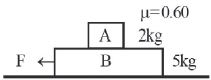
Two block $(A)\,2\,kg$ and $(B)\,5\,kg$ rest one over the other on a smooth horizontal plane. The cofficient of static and dynamic friction between $(A)$ and $(B)$ is the same and equal to $0.60$. The maximum horizontal force that can be applied to $(B)$ in order that both $(A)$ and $(B)$ do not have any relative motion : $(g = 10\,m/s^2)$