MCQ
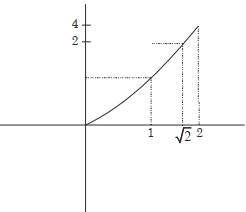
Let $[ x ]$ denote the greatest integer $\leq x$. Consider the function $f(x)=\max \left\{x^2, 1+[x]\right\}$. Then the value of the integral $\int \limits_0^2 f ( x ) dx$ is :
  • $\frac{5+4 \sqrt{2}}{3}$
  • B
    $\frac{8+4 \sqrt{2}}{3}$
  • C
    $\frac{1+5 \sqrt{2}}{3}$
  • D
    $\frac{4+5 \sqrt{2}}{3}$

Answer

Correct option: A.
$\frac{5+4 \sqrt{2}}{3}$
a
$A=\int \limits_0^1 1 . d x+\int \limits_1^{\sqrt{2}} 2 d x+\int \limits_{\sqrt{2}}^2 x^2 d x$

$=1+2 \sqrt{2}-2+\frac{8}{3}-\frac{2 \sqrt{2}}{3}$

$=\frac{5}{3}+\frac{4 \sqrt{2}}{3}$

Need a full question paper?

Generate a complete, print-ready paper with questions like this in minutes — across 16+ boards, with answer keys.

Start Generating Free

Similar questions

Maximize Z = 11 x + 8y subject to $\text{x}\leq4,\text{y}\leq6,\text{x}+\text{y}\leq6,\text{x}\geq0,\text{y}\geq0.$
  1. 44 at (4, 2)
  2. 60 at (4, 2)
  3. 62 at (4, 0)
  4. 48 at (4, 2)
$\tan ^{-1}\left(\tan \frac{31 \pi}{6}\right)=$ __________ .
$\int_{-\pi / 4}^{\pi / 4} \sec ^2 x d x$ is equal to
If the points $P$ and $Q$ are respectively the circumcentre and the orthocentre of a $\triangle ABC$, then $\overrightarrow{ PA }+\overrightarrow{ PB }+\overrightarrow{ PC }$ is equal to
Let $\mathrm{a}, \mathrm{b} \in R, \mathrm{b} \neq 0$, Define a function

$f(x)= \begin{cases}\operatorname{a} \sin \frac{\pi}{2}(x-1), & \text { for } x \leq 0 \\ \frac{\tan 2 x-\sin 2 x}{b x^{3}}, & \text { for } x>0\end{cases}$

If $f$ is continuous at $x=0$, then $10-a b$ is equal to ...... .

The solution of the differential equation $x\frac{{{d^2}y}}{{d{x^2}}} = 1$, given that $y = 1,\;\frac{{dy}}{{dx}} = 0$when $x = 1$, is
Let $\vec a=j -k $ and $ \vec c= i -j -k $ Then the vector $\vec b$ satisfying $\vec a \times \vec b + \vec c = 0$ and $\vec a\cdot \vec b=3 $
If $y = {\sin ^{ - 1}}\left( {{{19} \over {20}}x} \right) + {\cos ^{ - 1}}\left( {{{19} \over {20}}x} \right)$, then ${{dy} \over {dx}} = $
If $I = \int_0^{\pi /4} {\,{{\sin }^2}x\,dx} $ and $J = \int_0^{\pi /4} {{{\cos }^2}x\,dx,} $ then $I = $
If $\alpha=\tan^{-1}\Big(\tan\frac{5\pi}{4}\Big)$ and $\beta=\tan^{-1}\Big(-\tan\frac{2\pi}{3}\Big),$ then:

  1. $4\alpha=3\beta$

  2. $3\alpha=4\beta$

  3. $\alpha-\beta=\frac{7\pi}{12}$

  4. $\text{none of these}$