Question
Let x = f(t) and y = g(t) be parametric forms with t as a parameter, then
$\frac{\text{dy}}{\text{dx}}=\frac{\text{dy}}{\text{dt}}\times\frac{\text{dt}}{\text{dx}}=\frac{\text{g}'(\text{t})}{\text{f}'(\text{t})},$ where $\text{f}'(\text{t})\neq0.$
On the basis of above information, answer the following questions.
  1. The derivative of $\text{f}(\tan\text{x})\text{w.r.t.}\text{ g}(\sec\text{x})\text{ at}\text{ x}=\frac{\pi}{4},$ where f'(1) = 2 and $\text{g}'(\sqrt{2})=4,$ is:
  1. $\frac{1}{\sqrt{2}}$
  2. ${\sqrt{2}}$
  3. 1
  4. 0
  1. The derivative of $\sin^{-1}\Big(\frac{2\text{x}}{1+\text{x}^2}\Big)$ with respect to $\cos^{-1}\Big(\frac{1-\text{x}^2}{1+\text{x}^2}\Big)$ is:
  1. -1
  2. 1
  3. 2
  4. 4
  1. The derivative of $\text{e}^{\text{x}^3}$ with respect to log x is:
  1. $\text{e}^{\text{x}^3}$
  2. $3\text{x}^22\text{e}^{\text{x}^3}$
  3. $3\text{x}^3\text{e}^{\text{x}^3}$
  4. $3\text{x}^2\text{e}^{\text{x}^3}+3\text{x}$
  1. The derivative of $\cos^{-1}(2\text{x}^2-1)\text{w.r.t.}\cos^{-1}\text{x}$ is:
  1. $2$
  2. $\frac{-1}{2\sqrt{1-\text{x}^2}}$
  3. $\frac{2}{\text{x}}$
  4. $1-\text{x}^2$
  1. If $\text{y}=\frac{1}{4}\mu^4$ and $\mu=\frac{2}{3}\text{x}^3+5,$ then $\frac{\text{dy}}{\text{dx}}=$
  1. $\frac{2}{27}\text{x}^2(2\text{x}^3+15)^3$
  2. $\frac{2}{7}\text{x}^2(2\text{x}^3+15)^3$
  3. $\frac{2}{27}\text{x}(2\text{x}^3+5)^3$
  4. $\frac{2}{7}(2\text{x}^3+15)^3$
Answer

  1. (a) $\frac{1}{\sqrt{2}}$

Solution:

Now, $\frac{\text{df}(\tan\text{x})}{\text{dg}(\sec\text{x})}=\frac{\text{f}'(\tan \text{x})\sec^2\text{x}}{\text{g}'(\sec\text{x})\sec\text{x}\tan \text{x}}$

$=\frac{\text{f}'(\tan \text{x})\sec\text{x}}{\text{g}'(\sec\text{x})\tan \text{x}}$

$\therefore\Big[\frac{\text{df}(\tan\text{x})}{\text{dg}(\sec\text{x})}\Big]_{\text{x}=\frac{\pi}{4}}=\frac{\text{f}'(1)\sqrt{2}}{\text{g}'(\sqrt{2})\cdot1}=\frac{2\sqrt{2}}{4\cdot1}=\frac{1}{\sqrt{2}}$

  1. (b) 1
  1. (c) $3\text{x}^3\text{e}^{\text{x}^3}$

Solution:

Let $\text{y}=\text{e}^{\text{x}^3},\text{z}=\log\text{x}$

Differentiating w.r.t. x, we get

$\frac{\text{dy}}{\text{dx}}=\text{e}^{\text{x}^3}(3\text{x}^2)=3\text{x}^2\text{e}^{\text{x}^3}$ and $\therefore\frac{\text{dy}}{\text{dz}}=\frac{\frac{\text{dy}}{\text{dx}}}{\frac{\text{dz}}{\text{dx}}}=\frac{3\text{x}^2\text{e}^{\text{x}^3}}{\Big(\frac{1}{\text{x}}\Big)}=3\text{x}^3\text{e}^{\text{x}^3}$

  1. (a) $2$

Solution:

Let $\text{y}=\cos^{-1}(2\text{x}^2-1)=2\cos^{-1}\text{x}$

Differentiating w.r.t. $\cos^{-1}\text{x},$ we get

$\frac{\text{dy}}{\text{d}(\cos^{-1}\text{x})}=\frac{2\text{d}(\cos^{-1}\text{x})}{\text{d}(\cos^{-1}\text{x})}=2$

  1. (a) $\frac{2}{27}\text{x}^2(2\text{x}^3+15)^3$

Solution:

We have, $\text{y}=\frac{1}{4}\text{u}^4\Rightarrow\frac{\text{dy}}{\text{du}}=\frac{1}{4}\cdot4\text{u}^3=\text{u}^3$

and $\text{u}=\frac{2}{3}\text{x}^3+5\Rightarrow\frac{\text{du}}{\text{dx}}=\frac{2}{3}\cdot3\text{x}^2=2\text{x}^2$

$\therefore\frac{\text{dy}}{\text{dx}}=\frac{\text{dy}}{\text{du}}\cdot\frac{\text{du}}{\text{dx}}=\text{u}^3\cdot2\text{x}^2=\Big(\frac{2}{3}\text{x}^3+5\Big)^3(2\text{x})^2$

$=\frac{2}{27}\text{x}^2(2\text{x}^3+15)^3$

Need a full question paper?

Generate a complete, print-ready paper with questions like this in minutes — across 16+ boards, with answer keys.

Start Generating Free

Similar questions

In an office three employees Govind, Priyanka and Tahseen process incoming copies of a certain form. Govind process $50 \%$ of the forms, Priyanka processes $20 \%$ and Tahseen the remaining $30 \%$ of the forms. Govind has an error rate of 0.06 , Priyanka has an error rate of 0.04 and Tahseen has an error rate of 0.03 . 

Image

(i) The manager of the company wants to do a quality check. During inspection he selects a form at random from the days output of processed forms. If the form selected at random has an error, find the probability that the form is NOT processed by Govind.

(ii) Find the probability that Priyanka processed the form and committed an error.

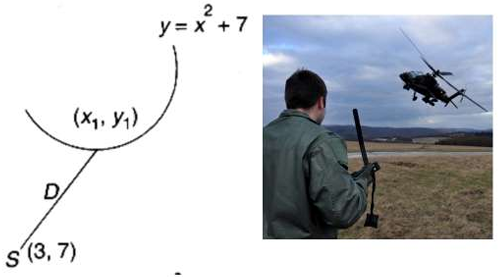
An Apache helicopter of the enemy is flying along the curve given by $y=x^2+7$. A soldier, placed at $(3,7)$ want to shoot down the helicopter when it is nearest to him.

Image

(i) If $\mathrm{P}\left(\mathrm{x}_1, \mathrm{y}_1\right)$ be the position of a helicopter on curve $\mathrm{y}=\mathrm{x}^2+7$, then find distance $\mathrm{D}$ from $\mathrm{P}$ to soldier place at $(3,7)$.

(ii) Find the critical point such that distance is minimum.

(iii) Verify by second derivative test that distance is minimum at $(1,8)$.

OR

Find the minimum distance between soldier and helicopter?

If a relation between x and y is such that y cannot be expressed in terms of x, then y is called an implicit function of x. When a given relation expresses y as an implicit function of x and we want to find $\frac{\text{dy}}{\text{dx}},$ then we differentiate every term of the given relation w.r.t. x, remembering that a tenn in y is first differentiated w.r.t. y and then multiplied by $\frac{\text{dy}}{\text{dx}}.$
Based on the ab:ve information, find the value of $\frac{\text{dy}}{\text{dx}}$ in each of the following questions.
  1. x3 + x2y + xy2 + y3 = 81
  1. $\frac{(3\text{x}^2+2\text{xy}+\text{y}^2)}{\text{x}^2+2\text{xy}+3\text{y}^2}$
  2. $\frac{-(3\text{x}^2+2\text{xy}+\text{y}^2)}{\text{x}^2+2\text{xy}+3\text{y}^2}$
  3. $\frac{(3\text{x}^2+2\text{xy}-\text{y}^2)}{\text{x}^2-2\text{xy}+3\text{y}^2}$
  4. $\frac{3\text{x}^2+\text{xy}+\text{y}^2}{\text{x}^2+\text{xy}+3\text{y}^2}$
  1. xy = ex-y
  1. $\frac{\text{x}-\text{y}}{(1+\log\text{x})}$
  2. $\frac{\text{x}+\text{y}}{(1+\log\text{x})}$
  3. $\frac{\text{x}-\text{y}}{\text{x}(1+\log\text{x})}$
  4. $\frac{\text{x}+\text{y}}{\text{x}(1+\log\text{x})}$
  1. $\text{e}^{\sin\text{y}}=\text{xy}$
  1. $\frac{-\text{y}}{\text{x}(\text{y}\cos\text{y}-1)}$
  2. $\frac{\text{y}}{\text{y}\cos\text{y}-1}$
  3. $\frac{\text{y}}{\text{y}\cos\text{y}+1}$
  4. $\frac{\text{y}}{\text{x}(\text{y}\cos\text{y}-1)}$
  1. $\sin^2\text{x}+\cos^2\text{y}=1$
  1. $\frac{\sin2\text{y}}{\sin2\text{x}}$
  2. $-\frac{\sin2\text{x}}{\sin2\text{y}}$
  3. $-\frac{\sin2\text{y}}{\sin2\text{x}}$
  4. $\frac{\sin2\text{x}}{\sin2\text{y}}$
  1. $\text{y}=(\sqrt{\text{x}})^{\sqrt{\text{x}}^\sqrt{\text{x}}...\infty}$
  1. $\frac{-\text{y}^2}{\text{x}(2-\text{y}\log\text{x})}$
  2. $\frac{\text{y}^2}{2+\text{y}\log\text{x}}$
  3. $\frac{\text{y}^2}{\text{x}(2+\text{y}\log\text{x})}$
  4. $\frac{\text{y}^2}{\text{x}(2-\text{y}\log\text{x})}$
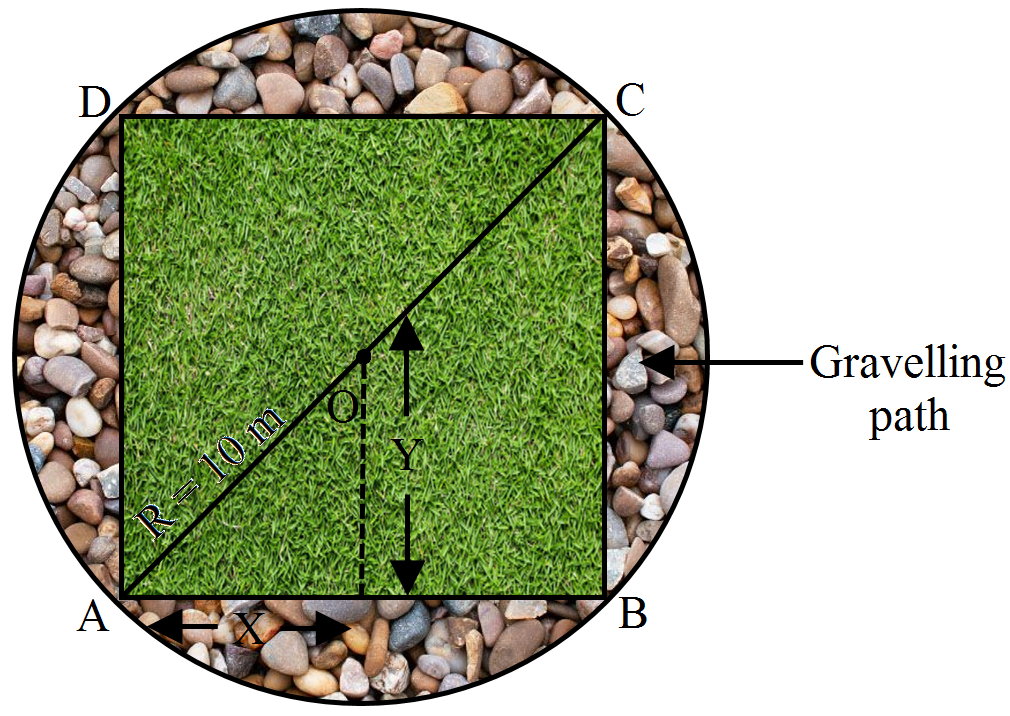
In a society there is a garden in the shape of rectangle inscribed in a circle of radius 10m as shown in given figure.

Based on the above information, answer the following questions.
  1. If 2x and 2y denotes the length and breadth in metres, of the rectangular part, then the relation between the variables is.
  1. x2 - y2 = 10
  2. x2 + y2 = 10
  3. x2 + y2 = 100
  4. x2 - y2 = 100
  1. The area (A) of green grass, in terms of x, is given by.
  1. $2\text{x}\sqrt{100-\text{x}^2}$
  2. $4\text{x}\sqrt{100-\text{x}^2}$
  3. $2\text{x}\sqrt{100+\text{x}^2}$
  4. $4\text{x}\sqrt{100+\text{x}^2}$
  1. The maximum value of A is.
  1. $100\text{m}^2$
  2. $200\text{m}^2$
  3. $400\text{m}^2$
  4. $1600\text{m}^2$
  1. The value of length of rectangle, when A is maximum, is.
  1. $10\sqrt{2}\text{m}$
  2. $20\sqrt{2}\text{m}$
  3. $20\text{m}$
  4. $5\sqrt{2}\text{m}$
  1. The area of gravelling path is.
  1. $100(\pi+2)\text{m}^2$
  2. $100(\pi-2)\text{m}^2$
  3. $200(\pi+2)\text{m}^2$
  4. $200(\pi-2)\text{m}^2$
The Government declare that farmers can get ₹ 300 per quintal for their onions on 1st July and after that, the price will be dropped by ₹ 3 per quintal per extra day. Govind's father has 80 quintals of onions in the field on 1st July and he estimates that the crop is increasing at the rate of 1 quintal per day.

Image

(i) If $x$ is the number of days after $1^{\text {st }}$ July, then express price and quantity of onion and the revenue as a function of $x$.

(ii) Find the number of days after 1st July, when Govind's father attains maximum revenue.

(iii) On which day should Govind's father harvest the onions to maximize his revenue?

OR

Find the maximum revenue collected by Govind's father.

Three car dealers, say A, Band C, deals in three types of cars, namely Hatchback cars, Sedan cars, SUV cars. The sales figure of 2019 and 2020 showed that dealer A sold 120 Hatchback, 50 Sedan, 10 SUV cars in 2019 and 300 Hatchback, 150 Sedan, 20 SUV cars in 2020; dealer B sold 100 Hatchback, 30 Sedan, 5 SUV cars in 2019 and 200 Hatchback, 50 Sedan, 6 SUV cars in 2020; dealer C sold 90 Hatchback, 40 Sedan, 2 SUV cars in 2019 and 100 Hatchback, 60 Sedan, 5 SUV cars in 2020.

Based on the above information, answer the following questions.
  1. The matrix summarizing sales data of 2019 is:
  1. $\begin{matrix}&\text{Hatchback}&\text{Sedan}&\text{SUV}\end{matrix}\\\begin{matrix}\text{A}\\\text{B}\\\text{C}\end{matrix}\begin{bmatrix}\ \ \ \ \ \ 300\ \ \ &\ \ 150&\ \ \ \ \ 20\\\ \ \ 200&\ \ 50&\ \ \ \ \ 6\\\ \ \ 100&\ \ 30&\ \ \ \ \ 5\end{bmatrix}$
  2. $\begin{matrix}&\text{Hatchback}&\text{Sedan}&\text{SUV}\end{matrix}\\\begin{matrix}\text{A}\\\text{B}\\\text{C}\end{matrix}\begin{bmatrix}\ \ \ \ \ \ 120\ \ \ &\ \ 100&\ \ \ \ \ 20\\\ \ \ 100&\ \ 30&\ \ \ \ \ 5\\\ \ \ 90&\ \ 40&\ \ \ \ \ 2\end{bmatrix}$
  3. $\begin{matrix}&\text{Hatchback}&\text{Sedan}&\text{SUV}\end{matrix}\\\begin{matrix}\text{A}\\\text{B}\\\text{C}\end{matrix}\begin{bmatrix}\ \ \ \ \ \ 100\ \ \ &\ \ 30&\ \ \ \ \ 5\\\ \ \ 120&\ \ 50&\ \ \ \ \ 10\\\ \ \ 90&\ \ 40&\ \ \ \ \ 2\end{bmatrix}$
  4. $\begin{matrix}&\text{Hatchback}&\text{Sedan}&\text{SUV}\end{matrix}\\\begin{matrix}\text{A}\\\text{B}\\\text{C}\end{matrix}\begin{bmatrix}\ \ \ \ \ \ 200\ \ \ &\ \ 50&\ \ \ \ \ 6\\\ \ \ 100&\ \ 30&\ \ \ \ \ 5\\\ \ \ 300&\ \ 150&\ \ \ \ \ 20\end{bmatrix}$
  1. The matrix summarizing sales data of 2020 is:
  1. $\begin{matrix}&\text{Hatchback}&\text{Sedan}&\text{SUV}\end{matrix}\\\begin{matrix}\text{A}\\\text{B}\\\text{C}\end{matrix}\begin{bmatrix}\ \ \ \ \ \ 300\ \ \ &\ \ 150&\ \ \ \ \ 20\\\ \ \ 200&\ \ 50&\ \ \ \ \ 6\\\ \ \ 100&\ \ 60&\ \ \ \ \ 5\end{bmatrix}$
  2. $\begin{matrix}&\text{Hatchback}&\text{Sedan}&\text{SUV}\end{matrix}\\\begin{matrix}\text{A}\\\text{B}\\\text{C}\end{matrix}\begin{bmatrix}\ \ \ \ \ \ 120\ \ \ &\ \ 50&\ \ \ \ \ 10\\\ \ \ 100&\ \ 60&\ \ \ \ \ 5\\\ \ \ 90&\ \ 40&\ \ \ \ \ 2\end{bmatrix}$
  3. $\begin{matrix}&\text{Hatchback}&\text{Sedan}&\text{SUV}\end{matrix}\\\begin{matrix}\text{A}\\\text{B}\\\text{C}\end{matrix}\begin{bmatrix}\ \ \ \ \ \ 100\ \ \ &\ \ 60&\ \ \ \ \ 5\\\ \ \ 120&\ \ 50&\ \ \ \ \ 10\\\ \ \ 90&\ \ 40&\ \ \ \ \ 2\end{bmatrix}$
  4. $\begin{matrix}&\text{Hatchback}&\text{Sedan}&\text{SUV}\end{matrix}\\\begin{matrix}\text{A}\\\text{B}\\\text{C}\end{matrix}\begin{bmatrix}\ \ \ \ \ \ 200\ \ \ &\ \ 50&\ \ \ \ \ 6\\\ \ \ 100&\ \ 60&\ \ \ \ \ 5\\\ \ \ 300&\ \ 150&\ \ \ \ \ 20\end{bmatrix}$
  1. The cost incurred by the organisation on village Z is:
  1. $\begin{matrix}&\text{Hatchback}&\text{Sedan}&\text{SUV}\end{matrix}\\\begin{matrix}\text{A}\\\text{B}\\\text{C}\end{matrix}\begin{bmatrix}\ \ \ \ \ \ 190\ \ \ &\ \ 100&\ \ \ \ \ 7\\\ \ \ 300&\ \ 80&\ \ \ \ \ 11\\\ \ \ 420&\ \ 200&\ \ \ \ \ 30\end{bmatrix}$
  2. $\begin{matrix}&\text{Hatchback}&\text{Sedan}&\text{SUV}\end{matrix}\\\begin{matrix}\text{A}\\\text{B}\\\text{C}\end{matrix}\begin{bmatrix}\ \ \ \ \ \ 300\ \ \ &\ \ 80&\ \ \ \ \ 11\\\ \ \ 190&\ \ 100&\ \ \ \ \ 7\\\ \ \ 420&\ \ 200&\ \ \ \ \ 30\end{bmatrix}$
  3. $\begin{matrix}&\text{Hatchback}&\text{Sedan}&\text{SUV}\end{matrix}\\\begin{matrix}\text{A}\\\text{B}\\\text{C}\end{matrix}\begin{bmatrix}\ \ \ \ \ \ 420\ \ \ &\ \ 200&\ \ \ \ \ 30\\\ \ \ 300&\ \ 80&\ \ \ \ \ 11\\\ \ \ 190&\ \ 100&\ \ \ \ \ 7\end{bmatrix}$
  4. None of these
  1. The increase in sales from 2019 to 2020 is given by the matrix.
  1. $\begin{matrix}&\text{Hatchback}&\text{Sedan}&\text{SUV}\end{matrix}\\\begin{matrix}\text{A}\\\text{B}\\\text{C}\end{matrix}\begin{bmatrix}\ \ \ \ \ \ 180\ \ \ &\ \ 100&\ \ \ \ \ 10\\\ \ \ 10&\ \ 20&\ \ \ \ \ 1\\\ \ \ 100&\ \ 20&\ \ \ \ \ 3\end{bmatrix}$
  2. $\begin{matrix}&\text{Hatchback}&\text{Sedan}&\text{SUV}\end{matrix}\\\begin{matrix}\text{A}\\\text{B}\\\text{C}\end{matrix}\begin{bmatrix}\ \ \ \ \ \ 10\ \ \ &\ \ 20&\ \ \ \ \ 3\\\ \ \ 100&\ \ 20&\ \ \ \ \ 1\\\ \ \ 180&\ \ 100&\ \ \ \ \ 10\end{bmatrix}$
  3. $\begin{matrix}&\text{Hatchback}&\text{Sedan}&\text{SUV}\end{matrix}\\\begin{matrix}\text{A}\\\text{B}\\\text{C}\end{matrix}\begin{bmatrix}\ \ \ \ \ \ 180\ \ \ &\ \ 100&\ \ \ \ \ 10\\\ \ \ 100&\ \ 20&\ \ \ \ \ 1\\\ \ \ 10&\ \ 20&\ \ \ \ \ 3\end{bmatrix}$
  4. $\begin{matrix}&\text{Hatchback}&\text{Sedan}&\text{SUV}\end{matrix}\\\begin{matrix}\text{A}\\\text{B}\\\text{C}\end{matrix}\begin{bmatrix}\ \ \ \ \ \ 100\ \ \ &\ \ 20&\ \ \ \ \ 3\\\ \ \ 180&\ \ 100&\ \ \ \ \ 10\\\ \ \ 10&\ \ 20&\ \ \ \ \ 3\end{bmatrix}$
  1.  If each dealer receive profit of ₹ 50000 on sale of a Hatchback. ₹ 100000 on sale of a Sedan and ₹ 200000 on sale of a SUV, then amount of profit received in the year 2020 by each dealer is given by the matrix.
  1. $\begin{matrix}\text{A}\\\text{B}\\\text{C}\end{matrix}\begin{bmatrix}30000000\\15000000\\12000000\end{bmatrix}$
  2. $\begin{matrix}\text{A}\\\text{B}\\\text{C}\end{matrix}\begin{bmatrix}12000000\\16200000\\34000000\end{bmatrix}$
  3. $\begin{matrix}\text{A}\\\text{B}\\\text{C}\end{matrix}\begin{bmatrix}34000000\\16200000\\12000000\end{bmatrix}$
  4. $\begin{matrix}\text{A}\\\text{B}\\\text{C}\end{matrix}\begin{bmatrix}15000000\\30000000\\12000000\end{bmatrix}$
A football match is organised between students of class XII of two schools, say school A and school B. For which a team from each school is chosen. Remaining students of class XII of school A and Bare respectively sitting 
on the plane represented by the equation$ \vec{\text{r}}.(\hat{\text{i}}+\hat{\text{j}}+\hat{2\text{k}})=5$ and $ \vec{\text{r}}.(\hat{2\text{i}}-\hat{\text{j}}+\hat{\text{k}})=6$ to cheer up the team of their respective schools. 


Based on the above information, answer the following questions. 

  1. The cartesian equation of the plane on which students of school A are seated is:
  1. 2x - y + z = 8
  2. 2x + y + z = 8
  3. x + y + 2z = 5
  4. x + y + z = 5
  1. The magnitude of the normal to the plane on which students of school Bare seated, is:
  1. $\sqrt{5}$

  2. $\sqrt{6}$

  3. $\sqrt{3}$

  4. $\sqrt{2}$

  1. The intercept form of the equation of the plane on which students of school Bare seated is:
  1. $\frac{\text{x}}{6}+\frac{\text{y}}{6}+\frac{\text{z}}{6}=1$

  2. $\frac{\text{x}}{3}+\frac{\text{y}}{(-6)}+\frac{\text{z}}{6}=1$

  3. $\frac{\text{x}}{3}+\frac{\text{y}}{6}+\frac{\text{z}}{6}=1$

  4. $\frac{\text{x}}{3}+\frac{\text{y}}{6}+\frac{\text{z}}{3}=1$

  1. Which of the following is a student of school B?
  1. Mohit sitting at (1, 2, 1)
  2. Ravi sitting at (0, 1, 2)
  3. Khushi sitting at (3, 1, 1)
  4. Shewta sitting at (2, -1, 2)
  1. The distance of the plane, on which students of school Bare seated, from the origin is:
  1. 6 units
  2. $\frac{1}{\sqrt{6}}\text{ units}$

  3. $\frac{5}{\sqrt{6}}\text{ units}$

  4. $\sqrt{6}\text{ units}$

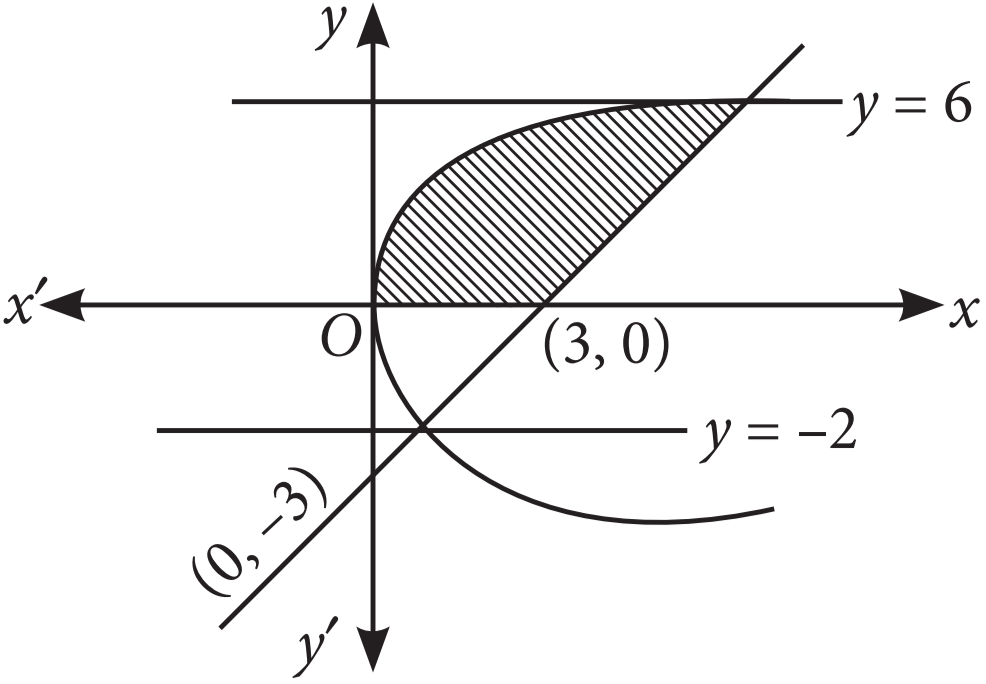
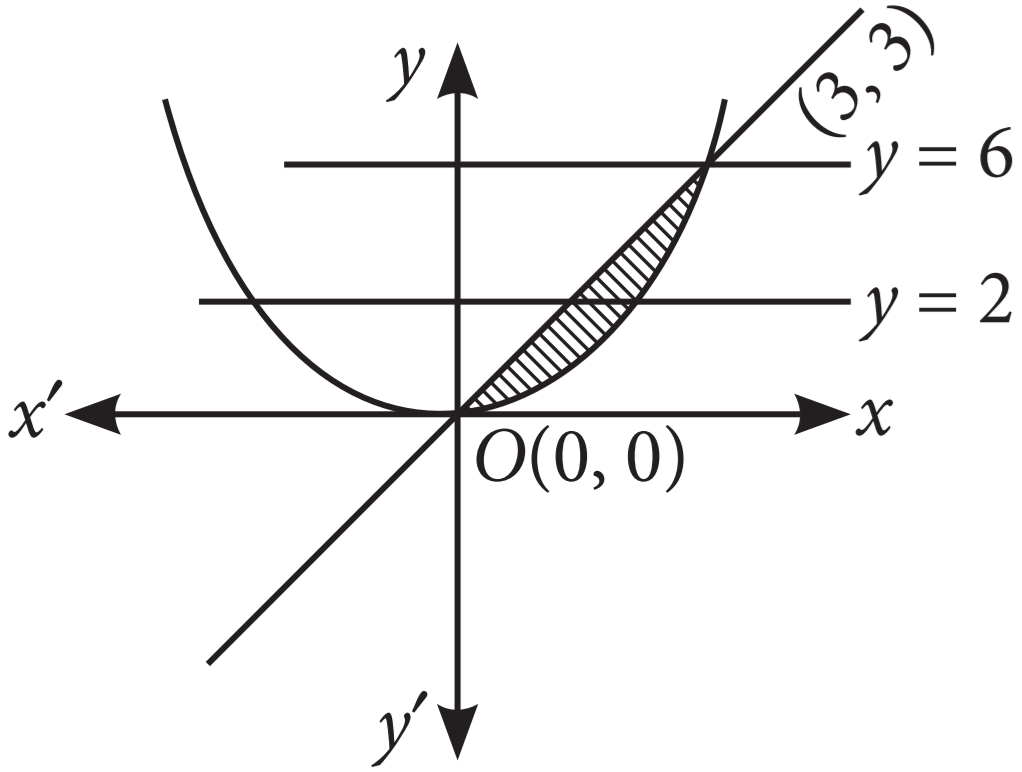
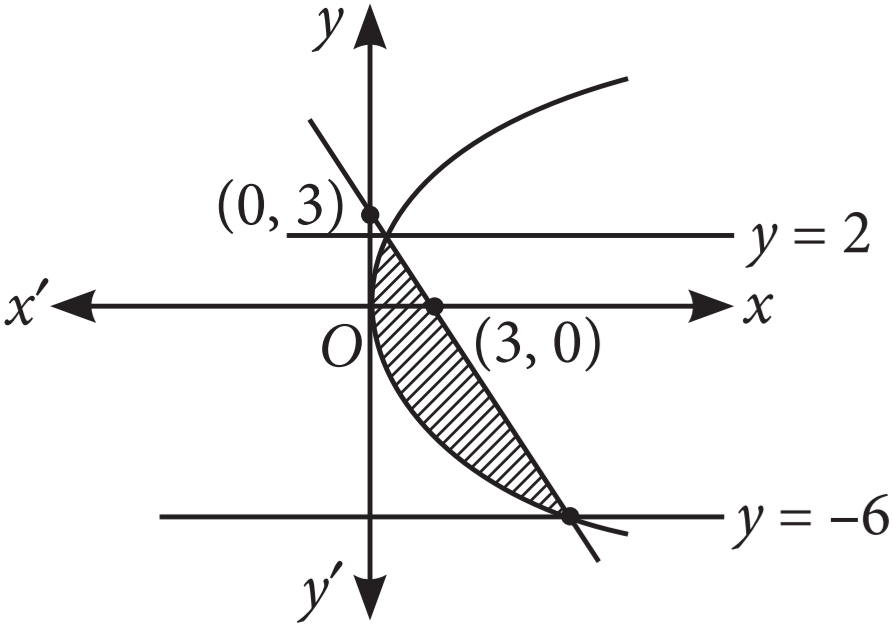
Consider the following equation of curve y2 = 4x and straight line x + y = 3.
Based on the above information, answer the following questions.
  1. The line x + y = 3 cuts the x-axis and y-axis respectively at.
  1. (0, 2), (2, 0)
  2. (3, 3), (0, 0)
  3. (0, 3), (3, 0)
  4. (3, 0), (0, 3)
  1. Point(s) of intersection of two given curves is (are).
  1. (1, -2), (-9, 6)
  2. (2, 1), (-6, 9)
  3. (1, 2), (9, -6)
  4. None of these.
  1. Which of the following shaded portion re present the area bounded by given curves?
    1. None of these
  1. Value of the integral $\int\limits_{-6}^{2}(3-\text{y})\text{ dy}$ is
  1. 10
  2. 20
  3. 30
  4. 40
  1. Value of area bounded by given curves is.
  1. $56\text{ sq.units}$
  2. $\frac{63}{5}\text{ sq. units}$
  3. $\frac{64}{3}\text{ sq. units}$
  4. $31\text{ sq.units}$
A differential equation is said to be in the variable separable form if it is expressible in the form f(x) dx = g(y) dy.
The solution of this equation is given by
$\int\text{f(x)dx}=\int\text{g(y)dy}+\text{c},$ where c is the constant of integration.
Based on the above information, answer the following questions.
  1. If the solution of the differential equation $\frac{\text{dy}}{\text{dx}}=\frac{\text{ax+3}}{\text{2y+f}}$ represents a circle, then the value of 'a' is:
  1. 2
  2. -2
  3. 3
  4. -4
  1. The differential equation $\frac{\text{dy}}{\text{dx}}=\frac{\sqrt{1-\text{y}^2}}{\text{y}}$ determines a family of circle with.
  1. Variable radii and fixed centre (0, 1)
  2. Variable radii and fixed centre (0, -1)
  3. Fixed radius 1 and variable centre on x-axis
  4. Fixed radius 1 and variable centre on y-axis
  1. If = y'+ 1, y(0) = 1, then y (In 2) =
  1. 1
  2. 2
  3. 3
  4. 4
  1. The solution of the differential equation $\frac{\text{dy}}{\text{dx}}=\text{e}^\text{x-y}+\text{x}^2\text{e}^\text{-y}$ is:
  1. $\text{e}^\text{x}=\frac{\text{y}^3}{3}+\text{e}^\text{y}+\text{c}$
  2. $\text{e}^\text{y}=\frac{\text{x}^2}{3}+\text{e}^\text{x}+\text{c}$
  3. $\text{e}^\text{y}=\frac{\text{x}^3}{3}+\text{e}^\text{x}+\text{c}$
  4. None of these
  1. If $\frac{\text{dy}}{\text{dx}}=\text{y}\sin2\text{x},\ \text{y}(0)=1,$ then its solution is:
  1. $\text{y}=\text{e}^{\sin^2}\text{x}$
  2. $\text{y}={\sin^2}\text{x}$
  3. $\text{y}={\cos^2}\text{x}$
  4. $\text{y}=\text{e}^{\cos^2}\text{x}$
In pre-board examination of class XII, commerce stream with Economics and Mathematics of a particular school, 50% of the students failed in Economics, 35% failed in Mathematics and 25% failed in both Economics and Mathematics. A student is selected at random from the class.

Based on the above information, answer the following questions.

  1. The probability that the selected student has failed in Economics, if it is known that he has failed in Mathematics, is:
  1. $\frac{3}{10}$

  2. $\frac{12}{25}$

  3. $\frac{1}{4}$

  4. $\frac{5}{7}$
  1. The probability that the selected student has failed in Mathematics, if it is known that he has failed in Economics, is:
  1. $\frac{22}{25}$

  2. $\frac{12}{25}$

  3. $\frac{1}{2}$

  4. $\frac{3}{25}$
  1. The probability that the selected student has passed in at least one of the two subjects, is:
  1. $\frac{1}{4}$

  2. $\frac{1}{2}$

  3. $\frac{3}{4}$

  4. None of these.

  1. The probability that the selected student has failed in at least one of the two subjects, is:
  1. $\frac{3}{5}$

  2. $\frac{22}{25}$

  3. $\frac{2}{5}$

  4. $\frac{43}{100}$

  1. The probability that the selected student has passed in Mathematics, if it is known that he has failed in Economics, is:
  1. $\frac{2}{5}$

  2. $\frac{3}{4}$

  3. $\frac{1}{3}$

  4. $\frac{1}{2}$