Question
Let x = f(t) and y = g(t) be parametric forms with t as a parameter, then
$\frac{\text{dy}}{\text{dx}}=\frac{\text{dy}}{\text{dt}}\times\frac{\text{dt}}{\text{dx}}=\frac{\text{g}'(\text{t})}{\text{f}'(\text{t})},$ where $\text{f}'(\text{t})\neq0.$
On the basis of above information, answer the following questions.
  1. The derivative of $\text{f}(\tan\text{x})\text{w.r.t.}\text{ g}(\sec\text{x})\text{ at}\text{ x}=\frac{\pi}{4},$ where f'(1) = 2 and $\text{g}'(\sqrt{2})=4,$ is:
  1. $\frac{1}{\sqrt{2}}$
  2. ${\sqrt{2}}$
  3. 1
  4. 0
  1. The derivative of $\sin^{-1}\Big(\frac{2\text{x}}{1+\text{x}^2}\Big)$ with respect to $\cos^{-1}\Big(\frac{1-\text{x}^2}{1+\text{x}^2}\Big)$ is:
  1. -1
  2. 1
  3. 2
  4. 4
  1. The derivative of $\text{e}^{\text{x}^3}$ with respect to log x is:
  1. $\text{e}^{\text{x}^3}$
  2. $3\text{x}^22\text{e}^{\text{x}^3}$
  3. $3\text{x}^3\text{e}^{\text{x}^3}$
  4. $3\text{x}^2\text{e}^{\text{x}^3}+3\text{x}$
  1. The derivative of $\cos^{-1}(2\text{x}^2-1)\text{w.r.t.}\cos^{-1}\text{x}$ is:
  1. $2$
  2. $\frac{-1}{2\sqrt{1-\text{x}^2}}$
  3. $\frac{2}{\text{x}}$
  4. $1-\text{x}^2$
  1. If $\text{y}=\frac{1}{4}\mu^4$ and $\mu=\frac{2}{3}\text{x}^3+5,$ then $\frac{\text{dy}}{\text{dx}}=$
  1. $\frac{2}{27}\text{x}^2(2\text{x}^3+15)^3$
  2. $\frac{2}{7}\text{x}^2(2\text{x}^3+15)^3$
  3. $\frac{2}{27}\text{x}(2\text{x}^3+5)^3$
  4. $\frac{2}{7}(2\text{x}^3+15)^3$

Answer

  1. (a) $\frac{1}{\sqrt{2}}$

Solution:

Now, $\frac{\text{df}(\tan\text{x})}{\text{dg}(\sec\text{x})}=\frac{\text{f}'(\tan \text{x})\sec^2\text{x}}{\text{g}'(\sec\text{x})\sec\text{x}\tan \text{x}}$

$=\frac{\text{f}'(\tan \text{x})\sec\text{x}}{\text{g}'(\sec\text{x})\tan \text{x}}$

$\therefore\Big[\frac{\text{df}(\tan\text{x})}{\text{dg}(\sec\text{x})}\Big]_{\text{x}=\frac{\pi}{4}}=\frac{\text{f}'(1)\sqrt{2}}{\text{g}'(\sqrt{2})\cdot1}=\frac{2\sqrt{2}}{4\cdot1}=\frac{1}{\sqrt{2}}$

  1. (b) 1
  1. (c) $3\text{x}^3\text{e}^{\text{x}^3}$

Solution:

Let $\text{y}=\text{e}^{\text{x}^3},\text{z}=\log\text{x}$

Differentiating w.r.t. x, we get

$\frac{\text{dy}}{\text{dx}}=\text{e}^{\text{x}^3}(3\text{x}^2)=3\text{x}^2\text{e}^{\text{x}^3}$ and $\therefore\frac{\text{dy}}{\text{dz}}=\frac{\frac{\text{dy}}{\text{dx}}}{\frac{\text{dz}}{\text{dx}}}=\frac{3\text{x}^2\text{e}^{\text{x}^3}}{\Big(\frac{1}{\text{x}}\Big)}=3\text{x}^3\text{e}^{\text{x}^3}$

  1. (a) $2$

Solution:

Let $\text{y}=\cos^{-1}(2\text{x}^2-1)=2\cos^{-1}\text{x}$

Differentiating w.r.t. $\cos^{-1}\text{x},$ we get

$\frac{\text{dy}}{\text{d}(\cos^{-1}\text{x})}=\frac{2\text{d}(\cos^{-1}\text{x})}{\text{d}(\cos^{-1}\text{x})}=2$

  1. (a) $\frac{2}{27}\text{x}^2(2\text{x}^3+15)^3$

Solution:

We have, $\text{y}=\frac{1}{4}\text{u}^4\Rightarrow\frac{\text{dy}}{\text{du}}=\frac{1}{4}\cdot4\text{u}^3=\text{u}^3$

and $\text{u}=\frac{2}{3}\text{x}^3+5\Rightarrow\frac{\text{du}}{\text{dx}}=\frac{2}{3}\cdot3\text{x}^2=2\text{x}^2$

$\therefore\frac{\text{dy}}{\text{dx}}=\frac{\text{dy}}{\text{du}}\cdot\frac{\text{du}}{\text{dx}}=\text{u}^3\cdot2\text{x}^2=\Big(\frac{2}{3}\text{x}^3+5\Big)^3(2\text{x})^2$

$=\frac{2}{27}\text{x}^2(2\text{x}^3+15)^3$

Need a full question paper?

Generate a complete, print-ready paper with questions like this in minutes — across 16+ boards, with answer keys.

Start Generating Free

Similar questions

In a bilateral cricket series between India and South Africa, the probability that India wins the first match is 0.6. If India wins any match, then the probability that it wins the next match is 0.4, otherwise the probability is 0.3. Also, it is given that there is no tie in any match.

Based on the above information answer the following questions.
  1. The probability that India won the second match, if lndia has already loose the first match is:
  1. 0.5
  2. 0.4
  3. 0.3
  4. 0.6
  1. The probability that India losing the third match, if India has already loose the first two matches is:
  1. 0.2
  2. 0.3
  3. 0.4
  4. 0.7
  1.  The probability that India losing the first two matches is:
  1. 0.12
  2. 0.28
  3. 0.42
  4. 0.01
  1. The probability that India winning the first three matches is:
  1. 0.92
  2. 0.96
  3. 0.94
  4. 0.096
  1. The probability that India winning exactly one of the first three matches is:
  1. 0.205
  2. 0.21
  3. 0.408
  4. 0.312
Let f(x) be a real valued function, then its
  • Left Hand Derivative (L.H.D.) : $\text{Lf}'(\text{a})=\lim_\limits{\text{h}\rightarrow0}\frac{\text{f}(\text{a}-\text{h})-\text{f}(\text{a})}{-\text{h}}$
  • Right Hand Derivative (R.H.D.) : $\text{Rf}'(\text{a})=\lim_\limits{\text{h}\rightarrow0}\frac{\text{f}(\text{a}+\text{h})-\text{f}(\text{a})}{\text{h}}$
Also, a function f(x) is said to be differentiable at x = a if its L.H.D. and R.H.D. at x = a exist and are equal.
For the function $\text{f}(\text{x})=\begin{cases}|\text{x}-3|,\text{x}\geq1\\\\\frac{\text{x}^2}{4}-\frac{3\text{x}}{2}+\frac{13}{4},\text{x}<1\end{cases},$ answer the following questions.
  1. R.H.D. of f(x) at x = 1 is:
  1. 1
  2. -1
  3. 0
  4. 2
  1. L.H.D. of f(x) at x = 1 is:
  1. 1
  2. -1
  3. 0
  4. 2
  1. f(x) is non-differentiable at:
  1. x = 1
  2. x = 2
  3. x = 3
  4. x = 4
  1. Find the value of f'(2).
  1. 1
  2. 2
  3. 3
  4. -1
  1. The value of f'(-1) is:
  1. 2
  2. 1
  3. -2
  4. -1
 In a wedding ceremony, consists of father, mother, daughter and son line up at random for a family photograph, as shown in figure.

Based on the above information, answer the following questions.
  1. Find the probability that daughter is at one end, given that father and mother are in the middle.
  1. $1$

  2. $\frac{1}{2}$

  3. $\frac{1}{3}$

  4. $\frac{2}{3}$
  1. Find the probability that mother is at right end, given that son and daughter are together.
  1. $\frac{1}{2}$

  2. $\frac{1}{3}$

  3. $\frac{1}{4}$

  4. $0$
  1. Find the probability that father and mother are in the middle, given that son is at right end.
  1. $\frac{1}{4}$

  2. $\frac{1}{2}$

  3. $\frac{1}{3}$

  4. $\frac{2}{3}$

  1. Find the probability that father and son are standing together, given that mother and daughter are standing together.
  1. $0$

  2. $1$

  3. $\frac{1}{2}$

  4. $\frac{2}{3}$

  1. Find the probability that father and mother are on either of the ends, given that son is at second position from the right end.
  1. $\frac{1}{3}$

  2. $\frac{2}{3}$

  3. $\frac{1}{4}$

  4. $\frac{2}{5}$  

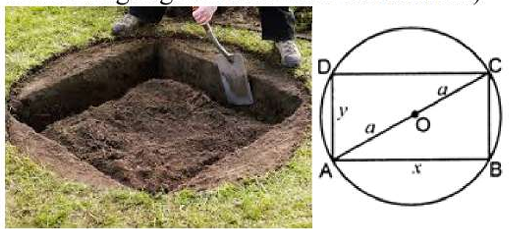
A gardener wants to construct a rectangular bed of garden in a circular patch of land. He takes the maximum perimeter of the rectangular region as possible. (Refer to the images given below for calculations) 

Image

(i) Find the perimeter of rectangle in terms of any one side and radius of circle.

(ii) Find critical points to maximize the perimeter of rectangle?

(iii) Check for maximum or minimum value of perimeter at critical point.

OR

If a rectangle of the maximum perimeter which can be inscribed in a circle of radius $10 \mathrm{~cm}$ is square, then the perimeter of region.

A magazine company in a town has 5000 subscribers on its list and collects fix charges of ₹ 3000 per year from each subscriber. 'The company proposes to increase the annual charges, and it is believed that for every increase of ₹ 1 one subscriber will discontinue service.

Based on the above information, answer the following questions.
  1. If x denote the amount of increase in annual charges, then revenue R, as a function of x can be represented as.
  1. R(x) = 3000 × 5000 × x
  2. R(x) = (3000 - 2x)(5000 + 2x)
  3. R(x) = (5000 + x)(3000 - x)
  4. R(x) = (3000 + x)(5000 - x)
  1. If magazine company increases ₹ 500 as annual charges, then R is equal to.
  1. ₹ 15750000
  2. ₹ 16750000
  3. ₹ 17500000
  4. ₹ 15000000
  1. If revenue collected by the magazine company is ₹ 15640000, then value of amount increased as annual charges for each subscriber, is.
  1. 400
  2. 1600
  3. Both (a) and (b)
  4. None of these
  1. What amount of increase in annual charges will bring maximum revenue?
  1. ₹ 1000
  2. ₹ 2000
  3. ₹ 3000
  4. ₹ 4000
  1. Maximum revenue is equal to.
  1. ₹ 15000000
  2. ₹ 16000000
  3. ₹ 20500000
  4. ₹ 25000000
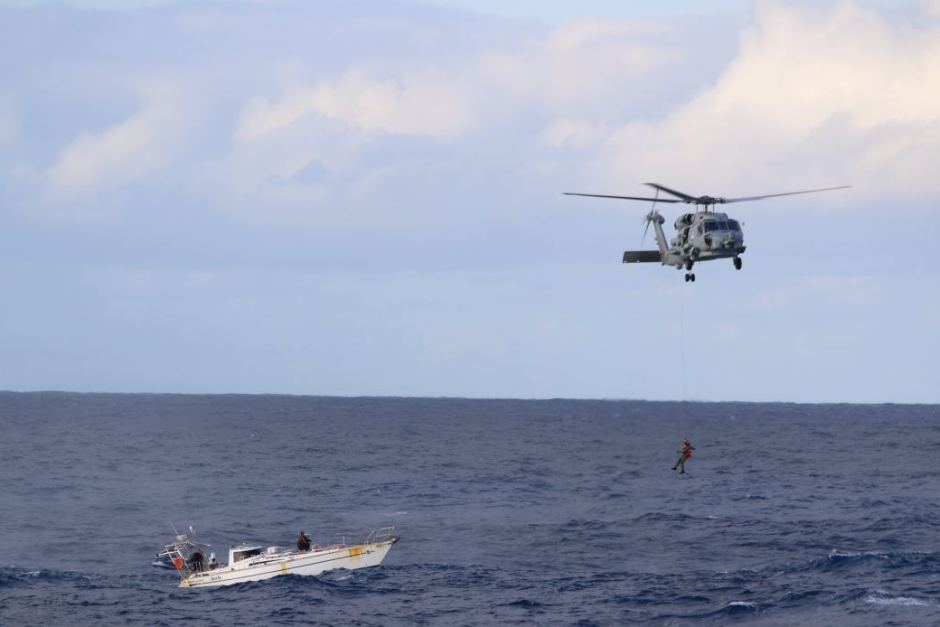
The Indian Coast Guard (ICG) while patrolling, saw a suspicious boat with four men. They were nowhere looking like fishermen. The soldiers were closely observing the movement of the boat for an opportunity to seize the boat. They observe that the boat is moving along a planar surface. At an instant of time, the coordinates of the position of coast guard helicopter and boat are (2, 3, 5) and (1, 4, 2) respectively.

Based on the above information, answer the following questions.

  1. If the line joining the positions of the helicopter and boat is perpendicular to the plane in which boat moves, then equation of plane is:
  1. x - y + 3z = 2
  2. x + y  + 3z = 2
  3. x - y + 3z = 3
  4. x + y + 3z = 3
  1. If the soldier decides to shoot the boat at given instant of time, where the distance measured in metres then what is the distance that bullet has to travel?
  1. $\sqrt{5}\text{m}$

  2. $\sqrt{8}\text{m}$

  3. $\sqrt{10}\text{m}$

  4. $\sqrt{11}\text{m}$

  1. If the speed of bullet is 30m/ sec, then how much time will the bullet take to hit the boat after the shot is fired?
  1. 30 seconds
  2. 1 second
  3. $\frac{1}{2}\text{second}$

  4. $\frac{\sqrt{11}}{30}\text{seconds}$

  1. At the given instant of time, the equation of line passing through the positions of helicopter and boat is:
  1. $\frac{\text{x}}{1}=\frac{\text{y}}{-1}=\frac{\text{z}}{3}$

  2. $\frac{\text{x}-1}{1}=\frac{\text{y}-4}{-1}=\frac{\text{z}-2}{3}$

  3. $\frac{\text{x}}{1}=\frac{\text{y}}{1}=\frac{\text{z}}{-3}$

  4. $\frac{\text{x}-1}{1}=\frac{\text{y}-4}{1}=\frac{\text{z}-2}{-3}$

  1. At a different instant of time, the boat moves to a different position along the planar surface. What should be the coordinates of the location of the boat for the bullet to hit the boat if soldier shoots the bullet along the line whose equation is $\frac{\text{x}-1}{1}=\frac{\text{y}-1}{-2}=\frac{\text{z}-2}{3}?$
  1. $\Big(\frac{1}{2},\frac{1}{2},\frac{1}{2}\Big)$

  2. $\Big(\frac{3}{4},\frac{3}{2},\frac{5}{4}\Big)$

  3. $\Big(\frac{1}{3},\frac{1}{4},\frac{1}{5}\Big)$

  4. None of these
In a college hostel accommodating 1000 students, one of the hostellers came in carrying Corona virus, and the hostel was isolated. The rate at which the virus spreads is assumed to be proportional to the product of the number of infected students and remaining students. There are 50 infected students after 4 days.

Based on the above information, answer the following questions.
  1. If n(I) denote the number of students infected by Corona virus at any time I, then maximum value of n(I) is:
  1. 50
  2. 100
  3. 500
  4. 1000
  1. $\frac{\text{dn}}{\text{dt}}$ is proporuona to:
  1. n(1000 - n)
  2. n(100 + n)
  3. n(100 - n)
  4. n(100 + n)
  1. The value of n(4) is:
  1. 1
  2. 50
  3. 100
  4. 1000
  1. The most general solution of differential equation formed in given situation is:
  1. $\frac{1}{1000}\log\Big(\frac{1000-\text{n}}{\text{n}}\Big)=\lambda\text{t}+\text{c}$
  2. $\log\Big(\frac{\text{n}}{100-\text{n}}\Big)=\lambda\text{t}+\text{c}$
  3. $\frac{1}{1000}\log\Big(\frac{\text{n}}{1000-\text{n}}\Big)=\lambda\text{t}+\text{c}$
  4. None of these.
  1. The value of n at any time is given by:
  1. $\text{n(t)}=\frac{1000}{1+999\text{e}^{-0.9906\text{t}}}$
  2. $\text{n(t)}=\frac{1000}{1-999\text{e}^{-0.9906\text{t}}}$
  3. $\text{n(t)}=\frac{100}{1-999\text{e}^{-0.9906\text{t}}}$
  4. $\text{n(t)}=\frac{100}{1+999\text{e}^{-0.9906\text{t}}}$
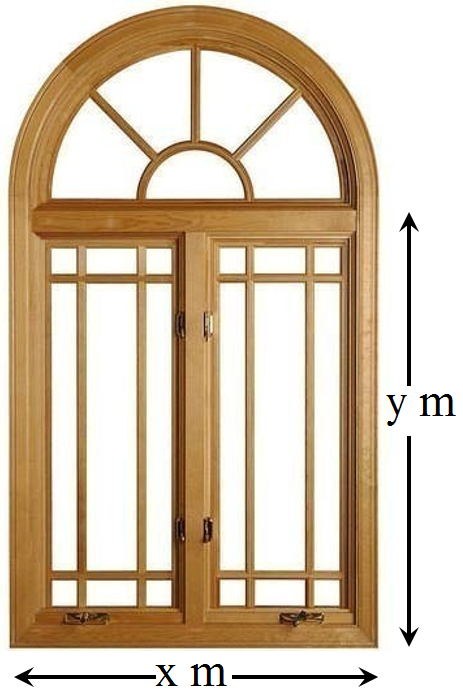
Rohan, a student of class XII, visited his uncle's flat with his father. He observe that the window of the house is in the form of a rectangle surmounted by a semicircular opening having perimeter 10m as shown in the figure.

Based on the above information, answer the following questions.
  1. If x and y represents the length and breadth of the rectangular region, then relation between x and y can be represented as.
  1. $\text{x}+\text{y}+\frac{\pi}{2}=10$
  2. $\text{x}+\text{2y}+\frac{\pi\text{x}}{2}=10$
  3. $\text{2x}+\text{2y}=10$
  4. $\text{x}+\text{2y}+\frac{\pi}{2}=10$
  1. The area (A) of the window can be given by.
  1. $\text{A}=\text{x}-\frac{\text{x}^3}{8}-\frac{\text{x}^2}{2}$
  2. $\text{A}=\text{5x}-\frac{\text{x}^2}{8}-\frac{\pi\text{x}^2}{8}$
  3. $\text{A}=\text{x}+\frac{\pi\text{x}^3}{8}-\frac{\text{3x}^2}{8}$
  4. $\text{A}=\text{5x}+\frac{\text{x}^3}{2}+\frac{\pi\text{x}^2}{8}$
  1. Rohan is interested in maximizing the area of the whole window, for this to happen, the value of x should be.
  1. $\frac{10}{2-\pi}$
  2. $\frac{20}{4-\pi}$
  3. $\frac{20}{4+\pi}$
  4. $\frac{10}{2+\pi}$
  1. Maximum area of the window is.
  1. $\frac{30}{4+\pi}$
  2. $\frac{30}{4-\pi}$
  3. $\frac{50}{4-\pi}$
  4. $\frac{50}{4+\pi}$
  1. For maximum value of A, the breadth of rectangular part of the window is.
  1. $\frac{10}{4+\pi}$
  2. $\frac{10}{4-\pi}$
  3. $\frac{20}{4+\pi}$
  4. $\frac{20}{4-\pi}$
If a real valued function f{x) is finitely derivable at any point of its domain, it is necessarily continuous at that point. But its converse need not be true.
For example, every polynomial, constant function are both continuous as well as differentiable and inverse trigonometric functions are continuous and differentiable in its domains etc.
Based on the above information, answer the following questions.
  1. If $\text{f}(\text{x})=\begin{cases}\text{x},\text{for x}\leq0\\0,\text{for x}>0\end{cases},$ then at x = 0
  1. f(x) is differentiable and continuous.
  2. f(x) is neither continuous nor differentiable.
  3. f(x) is continuous but not differentiable.
  4. None of these.
  1. If $\text{f}(\text{x})=|\text{x}-1|,\text{x }\in\text{ R},$ then at x = 1
  1. f(x) is not continuous.
  2. f(x) is continuous but not differentiable.
  3. f(x) is continuous and differentiable.
  4. None of these.
  1. f(x) = x3 is:
  1. Continuous but not differentiable at x = 3
  2. Continuous but not differentiable at x = 3
  3. Neither continuous nor differentiable at x = 3
  4. None of these.
  1. If $\text{f}(\text{x})=[\sin\text{x}],$ then which of the following is true?
  1. f(x) is continuous and differentiable at x = 0.
  2. f(x) is discontinuous at x = 0.
  3. f(x) is continuous at x = 0 but not differentiable.
  4. f(x) is differentiable but not continuous at $\text{x}=\frac{\pi}{2}.$
  1. If $\text{f}(\text{x})=\sin^{-1}\text{x},-1\leq\text{x}\leq1,$ then:
  1. f(x) is both continuous and differentiable.
  2. f(x) is neither continuous nor differentiable.
  3. f(x) is continuous but not differentiable.
  4. None of these.
Let $\text{A}=\begin{bmatrix}1&0\\2&1\end{bmatrix},$ and U1, U2 are e first and second columns respectively of a 2 × 2 matrix U. Also, let the column matrices U1 and U2 satisfying $\text{AU}_1=\begin{bmatrix}1\\0\end{bmatrix}$ and $\text{AU}_2=\begin{bmatrix}2\\3\end{bmatrix}.$
Based on the above information, answer the following questions.
  1. The matrix U1 + U2 is equal to:
  1. $\begin{bmatrix}1\\-1\end{bmatrix}$
  2. $\begin{bmatrix}2\\-2\end{bmatrix}$
  3. $\begin{bmatrix}3\\-3\end{bmatrix}$
  4. $\begin{bmatrix}4\\-4\end{bmatrix}$
  1. The value of |U| is:
  1. 2
  2. -2
  3. 3
  4. -3
  1. If $\text{X}=\begin{bmatrix}3&2\end{bmatrix}\text{U}\begin{bmatrix}3\\2\end{bmatrix},$ then the value of |X| =
  1. 3
  2. -3
  3. -5
  4. 5
  1. The minor of element at the position a22 in U is:
  1. 1
  2. 2
  3. -2
  4. -1
  1. If $\text{U}=[\text{a}_\text{ij}]_{2\times2},$ then the value of a11A11 + a12A12, where Aij denotes the cofactor of aij, is:
  1. 1
  2. 2
  3. -3
  4. 3