Question
Let f(x) be a real valued function, then its
  • Left Hand Derivative (L.H.D.) : $\text{Lf}'(\text{a})=\lim_\limits{\text{h}\rightarrow0}\frac{\text{f}(\text{a}-\text{h})-\text{f}(\text{a})}{-\text{h}}$
  • Right Hand Derivative (R.H.D.) : $\text{Rf}'(\text{a})=\lim_\limits{\text{h}\rightarrow0}\frac{\text{f}(\text{a}+\text{h})-\text{f}(\text{a})}{\text{h}}$
Also, a function f(x) is said to be differentiable at x = a if its L.H.D. and R.H.D. at x = a exist and are equal.
For the function $\text{f}(\text{x})=\begin{cases}|\text{x}-3|,\text{x}\geq1\\\\\frac{\text{x}^2}{4}-\frac{3\text{x}}{2}+\frac{13}{4},\text{x}<1\end{cases},$ answer the following questions.
  1. R.H.D. of f(x) at x = 1 is:
  1. 1
  2. -1
  3. 0
  4. 2
  1. L.H.D. of f(x) at x = 1 is:
  1. 1
  2. -1
  3. 0
  4. 2
  1. f(x) is non-differentiable at:
  1. x = 1
  2. x = 2
  3. x = 3
  4. x = 4
  1. Find the value of f'(2).
  1. 1
  2. 2
  3. 3
  4. -1
  1. The value of f'(-1) is:
  1. 2
  2. 1
  3. -2
  4. -1

Answer

We have, $\text{f}(\text{x})=\begin{cases}\text{x}-3&,\text{x}\geq3\\3-\text{x}&,1\leq\text{x}<3\\\\\frac{\text{x}^2}{4}-\frac{3\text{x}}{2}+\frac{13}{4}&,\text{x}<1\end{cases}$

  1. (b) -1

Solution:

$\text{Rf}'(1)=\lim\limits_{\text{h}\rightarrow0}\frac{\text{f}(1+\text{h})-\text{f}(1)}{\text{h}}$

$\lim\limits_{\text{h}\rightarrow0}\frac{3-(1+\text{h})-2}{\text{h}}=\lim\limits_{\text{h}\rightarrow0}-\frac{\text{h}}{\text{h}}=-1$

  1. (b) -1

Solution:

$\text{Lf}'(1)=\lim\limits_{\text{h}\rightarrow0}\frac{\text{f}(1-\text{h})-\text{f}(1)}{-\text{h}}$

$=\lim\limits_{\text{h}\rightarrow0}\frac{-1}{\text{h}}\Big[\frac{(1-\text{h})^2}{4}-\frac{3(1-\text{h})}{2}+\frac{13}{4}-2\Big]$

$=\lim\limits_{\text{h}\rightarrow0}\frac{-1}{\text{h}}\Big(\frac{1+\text{h}^2-2\text{h}-6+6\text{h}+13-8}{-4\text{h}}\Big)$

$=\lim\limits_{\text{h}\rightarrow0}\Big(\frac{\text{h}^2+4\text{h}}{-4\text{h}}\Big)=-1$

  1. (c) x = 3

Solution:

Since, R.H.D. at x = 3 is 1

and L.H.D. at x = 3 is - 1

$\therefore$ f(x) is non-differentiable at x = 3.

  1. (d) -1
  1. (c) -2

Solution:

From above, we have

$\text{f}'(\text{x})=\frac{\text{x}}{2}-\frac{3}{2},\text{x}<1$

$\therefore\text{f}'(-1)=\frac{-1}{2}-\frac{3}{2}=-2$

Need a full question paper?

Generate a complete, print-ready paper with questions like this in minutes — across 16+ boards, with answer keys.

Start Generating Free

Similar questions

Let f : A → B and g : B → C be two functions defined on non-empty sets A, B, C, then gof : A → C be is called the composition of f and g defined as, $\text{gof}(\text{x})=\text{g}\{\text{f(x)}\}\forall\text{ x }\in\text{ A}.$
Consider the functions $\text{f}(\text{x})=\begin{cases}\sin\text{x},&\text{x}\geq0\\1-\cos\text{x},&\text{x}\leq0\end{cases},\text{g}(\text{x})=\text{e}^\text{x}$ and then answer the following questions.
  1. The function gof(x) is defined as:
  1. $\text{gof}(\text{x})=\begin{cases}\text{e}^\text{x}&,\text{x}\geq0\\1-\text{e}^{\cos\text{x}}&,\text{x}\leq0\end{cases}$
  2. $\text{gof}(\text{x})=\begin{cases}\text{e}^{\sin\text{x}}&,\text{x}\leq0\\\text{e}^{1-\cos\text{x}}&,\text{x}\geq0\end{cases}$
  3. $\text{gof}(\text{x})=\begin{cases}\text{e}^{\sin\text{x}}&,\text{x}\leq0\\1-\text{e}^{\cos\text{x}}&,\text{x}\geq0\end{cases}$
  4. $\text{gof}(\text{x})=\begin{cases}\text{e}^{\sin\text{x}}&,\text{x}\geq0\\\text{e}^{1-\cos\text{x}}&,\text{x}\leq0\end{cases}$
  1. $\frac{\text{d}}{\text{dx}}\{\text{gof}(\text{x})\}=$
  1. $[\text{gof}(\text{x})]'=\begin{cases}\cos\text{x}\cdot\text{e}^{\sin\text{x}}&,\text{x}\geq0\\\text{e}^{1-\cos\text{x}}\cdot\sin\text{x}&,\text{x}\leq0\end{cases}$
  2. $[\text{gof}(\text{x})]'=\begin{cases}\cos\text{x}\cdot\text{e}^{\sin\text{x}}&,\text{x}\geq0\\-\sin\text{x}\cdot\text{e}^{1-\cos\text{x}}&,\text{x}\leq0\end{cases}$
  3. $[\text{gof}(\text{x})]'=\begin{cases}\cos\text{x}\cdot\text{e}^{\sin\text{x}}&,\text{x}\geq0\\\sin\text{x}\cdot({1-\cos\text{x}})&,\text{x}\leq0\end{cases}$
  4. $[\text{gof}(\text{x})]'=\begin{cases}\cos\text{x}\cdot\text{e}^{\sin\text{x}}&,\text{x}\geq0\$1-{\sin\text{x}})\cdot\text{e}^{1-\cos\text{x}}&,\text{x}\leq0\end{cases}$
  1. R.H.D. of gof(x) at x = 0 is:
  1. 0
  2. 1
  3. -1
  4. 2
  1. L.H.D. of gof(x) at x = 0 is:
  1. 0
  2. 1
  3. -1
  4. 2
  1. The value of f'(x) at $\text{x}=\frac{\pi}{4}$ is:
  1. $\frac{1}{9}$
  2. $\frac{1}{\sqrt2}$
  3. $\frac{1}{2}$
  4. Not defined.
A function f(x) is said to be continuous in an open interval (a, b), if it is continuous at every point in this interval.
A function f(x) is said to be continuous in the closed interval [a, b), if f(x) is continuous in (a, b) and $\lim\limits_{\text{x}\rightarrow0}\text{f}(\text{a}+\text{h})=\text{f}(\text{a})$ and $\lim\limits_{\text{x}\rightarrow0}\text{f}(\text{b}-\text{h})=\text{f}(\text{b})$
If function $\text{f}(\text{x})=\begin{cases}\frac{\sin(\text{a}+1)\text{x}+\sin\text{x}}{\text{x}}&,\text{x}<0\\\text{c}&,\text{x}=0\\\frac{\sqrt{\text{x}+\text{bx}^2}-\sqrt{\text{x}}}{\text{bx}^{\frac{3}{2}}}&,\text{x}>0\end{cases}$ is continuous at x = 0, then answer the following questions.
  1. The value of a is:
  1. $-\frac{3}{2}$
  2. $0$
  3. $\frac{1}{2}$
  4. $-\frac{1}{2}$
  1. The value of b is:
  1. 1
  2. -1
  3. 0
  4. Any real number.
  1. The value of c is:
  1. $1$
  2. $\frac{1}{2}$
  3. $-1$
  4. $-\frac{1}{2}$
  1. The value of a + c is:
  1. 1
  2. 0
  3. -1
  4. -2
  1. The value of c - a is:
  1. 1
  2. 0
  3. -1
  4. 2
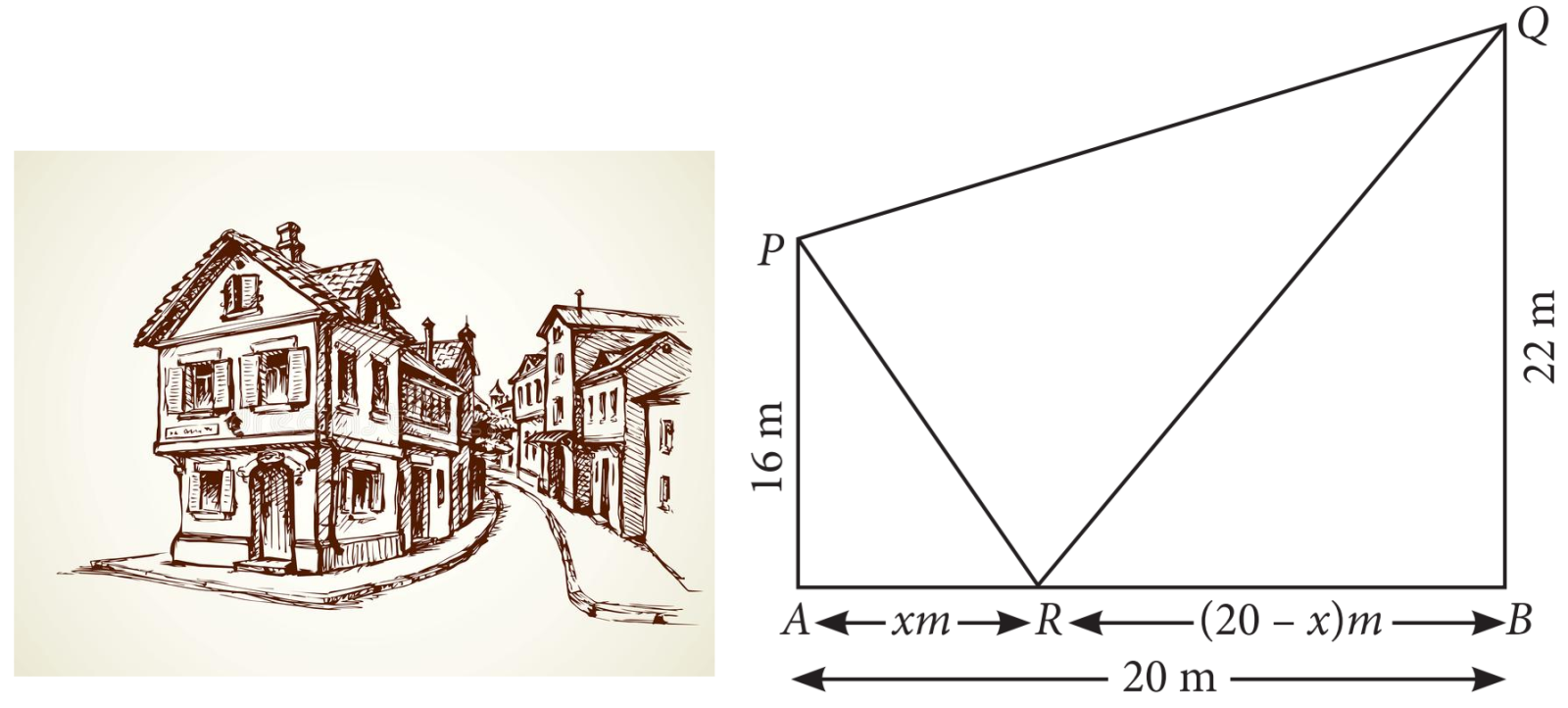
Two multi-storey buildings (represented by AP and BQ) are on opposite side of a 20m wide road at point A and B respectively. There is a point R on road as shown in figure.

Based on the above information, answer the following questions.

  1. Area of trapezium ABQP is.
  1. 380 sq. m
  2. 280 sq. m
  3. 320 sq. m
  4. 430 sq. m
  1. The length PQ is.
  1. 20.5m
  2. 19.80m
  3. 20.88m
  4. 21m
  1. Let there be a quantity S such that S = RP2 + RQ2, then S is given by.
  1. 2x2 - 40x - 1140
  2. 2x2 + 40x + 1140
  3. 2x2 - 40x + 1140
  4. 2x2 + 40x - 1140
  1. Find the value of x for which value of S is minimum.
  1. 10
  2. 0
  3. 4
  4. -10
  1. For minimum value of S, find the value of PR and RQ.
  1. 18.50m, 19.36m
  2. 18.86m, 24.17m
  3. 17.56m, 23.29m
  4. None of these
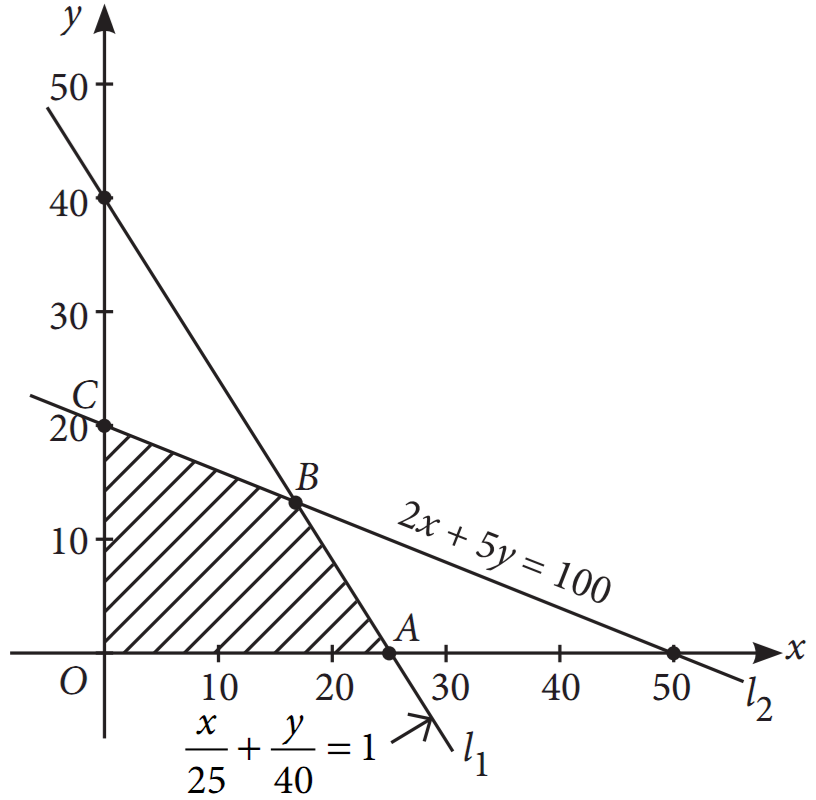
Deepa rides her car at 25 km/ hr. She has to spend ₹ 2 per km on diesel and if she rides it at a faster speed of 40 km/ hr, the diesel cost increases to ₹ 5 per km. She has ₹ 100 to spend on diesel. Let she travels x kms with speed 25 km/ hr and y kms with speed 40 km/ hr. The feasible region for the LPP is shown below:

Based on the above information, answer the following questions.
  1. What is the point of intersection of line l1 and l2?
  1. $\Big(\frac{40}{3},\frac{50}{3}\Big)$

  2. $\Big(\frac{50}{3},\frac{40}{3}\Big)$

  3. $\Big(\frac{-50}{3},\frac{40}{3}\Big)$

  4. $\Big(\frac{-50}{3},\frac{-40}{3}\Big)$

  1. The comer points of the feasible region shown in above graph are:
  1. $(0,25),(20,0),\Big(\frac{40}{3},\frac{50}{3}\Big)$

  2. $(0, 0), (25, 0), (0, 20) $

  3. $(0,0),\Big(\frac{40}{3},\frac{50}{3}\Big),(0,20)$

  4. $(0,0),(25,0),\Big(\frac{50}{3},\frac{40}{3}\Big),(0,20)$

  1. If Z = x + y be the objective function and max Z = 30. The maximum value occurs at point:
  1. $\Big(\frac{50}{3},\frac{40}{3}\Big)$
  2. (0, 0)
  3. (25, 0)
  4. (0, 20)
  1. If Z = 6x - 9y be the objective function, then maximum value of Z is:
  1. -20
  2. 150
  3. 180
  4. 20
  1. If Z = 6x + 3y be the objective function, then what is the minimum value of Z?
  1. 120
  2. 130
  3. 0
  4. 150
A student is preparing for the competitive examinations LIC AAO, SSC CGL and Bank P.O. The probabilities that the student is selected independently in competitive examination of LIC AAO, SSC CGL and Bank P.O. are a, band c respectively. Of these examinations, students has 50% chance of selection in at least one, 40% chance of selection in at least two and 30% chance of selection in exactly two examinations.

Based on the above information, answer the following questions.
  1. The value of a+ b + e - ab - be - ca + abe is:
  1. 0.3
  2. 0.5
  3. 0.7
  4. 0.6
  1. The value of ab + be + ae - 2abe is:
  1. 0.5
  2. 0.3
  3. 0.4
  4. 0.6
  1. The value of abe is:
  1. 0.1
  2. 0.5
  3. 0.7
  4. 0.3
  1. The value of ab + be + ae is:
  1. 0.1
  2. 0.6
  3. 0.5
  4. 0.3
  1. The value of a + b + e is:
  1. 1
  2. 1.5
  3. 1.6
  4. 1.4
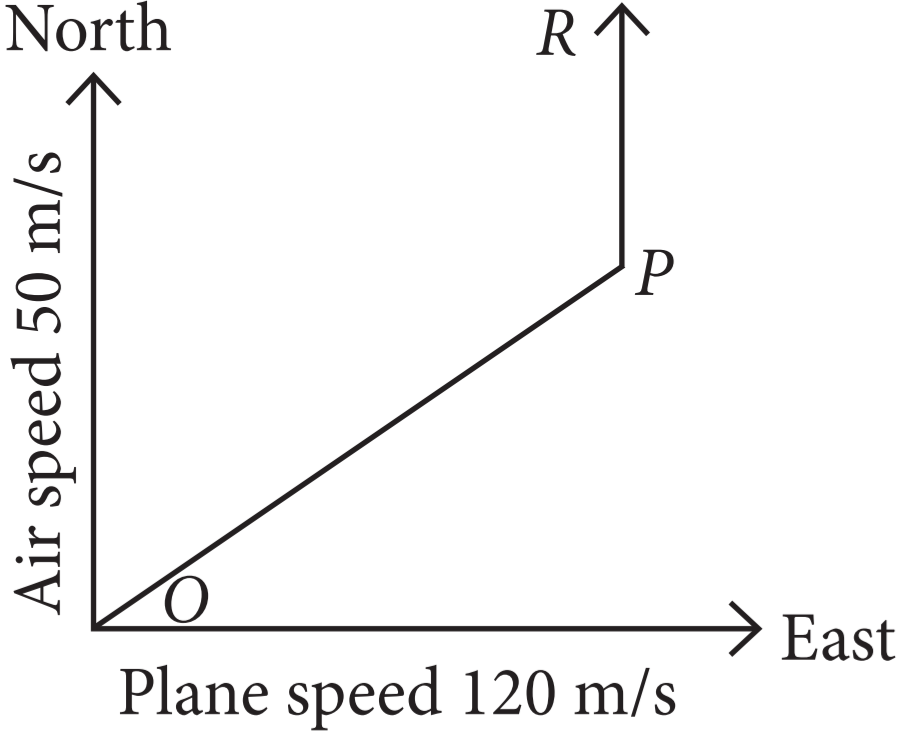
A plane started from airport situated at O with a velocity of 120m/s towards east. Air is blowing at a velocity of 50m/ s towards the north as shown in the figure.
The plane travelled 1hr in OP direction with the resultant velocity. From P to R the plane travelled 1hr keeping velocity of 120m/s and finally landed at R.

Based on the above information, answer the following questions.

  1. What is the resultant velocity from O to P?
  1. 100m/ s
  2. 130m/ s
  3. 126m/ s
  4. 180m/ s
  1. What is the direction of travel of plane from O to P with East?
  1. $\tan^{-1}\Big(\frac{5}{12}\Big)$
  2. $\tan^{-1}\Big(\frac{12}{3}\Big)$
  3. 50
  4. 80
  1. What is the displacement from O to P?
  1. 600km
  2. 468km
  3. 532km
  4. 500km
  1. What is the resultant velocity from P to R?
  1. 120m/ s
  2. 70m/ s
  3. 170m/ s
  4. 200m/ s
  1. What is the displacement from P to R?
  1. 450km
  2. 532km
  3. 610km
  4. 612km
If there is a statement involving the natural number n such that:
  1. The statement is true for n = 1
  2. When the statement is true for n = k (where k is some positive integer), then the statement is also true for n = k + 1.
Then, the statement is true for all natural numbers n.
Also, if A is a square matrix of order n, then A2 is defined as AA. In general, Am = AA .... A (m times). where m is any positive integer.
Based on the above information, answer the following questions.
  1. If $\text{A}=\begin{bmatrix}3&-4\\1&-1\end{bmatrix},$ then for any positive integer n,
  1. $\text{A}^\text{n}=\begin{bmatrix}3\text{n}&-4\text{n}\\\text{n}&-\text{n}\end{bmatrix}$
  2. $\text{A}^\text{n}=\begin{bmatrix}1+2\text{n}&-4\text{n}\\\text{n}&1-2\text{n}\end{bmatrix}$
  3. $\text{A}^\text{n}=\begin{bmatrix}3\text{n}&-8\text{n}\\1&-\text{n}\end{bmatrix}$
  4. $\text{A}^\text{n}=\begin{bmatrix}1+3\text{n}&-4\text{n}\\\text{n}&1-3\text{n}\end{bmatrix}$
  1. If $\text{A}=\begin{bmatrix}1&2\\0&1\end{bmatrix},$ then |An|, where $\text{n}\in\text{ N},$ is equal to:
  1. 2n
  2. 3n
  3. n
  4. 1
  1. If $\text{A}=\begin{bmatrix}1&0\\1&1\end{bmatrix}$ and $\text{I}=\begin{bmatrix}1&0\\0&1\end{bmatrix}$ then which of the following holds for all natural numbers $\text{n}\geq1?$
  1. A= nA - (n - 1)I
  2. An = 2n-1 A - (n - 1)I
  3. A= nA + (n - 1)I
  4. An = 2n-1 A + (n - 1)I
  1. Let $\text{A}=\begin{bmatrix}\text{a}&0&0\\0&\text{a}&0\\0&0&\text{a}\end{bmatrix}$ and $\text{A}^\text{n}=[\text{a}_{\text{ij}}]_{3\times3}$ for some positive integer n, then the cofactor of a13 is:
  1. an
  2. -an
  3. 2an
  4. 0
  1. If A is a square matrix such that |A| = 2, then for any positive integer n, |An| is equal to:
  1. 0
  2. 2n
  3. 2n
  4. n2
Order: The order of a differential equation is the order of the highest order derivative appearing in the differential equation.
Degree: The degree of differential equation is the power of the highest order derivative, when differential coefficients are made free from radicals and fractions. Also, differential equation must be a polynomial equation in derivatives for the degree to be defined.
Based on the above information, answer the following questions.
  1. Find the degree of the differential equation $2\frac{\text{d}^2\text{y}}{\text{dx}^2}+3\sqrt{1-\Big(\frac{\text{dy}}{\text{dx}}\Big)^2-\text{y}=0}.$
  1. 3
  2. 4
  3. 3
  4. 1
  1. Order and degree of the differential equation $\text{y}\frac{\text{dy}}{\text{dx}}=\frac{\text{x}}{\frac{\text{dy}}{\text{dx}}+\Big(\frac{\text{dy}}{\text{dx}}\Big)^3}$ are respectively.
  1. 1, 1
  2. 1, 2
  3. 1, 3
  4. 1, 4
  1. Find order and degree of the equation y'" + y2 + ey' = 0.
  1. Order = 3, degree = undefined.
  2. Order = 1, degree = 3.
  3. Order = 2, degree = undefined.
  4. Order = 1, degree = 2.
  1. Determine degree of the differential equation $(\sqrt{\text{a+x}})\times\Big(\frac{\text{dy}}{\text{dx}}\Big)+\text{x}=0.$
  1. 3
  2. Not defined
  3. 1
  4. 2
  1. Order and degree of the differential equation $\Bigg(1+\Big(\frac{\text{dy}}{\text{dx}}\Big)^3\Bigg)^\frac{7}{3}=7\frac{\text{d}^2\text{y}}{\text{dx}^2}$ are respectively.
  1. 2, 1
  2. 2, 3
  3. 1, 3
  4. $1,\ \frac{7}{3}$
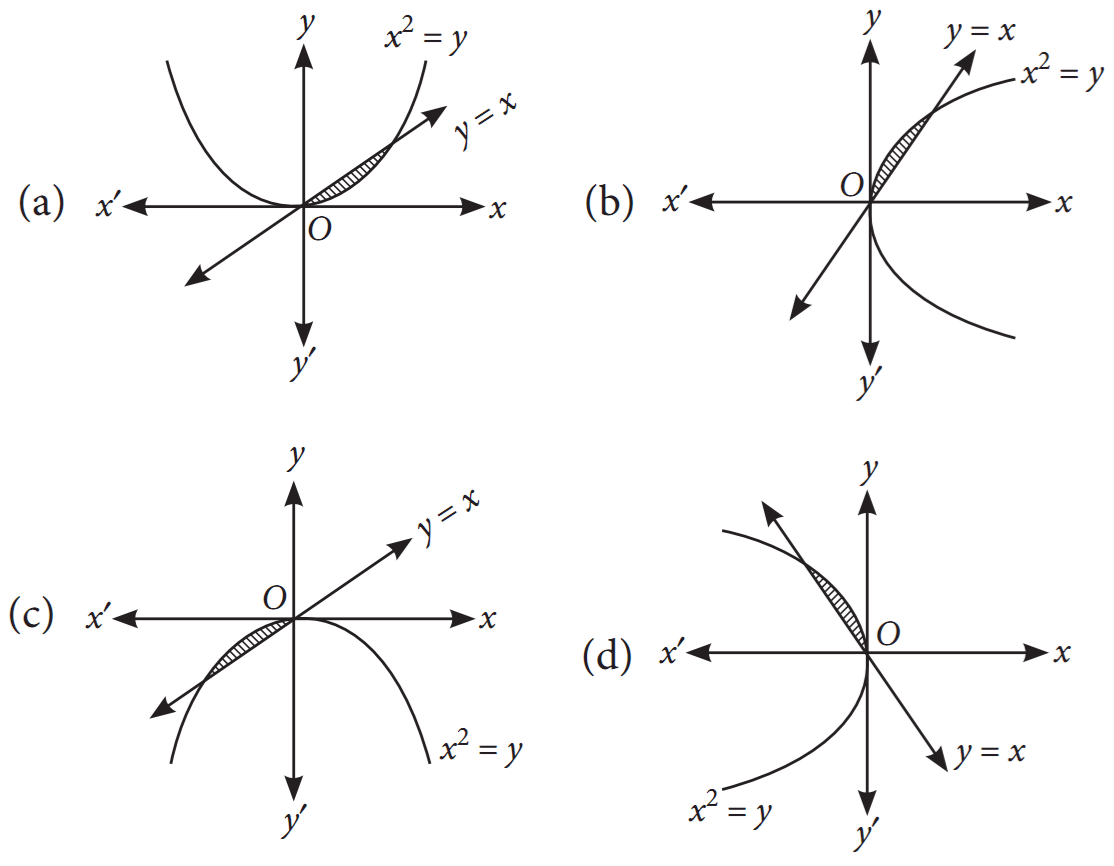
Consider the following equations of curves x2 = y and y = x.

On the basis of above information, answer the following questions.

  1. The point(s) of intersection of both the curves is (are).
  1. (0, 0)(2, 2)
  2. (0, 0)(1, 1)
  3. (0, 0)(-1, -1)
  4. (0, 0)(-2, -2)
  1. Area bounded by the curves is represented by which of the following graph?

  1. The value of the integral $\int\limits_{1}^{0}\text{x}\ \text{dx}$ is.
  1. $\frac{1}{4}$

  2. $\frac{1}{3}$

  3. $\frac{1}{2}$

  4. $1$

  1. The value of the integral $\int\limits_{0}^{1}\text{x}^2\ \text{dx}$ is.
  1. $\frac{1}{4}$

  2. $\frac{1}{3}$

  3. $\frac{1}{2}$

  4. $1$

  1. The value of area bounded by the curves x2 = y and x = y is.
  1. $\frac{1}{6}\text{ sq}.\text{unit}$

  2. $\frac{1}{3}\text{ sq}.\text{unit}$

  3. $\frac{1}{2}\text{ sq}.\text{unit}$

  4. ${1}\text{ sq}.\text{unit}$

Western music concert is organised every year in the stadium that can hold 36000 spectators. With ticket price of ₹ 10, the average attendance has been 24000. Some financial expert estimated that price of a ticket should be determined by the function.
$\text{p}(\text{x})=15-\frac{\text{x}}{3000}$ where x is the number of tickets sold.

Based on the above information, answer the following questions.
  1. The revenue, R as a function of x can be represented as.
  1. $15\text{x}-\frac{\text{x}^2}{3000}$
  2. $15-\frac{\text{x}^2}{3000}$
  3. $15\text{x}-\frac{1}{3000}$
  4. $15\text{x}-\frac{\text{x}}{3000}$
  1. The range of x is.
  1. [24000, 36000]
  2. [0, 24000]
  3. [0, 36000]
  4. None of these
  1. The value of x for which revenue is maximum, is.
  1. 20000
  2. 21000
  3. 22500
  4. 25000
  1. When the revenue is maximum, the price of the ticket is.
  1. ₹ 5
  2. ₹ 5.5
  3. ₹ 7
  4. ₹ 7.5
  1. How many spectators should be present to maximize the revenue?
  1. 21500
  2. 21000
  3. 22000
  4. 22500