MCQ
Light appears to travel in straight lines since
  • A
    It is not absorbed by the atmosphere
  • B
    It is reflected by the atmosphere
  • Its wavelength is very small
  • D
    Its velocity is very large

Answer

Correct option: C.
Its wavelength is very small
c
(c)

Need a full question paper?

Generate a complete, print-ready paper with questions like this in minutes — across 16+ boards, with answer keys.
Start Generating Free

Similar questions

Two electric charges 12μC and -6 μC are placed 20 cm apart in air. There will be a point P on the line joining these charges and outside the region between them, at which the electric potential is zero. The distance of P from -6 μC charge is.
A beam of monochromatic light is incident at $i = 50^o$ on one face of an equilateral prism, the angle of emergence is $40^o$, then the angle of minimum deviation is
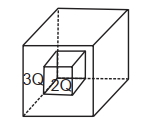
$\mathrm{C}_1$ and $\mathrm{C}_2$ are two hollow concentric cubes enclosing charges $2 Q$ and $3 Q$ respectively as shown in figure. The ratio of electric flux passing through $\mathrm{C}_1$ and $\mathrm{C}_2$ is :
Plane of eddy currents makes an angle with the plane of magnetic lines of force equal to
In a copper voltameter experiment, current is decreased to one-fourth of the initial value but it is passed for four times the earlier duration. Amount of copper deposited will be
The intensity of magnetic field is H and moment of magnet is M. The maximum potential energy is
Two equal charges $q$ of opposite sign separated by a distance $2a$ constitute an electric dipole of dipole moment $p$. If $P$ is a point at a distance $r$ from the centre of the dipole and the line joining the centre of the dipole to this point makes an angle $\theta $ with the axis of the dipole, then the potential at $P$ is given by $(r > > 2a)$ (Where $p = 2qa$)
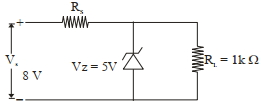
In the given circuit if the power rating of Zener diode is $10 \mathrm{~mW}$, the value of series resistance $R_s$ to regulate the input unregulated supply is:
The impurity atoms with which pure silicon may be doped to make it a $p-$type semiconductor are those of:
Characteristic $X-$ rays