MCQ
Light from a point source in air falls on a convex spherical glass surface $(\mu = 1.5,$ radius of curvature $= 20\, cm)$ The distance of light source from the glass surface is $100\, cm$. At what position is the image formed.......$cm$
  • A
    $50 $
  • $100 $
  • C
    $150$
  • D
    $40$

Answer

Correct option: B.
$100 $
b
$\frac{\mu_{2}}{v}-\frac{\mu_{1}}{u}=\frac{\mu_{2}-\mu_{1}}{R}$

$\frac{1.5}{v}+\frac{1}{100}=\frac{1.5-1}{20}$

$\mathrm{v}=+100 \mathrm{\,cm}$

Need a full question paper?

Generate a complete, print-ready paper with questions like this in minutes — across 16+ boards, with answer keys.

Start Generating Free

Similar questions

If force on a rocket having exhaust velocity of $300 \,m/sec$ is $210\, N$, then rate of combustion of the fuel is ........... $kg/s$
A baseband signal of $3.5\, MHz$ frequency is modulated with a carrier signal of $3.5 \,GHz$ frequency using amplitude modulation method. What should be the minimum size of antenna required to transmit the modulated signal $?$
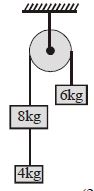
Three blocks of masses $4\,kg$, $6\,kg$ and $8\,kg$ are hanging over a fixed pulley as shown. The tension in the string connecting $8\,kg$ and $4\,kg$ block is
If $‘M’$ is the mass of water that rises in a capillary tube of radius $‘r’,$ then mass of water which will rise in a capillary tube of radius $‘2r’$ is
A particle, initially at rest on a frictionless horizontal surface, is acted upon by a horizontal force which is constant in size and direction. A graph is plotted between the work done $(W) $ on the particle, against the speed of the particle, $(v)$. If there are no other horizontal forces acting on the particle the graph would look like
A source of sound $A$ emitting waves of frequency $1800\,Hz$ is falling towards ground with a terminal speed $v.$ The observer $B$ on the ground directly beneath the source receives waves of frequency $2150\,Hz.$ The source $A$ receives waves, reflected from ground of frequency nearly ..... $Hz$ (Speed of sound $= 343\,m/s$ )
Which among the above compound/s does/do not form Silver mirror when treated with Tollen's reagent?
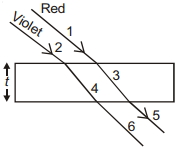
Two parallel rays of red and violet colour passed through a glass slab, which of the following is correct?
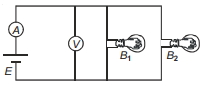
Two identical bulbs are connected in parallel across an ideal source of emf $E$. The ammeter $A$ and voltmeter $V$ are ideal. If bulb $B_2$ gets fused, then
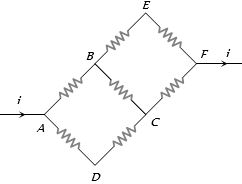
In the adjoining circuit diagram each resistance is of $10$ $\Omega$. The current in the arm $AD$ will be