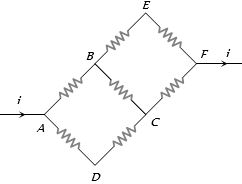
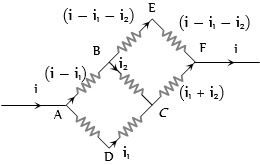
In the adjoining circuit diagram each resistance is of $10$ $\Omega$. The current in the arm $AD$ will be
Diffcult


Download our appand get started for free
Experience the future of education. Simply download our apps or reach out to us for more information. Let's shape the future of learning together!No signup needed.*
Similar Questions
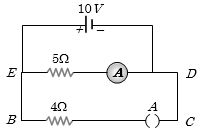
- 1In the given figure, when key $A$ is opened, the reading of the ammeter $A$ will be ........... $A$View Solution
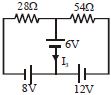
- 2Consider the circuit shown in the figure. The current $I_3$ is equal toView Solution
- 3Given below are two statements: one is labelled as Assertion A and the other is labelled as Reason $R$.View Solution
Assertion $A:$ Alloys such as constantan and manganin are used in making standard resistance coils.
Reason $R:$ Constantan and manganin have very small value of temperature coefficient of resistance.In the light of the above statements, choose the correct answer from the options given below.
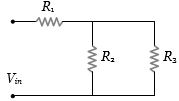
- 4For ensuring dissipation of same energy in all three resistors $({R_1},\,{R_2},\,{R_3})$ connected as shown in figure, their values must be related asView Solution
- 5A potentiometer consists of a wire of length $4\, m$ and resistance $10 \,\Omega$. It is connected to cell of $emf$ $2\, V$. The potential difference per unit length of the wire will be ............ $V/m$View Solution
- 6A certain wire has a resistance $R$. The resistance of another wire identical with the first except having twice its diameter isView Solution
- 7Consider a block of conducting material ofresistivity '$\rho$' shown in the figure. Current '$I$' enters at '$A$' and leaves from '$D$'. We apply superp osition principle to find voltage '$\Delta V$ ' developed between '$B$' and '$C$'. The calculation is done in the following steps:View Solution
$(i)$ Take current '$I$' entering from '$A$' and assume it to spread over a hemispherical surface in the block.
$(ii)$ Calculatefield $E(r)$ at distance '$r$' from $A$ by using Ohm's law $E = \rho j$, where j is the current per unit area at '$r$'.
$(iii)$ From the '$r$' dependence of $E(r)$, obtain the potential $V(r)$ at $r$.
$(iv)$ Repeat $(i), (ii)$ and $(iii)$ for current '$I$' leaving '$D$' and superpose results for '$A$' and '$D$'.For current entering at $A$, the electric field at a distance '$r$'
from $A$ is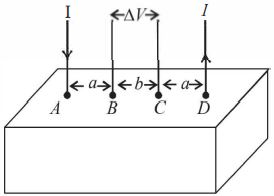
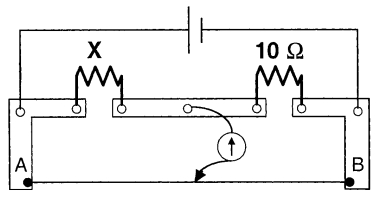
- 8A meter bridge is set-up as shown, to determine an unknown resistance ' $X$ ' using a standard $10$ ohm resistor. The galvanometer shows null point when tapping-key is at $52 \ cm$ mark. The end-corrections are $1 \ cm$ and $2 \ cm$ respectively for the ends $A$ and $B$. The determined value of ' $X$ ' isView Solution
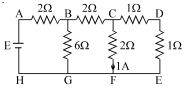
- 9The figure shows a network of resistors and $a$ battery. If $1\,A$ current flowsthrough the branch $CF$, then answer the following questions The current throughView Solution
- 10A resistor ${R_1}$ dissipates the power $P$ when connected to a certain generator. If the resistor ${R_2}$ is put in series with ${R_1}$, the power dissipated by ${R_1}$View Solution