Question
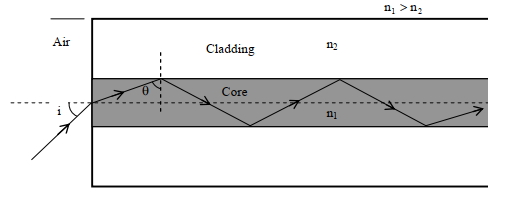
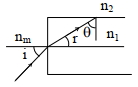
Light guidance in an optical fiber can be understood by considering a structure comprising of thin solid glass cylinder of refractive index $n_1$ surrounded by a medium of lower refractive index $n_2$. The light guidance in the structure takes place due to successive total internal reflections at the interface of the media $n_1$ and $n_2$ as shown in the figure. All rays with the angle of incidence $i$ less than a particular value $i_m$ are confined in the medium of refractive index $n_1$. The numerical aperture ($NA$) of the structure is defined as $\sin i_m$ - $Image$

$1.$ For two structures namely $S_1$ with $n_1=\sqrt{45} / 4$ and $n_2=3 / 2$, and $S_2$ with $n_1=8 / 5$ and $n_2=7 / 5$ and taking the refractive index of water to be $4 / 3$ and that of air to be 1 , the correct option$(s)$ is(are)

$(A)$ $NA$ of $S_1$ immersed in water is the same as that of $S_2$ immersed in a liquid of refractive index $\frac{16}{3 \sqrt{15}}$

$(B)$ $NA$ of $S _1$ immersed in liquid of refractive index $\frac{6}{\sqrt{15}}$ is the same as that of $S _2$ immersed in water

$(C)$ $NA$ of $S_1$ placed in air is the same as that of $S_2$ immersed in liquid of refractive index $\frac{4}{\sqrt{15}}$.

$(D)$ $NA$ of $S_1$ placed in air is the same as that of $S_2$ placed in water

$2.$ If two structures of same cross-sectional area, but different numerical apertures $N A_1$ and $NA _2\left( NA _2< NA _1\right)$ are joined longitudinally, the numerical aperture of the combined structure is

$(A)$ $\frac{ NA _1 NA _2}{ NA _1+ NA _2}$ $(B)$ $NA _1+ NA _2$ $(C)$ $NA _1$ $(D)$ $NA _2$

Give the answer question $1$ and $2.$
Answer

$1.$ $\theta \geq c$

$\Rightarrow 90^{\circ}-r \geq c$

$\Rightarrow \sin \left(90^{\circ}-r\right) \geq c$

$\Rightarrow \cos r \geq \sin c$

using $\frac{\sin i }{\sin r }=\frac{ n _1}{ n _{ m }}$ and $\sin c =\frac{ n _2}{ n _1}$

we get, $\sin ^2 i_m=\frac{n_1^2-n_2^2}{n_m^2}$

Putting values, we get, correct options as $A \& C$

$2.$ For total internal reflection to take place in both structures, the numerical aperture should be the least one for the combined structure \& hence, correct option is $D$.

Need a full question paper?

Generate a complete, print-ready paper with questions like this in minutes — across 16+ boards, with answer keys.

Start Generating Free

Similar questions

In Young's double slit interference experiment , the slit widths are in the ratio $1 : 25$. Then the ratio of intensity at the maxima and minima in the interference pattern is
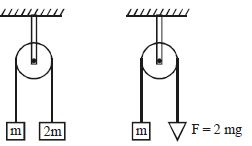
Two pulley arrangements of figure given are identical. The mass of the rope is negligible. In fig $(a)$, the mass $m$ is lifted by attaching a mass $2\,m$ to the other end of the rope. In fig $(b)$, $m$ is lifted up by pulling the other end of the rope with a constant downward force $F = 2mg$. The acceleration of $m$ in the two cases are respectively
The maximum speed of a car on a road-turn of radius $30\, m$, if the coefficient of friction between the tyres and the road is $0.4$, will be .......... $m/sec$
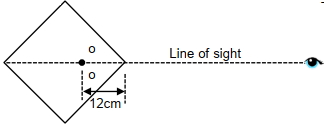
A large square container with thin transparent vertical walls and filled with water (refractive index $\frac{4}{3}$ ) is kept on a horizontal table. A student holds a thin straight wire vertically inside the water $12 cm$ from one of its corners, as shown schematically in the figure. Looking at the wire from this corner, another student sees two images of the wire, located symmetrically on each side of the line of sight as shown. The separation (in $cm$ ) between these images is . . . . . 
The position vector $\vec{r}$ of a particle of mass $m$ is given by the following equation

$\vec{r}(t)=\alpha t^3 \hat{i}+\beta t^2 \hat{j}$

where $\alpha=10 / 3 \mathrm{~m} \mathrm{~s}^{-3}, \beta=5 \mathrm{~m} \mathrm{~s}^{-2}$ and $m=0.1 \mathrm{~kg}$. At $t=1 \mathrm{~s}$, which of the following statement($s$) is(are) true about the particle?

($A$) The velocity $\vec{v}$ is given by $\vec{v}=(10 \hat{i}+10 \hat{j}) \mathrm{ms}^{-1}$

($B$) The angular momentum $\vec{L}$ with respect to the origin is given by $\vec{L}=-15 / 3) \hat{k} \mathrm{~N} \mathrm{~m} \mathrm{~s}$

($C$) The force $\vec{F}$ is given by $\vec{F}=(\hat{i}+2 \hat{j}) \mathrm{N}$

($D$) The torque $\vec{\tau}$ with respect to the origin is given by $\vec{\tau}=-(20 / 3) \hat{k} \mathrm{~N} \mathrm{~m}$

The largest distance between the interatomic planes of a crystal is $10^{-7}$ cm. The upper limit for the wavelength of $X-$ rays which can be usefully studied with this crystal is ............ $\mathop {\rm{A}}\limits^o $
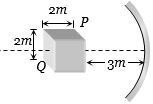
A cube of side $2\, m$ is placed in front of a concave mirror focal length $1\,m$ with its face $P$ at a distance of $3\, m$ and face $Q$ at a distance of $5\, m$ from the mirror. The distance between the images of face $P$ and $Q$ and height of images of $P$ and $Q$ are
Four ray $1, 2, 3$ and $4$ are incident normally on the face $P Q$ of an isosceles prism $P Q R$ with apex angle $\angle Q=120^{\circ}$. The refractive indices of the material of the prism for the above rays $1,2,3$ and $4$ are $1.85$, $1.95,2.05$ and $2.15$ respectively and the surrounding medium is air. Then, the rays emerging from the face $Q R$ are
A stone tied to the end of a string of $1\, m$ long is whirled in a horizontal circle with a constant speed. If the stone makes $22$ revolution in $44,$ seconds, what is the magnitude and direction of acceleration of the stone?
The average thermal energy for a mono$-$atomic gas is : $\left( k _{ B }\right.$ is Boltzmann constant and $T ,$ absolute $e$. temperature)