The maximum speed of a car on a road-turn of radius $30\, m$, if the coefficient of friction between the tyres and the road is $0.4$, will be .......... $m/sec$
Easy


Download our appand get started for free
Experience the future of education. Simply download our apps or reach out to us for more information. Let's shape the future of learning together!No signup needed.*
Similar Questions
- 1The maximum tension which an inextensible ring of mass $0.1\, kg/m$ can bear is $10\,N$. The maximum velocity in $m/s$ with which it can be rotated is ........ $m/s.$View Solution
- 2Two blocks $A$ and $B$ of masses $5 \,kg$ and $3 \,kg$ respectively rest on a smooth horizontal surface with $B$ over $A$. The coefficient of friction between $A$ and $B$ is $0.5$. The maximum horizontal force (in $kg$ wt.) that can be applied to $A$, so that there will be motion of $A$ and $B$ without relative slipping, isView Solution
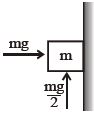
- 3View SolutionA block pressed against the vertical wall is in equilibrium. The minimum coefficient of friction is:-
- 4A cyclist riding the bicycle at a speed of $14 \sqrt{3} \,m / s$ takes a turn around a circular road of radius $20 \sqrt{3} \,m$ without skidding. What is his inclination to the vertical?View Solution
- 5The maximum velocity (in $ms^{-1}$) with which a car driver must traverse a flat curve of radius $150 \,m$ and coefficient of friction $0.6$ to avoid skidding isView Solution
- 6A motor car has a width $1.1$ m between wheels. Its centre of gravity is $0.62$ m above the ground and the coefficient of friction between the wheels and the road is $0.8$. ...... $m/s$ is the maximum possible speed, if the centre of gravity inscribes a circle of radius $15$ m ? (Road surface is horizontal)View Solution
- 7A body of mass $'m '$ is tied to one end of a spring and whirled round in a horizontal plane with a constant angular velocity. The elongation in the spring is $1\, cm$. If the angular velocity is doubled, the elongation in the spring is $5\, cm$. The original length of the spring is ......... $cm$View Solution
- 8A bullet of mass $0.1\,kg$ moving horizontally with speed $400\,ms ^{-1}$ hits a wooden block of mass $3.9\,kg$ kept on a horizontal rough surface. The bullet gets embedded into the block and moves $20\,m$ before coming to rest. The coefficient of friction between the block and the surface is $........$ $\left(\text { Given } g=10 \,ms ^2\right. \text { ) }$View Solution
- 9View SolutionA passenger inside a bus moving with uniform speed suddenly finds that a ball at rest, starts moving towards his left. It means that the bus now is
- 10A uniform rope of length l lies on a table. If the coefficient of friction is $\mu $, then the maximum length ${l_1}$ of the part of this rope which can overhang from the edge of the table without sliding down isView Solution