Question
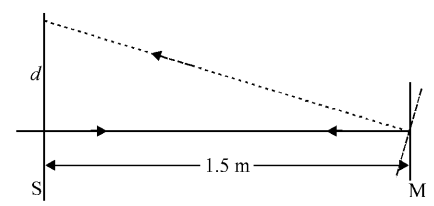
Light incident normally on a plane mirror attached to a galvanometer coil retrace backwards (as shown in Fig.). A current in the coil produces a deflection of 3.5° of the mirror. What is the displacement of the reflected spot of light on a screen placed 1.5 m away? Image
Answer

Here we know that the reflected rays are deflected at an angle twice to the angle of rotation of the mirror. From the figure we see that when the mirror is turned from M to M'position by an angle theta = 3.5 deg The reflected ray OB is bent as:
Image
$\angle 2 \theta=2 \times 3.5^{\circ}=7^{\circ}=\angle AOB$.
In right triangle $AOB , \tan 2 \theta=\frac{ AB }{ AO }$
or $\tan 7^{\circ}=\frac{d}{1.5}$
$\begin{aligned} d & =1.5 \times \tan 7^{\circ} \\ & =1.5 \times 0.1228 \\ & =0.1842 m \\ & =18.42 cm .\end{aligned}$

Need a full question paper?

Generate a complete, print-ready paper with questions like this in minutes — across 16+ boards, with answer keys.

Start Generating Free

Similar questions

A circular copper-ring of radius r translates in its plane with a constant velocity v. A uniform magnetic field B exists in the space in a direction perpendicular to the plane of the ring. Consider different pairs of diametrically opposite points on the ring.
  1. Between which pair of points is the emf maximum? What is the value of this maximum emf?
  2. Between which pair of points is the emf minimum? What is the value of this minimum emf?
Find the temperature at which the average thermal kinetic energy is equal to the energy needed to take a hydrogen atom from its ground state to n = 3 state. Hydrogen can now emit red light of wavelength 653.1nm. Because of Maxwellian distribution of speeds, a hydrogen sample emits red light at temperatures much lower than that obtained from this problem. Assume that hydrogen molecules dissociate into atoms.
A current loop of arbitrary shape lies in a uniform magnetic field B. Show that the net magnetic force acting on the loop is zero.
Is it possible for two bodies to be in thermal equilibrium if they are not in contact?
  1. Write the basic nuclear process involved in the emission of$\beta^{+}$ in a symbolic form, by a radioactive nuclear.
  2. in the reactions given below:
  1. $^{11}_{6}\text{C}\rightarrow ^{\text{z}}_{\text{y}}\text{B} + \text{x} + \text{v}$
  2. $^{12}_{6}\text{C}\rightarrow ^{12}_{6}\text{C}\rightarrow^{20}_{\text{a}}\text{Ne} + ^{c}_{b}\text{He}$

Find the values of x,y, and z and a,b and c.

  1. For a given a.c.,$\text{i} = \text{i}_{m}\sin\omega\text{t},$ show that the average power dissipated in a resistor R over a complete cycle is $\frac{1}{2}\text{i}_{m}^{2}\text{R}.$
  2. A light bulb is rated at 100 W for a 220 V a.c. supply. Calculate the resistance of the bulb.
Draw V – I characteristics of a p–n junction diode. Answer the following questions, giving reasons:
  1. Why is the current under reverse bias almost independent of the applied potential up to a critical voltage?
  2. Why does the reverse current show a sudden increase at the critical voltage?
Name any semiconductor device which operates under the reverse bias in the breakdown region.
Consider the plane S formed by the dipole axis and the axis of earth. Let P be point on the magnetic equator and in S. Let Q be the point of intersection of the geographical and magnetic equators. Obtain the declination and dip angles at P and Q.
Two particles have equal masses of 5.0g each and opposite charges of +4.0 × 10-5 C and -4.0 × 10-5C. They are released from rest with a separation of 1.0m between them. Find the speeds of the particles when the separation is reduced to 50cm.
(a) Stars located very far away, which cannot be seen with the eye, can be seen through a telescope. Why?
(b) The magnifying power of two telescopes is the same but the apertures of their objective lenses are different. What will be the change in the final images formed by them?