A block of mass $M$ rests on a rough horizontal table. A steadily increasing horizontal force is applied such that the block starts to slide on the table without toppling. The force is continued even after sliding has started. Assume the coefficients of static and kinetic friction between the table and the block to be equal. The correct representation of the variation of the frictional force $f$, exerted by the table on the block with time $t$ is given by
KVPY 2010, Medium
Download our app for free and get started
(a)
Force of friction is self adjusting. When applied force is increased friction, first increases till it reaches a maximum value called limiting friction.
If applied force is further increased, then friction does not increases further and body begins to move.
Force of friction then remains constant and its value is given by
$f=\mu N$

Download our appand get started for free
Experience the future of education. Simply download our apps or reach out to us for more information. Let's shape the future of learning together!No signup needed.*
Similar Questions
- 1A block of mass $10\; \mathrm{kg}$ is in contact against the inner wall of a hollow cylindow cylindrical drum of radius $1 \;\mathrm{m}$. The coeffident of friction between the block and the inner wall of the cylinder is $0.1$. The minimum angular velocity needed for the cylinder to keep the block stationary when the cylinder is vertical and rotating about its axis, will be: ......$rad/s$ $\left(g-10 m / s^{2}\right)$View Solution
- 2A small block starts slipping down from a point $B$ on an inclined plane $A B,$ which is making an angle $\theta$ with the horizontal section $BC$ is smooth and the remaining section $CA$ is rough with a coefficient of friction $\mu .$ It is found that the block comes to rest as it reaches the bottom (point $A)$ of the inclined plane. If $B C=2A C$, the coefficient of friction is given by $\mu=k \tan \theta$ .The value of $k$ isView Solution
- 3A car of weight $W$ is on an inclined road that rises by $100\,m$ over a distance of $1\,Km$ and applies a constant frictional force $\frac {W}{20}$ on the car. While moving uphill on the road at a speed of $10\,ms^{-1},$ the car needs power $P.$ If it needs power $\frac {P}{2}$ while moving down hill at speed $v$ then value of $v$ is ........ $ms^{-1}$View Solution
- 4A horizontal force of $4\,N$ is needed to keep a block of mass $0.5\, kg$ sliding on a horizontal surface with a constant speed. The coefficient of sliding friction must be :- $[g = 10\, m/s^2]$View Solution
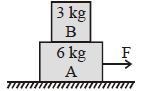
- 5Two blocks $A$ and $B$ of masses $6\, kg$ and $3\, kg$ rest on a smooth horizontal surface as shown in the figure. If coefficient of friction between $A$ and $B$ is $0.4$, the maximum horizontal force which can make them without separation is ........ $N$View Solution
- 6An army vehicle of mass $1000\, kg$ is moving with a velocity of $10 \,m/s$ and is acted upon by a forward force of $1000\, N$ due to the engine and a retarding force of $500 \,N$ due to friction. ........... $m/s$ will be its velocity after $10\, s$View Solution
- 7The maximum tension which an inextensible ring of mass $0.1\, kg/m$ can bear is $10\,N$. The maximum velocity in $m/s$ with which it can be rotated is ........ $m/s.$View Solution
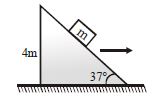
- 8If the coefficient of friction between block & wedge is $\mu $, then the maximum horizontal acceleration of the wedge for which block will remain at rest w.r.t. the wedge isView Solution
- 9A vehicle is moving with a velocity $v$ on a curved road of width $b$ and radius of curvature $R.$ For counteracting the centrifugal force on the vehicle, the difference in elevation required in between the outer and inner edges of the road isView Solution
- 10View SolutionA car sometimes overturns while taking a turn. When it overturns, it is