Light of wavelength 560nm goes through a pinhole of diameter 0.20mm and falls on a wall at a distance of 2.00m. What will be the radius of the central bright spot formed on the wall?
Download our app for free and get started
$\lambda=560\text{nm}=560\times10^{-9}\text{m},$ $\text{b}=0.20\text{mm}=2\times10^{-4}\text{m},\text{D}=2\text{m}$
Since, $\text{R}=1.22\frac{\lambda\text{D}}{\text{b}}=1.22\times\frac{560\times10^{-9}\times2}{2\times10^{-4}}$ $=6.832\times10^{-3}\text{M}=0.683\text{cm}.$
So, diameter $=2\text{R}=1.37\text{cm}.$
Since, $\text{R}=1.22\frac{\lambda\text{D}}{\text{b}}=1.22\times\frac{560\times10^{-9}\times2}{2\times10^{-4}}$ $=6.832\times10^{-3}\text{M}=0.683\text{cm}.$
So, diameter $=2\text{R}=1.37\text{cm}.$

Download our appand get started for free
Experience the future of education. Simply download our apps or reach out to us for more information. Let's shape the future of learning together!No signup needed.*
Similar Questions
- 1View SolutionCalculate the radius of curvature of an equi-concave lens of refractive index 1.5, when it is kept in a medium of refractive index 1.4, to have a power of -5D?
- 2View SolutionA parallel beam of monochromatic light falls normally on a single narrow slit. How does the angular width of the principal maximum in the resulting diffraction pattern depend on the width of the slit?
- 3A Young's double slit apparatus has slits separated by 0.28mm and a screen 48cm away from the slits. The whole apparatus is immersed in water and the slits are illuminated by the red light ($\lambda=700\text{nm}$ in vacuum). Find the fringe-width of the pattern formed on the screen.View Solution
- 4View SolutionWhy is the interference pattern not detected, when two coherent sources are far apart?
- 5View SolutionIn a Young's double slit experiment, two narrow vertical slits placed 0.800mm apart are illuminated by the same source of yellow light of wavelength 589nm. How far are the adjacent bright bands in the interference pattern observed on a screen 2.00m away?
- 6Find the intensity at a point on a screen in Young’s double slit experiment where the interfering waves have a path difference of (i) $\lambda/6$, and (ii) $\lambda/2.$View Solution
- 7View SolutionAmong the following waves which can be polarised? Sound waves, radio waves, X-rays, cathode rays.
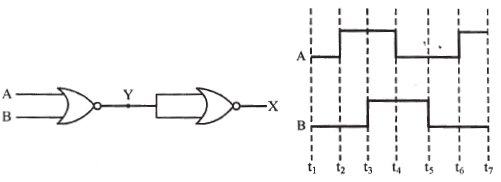
- 8View SolutionDraw the output waveform at X, using the given inputs A and B for the logic circuit shown below. Also, identify the logic operation performed by this circuit.
- 9Two transparent slabs having equal thickness but different refractive indices $\mu_1$ and $\mu_2$ are pasted side by side to form a composite slab. This slab is placed just after the double slit in a Young's experiment so that the light from one slit goes through one material and the light from the other slit goes through the other material. What should be the minimum thickness of the slab so that there is a minimum at the point $P_0$ which is equidistant from the slits?View Solution
- 10View SolutionWhen are two objects just resolved? Explain. How can the resolving power of a compound microscope be increased? Use relevant formula to support your answer.