Question
When are two objects just resolved? Explain. How can the resolving power of a compound microscope be increased? Use relevant formula to support your answer.

Answer

Two objects are said to be just resolved when, in their diffraction patterns, central maxima of one object coincides with the first minima, of the diffraction pattern of the second object. Limit of resolution of compound microscope.
$ \text{d}_{min}=\frac{1.22{\lambda}}{2\text{ }n\text{ }sin\text{ }{\beta}}$
Resolving power is the reciprocal of limit of resolution $( \text{d}_{min})$
Therefore, to increase resolving power $\lambda$ can be reduced and refractive index of the medium can be increased.

Need a full question paper?

Generate a complete, print-ready paper with questions like this in minutes — across 16+ boards, with answer keys.
Start Generating Free

Similar questions

$1 F ($ farad$)$ is a very large unit for practical purposes. Explain with example.
Explain Cassegrain telescpoe with the help of figure.
Prove that the electric field at the surface of a charged conductor is $\overrightarrow{ E }=\frac{\sigma}{\varepsilon_0} \hat{n}$. Where, $\sigma$ - Surface charge density, $\hat{n}$ - unit vector normal to the surface and in going outward direction.
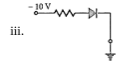
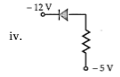
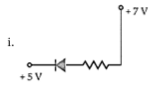
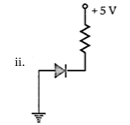
In the following diagrams indicate which of the diodes are forward biased and which are reverse biased.
Image
Image
Image
Image
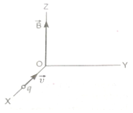
As shown in figure, a charge q moving along the X -axis with a velocity $\vec{v}$ is subjected to a uniform magnetic field $\vec{B}$ acting along the Z-axis as it crosses the origin O.
Image
i. Trace its trajectory.
ii. Does the charge gain kinetic energy, as it enters the magnetic field? Justify your answer.
A capacitor of capacitance C is given a charge Q. At t = 0, it is connected to an ideal battery of emf $\in$ through a resistance R. Find the charge on the capacitor at time t.
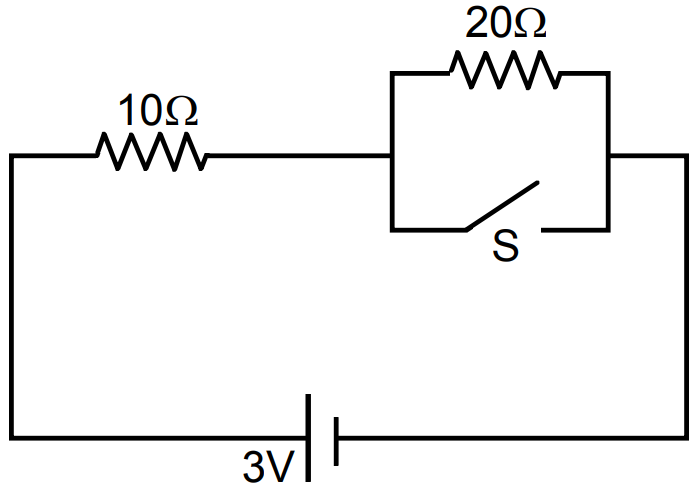
Consider the circuit shown in figure. Find the current through the $10\Omega$ resistor when the switch S is (a) Open (b) Closed.
The gravitational field in a region is given by $\overrightarrow{\text{E}}=(5\text{N/kg})\overrightarrow{\text{i}}+(12\text{N/kg})\overrightarrow{\text{j}}.$
  1. Find the magnitude of the gravitational force acting on a particle of mass 2kg placed at the origin.
  2. Find the potential at the points (12m, 0) and (0, 5m) if the potential at the origin is taken to be zero.
  3. Find the change in gravitational potential energy if a particle of mass 2kg is taken from the origin to the point (12m, 5m).
  4. Find the change in potential energy if the particle is taken from (12m, 0) to (0, 5m).
Explain the effect of dielectric on the capacitance of parallel plate capacitor and derive the equation of dielectric constant.
X-ray and visible light travel at the same speed in vacuum. Do they travel at the same speed in glass?