MCQ
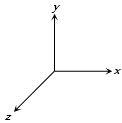
Light wave is travelling along y-direction. If the corresponding $\vec E$ vector at any time is along the $x-$axis, the direction of $\vec B$ vector at that time is along
  • A
    $y-$axis
  • B
    $x-$axis
  • C
    $+ z$-axis
  • $-z$ axis

Answer

Correct option: D.
$-z$ axis
d
(d) Direction of wave propagation is given by $\overrightarrow E \times \overrightarrow B $.

Need a full question paper?

Generate a complete, print-ready paper with questions like this in minutes — across 16+ boards, with answer keys.

Start Generating Free

Similar questions

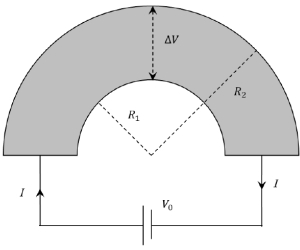
Shown in the figure is a semicircular metallic strip that has thickness $t$ and resistivity $\rho$. Its inner radius is $R_1$ and outer radius is $R_2$. If a voltage $V_0$ is applied between its two ends, a current $I$ flows in it. In addition, it is observed that a transverse voltage $\Delta V$ develops between its inner and outer surfaces due to purely kinetic effects of moving electrons (ignore any role of the magnetic field due to the current). Then (figure is schematic and not drawn to scale)-

$(A)$ $I =\frac{V_0 t}{\pi \rho} \ln \left(\frac{R_2}{R_1}\right)$

$(B)$ the outer surface is at a higher voltage than the inner surface

$(C)$ the outer surface is at a lower voltage than the inner surface

$(D)$ $\Delta V \propto I ^2$
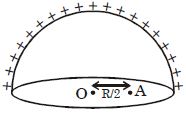
A hemispherical bowl of mass $m$ is uniformly charged with charge density $'\sigma '$ . Electric potential due to charge distribution at a point $'A'$ is (which lies at centre of radius as shown).
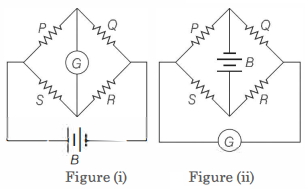
Figure $(i)$ below shows a Wheatstone's bridge in which $P, Q, R$ and $S$ are fixed resistances, $G$ is a galvanometer and $B$ is a battery. For this particular case, the galvanometer shows zero deflection. Now, only the positions of $B$ and $G$ are interchanged, as shown in figure $(ii)$. The new deflection of the galvanometer
In a potentiometer circuit there is a cell of e.m.f. 2 volt, a resistance of 5 ohm and a wire of uniform thickness of length 1000 cm and resistance 15 ohm. The potential gradient in the wire is
Which of the following statement is not correct in the case of light emitting diodes?

$A.$ It is a heavily doped p-n junction.

$B.$ It emits light only when it is forward biased.

$C.$ It emits light only when it is reverse biased.

$D.$ The energy of the light emitted is equal to or slightly less than the energy gap of the semiconductor used.

Choose the correct answer from the options given below :
The Lyman transitions involve:
In a series $LCR$ circuit, the inductive reactance $\left( X _{ L }\right)$ is $10\, \Omega$ and the capacitive reactance $\left( X _{ C }\right)$ is $4\, \Omega$. The resistance $( R )$ in the circuit is $6\, \Omega$. The power factor of the circuit is :
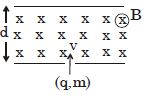
A charged particle projected in a limited magnetic field according to figure. The charged  particle does not strike to the opposite plate provided
A body is positively charged, it implies that:
A dry cell has an $e.m.f.$ of $1.5\, V$ and an internal resistance of $0.05\,\Omega $. The maximum current obtainable from this cell for a very short time interval is ................... $A$