MCQ
light waves can be polarised as they are
  • Transverse
  • B
    Of high frequency
  • C
    Longitudinal
  • D
    Reflected

Answer

Correct option: A.
Transverse
Only transverse waves can be polarised.

Need a full question paper?

Generate a complete, print-ready paper with questions like this in minutes — across 16+ boards, with answer keys.
Start Generating Free

Similar questions

Orbital acceleration of electron is
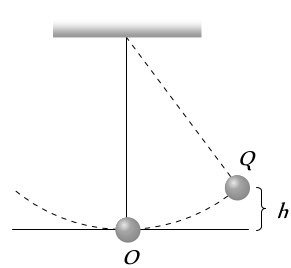
The bob of a simple pendulum is displaced from its equilibrium position $O$ to a position $Q$ which is at height $h$ above $O$ and the bob is then released. Assuming the mass of the bob to be $m$ and time period of oscillations to be $2.0 sec$, the tension in the string when the bob passes through $O$ is
The dimensional formula $M^0 L^2 T^{-2}$ stands for
In what form is the energy stored in an inductor or A coil of inductance $L$ is carrying a steady current $i$. What is the nature of its stored energy
A voltmeter of resistance $1000\,\Omega $ gives full scale deflection when a current of $100\, mA$ flow through it. The shunt resistance required across it to enable it to be used as an ammeter reading $1\, A$ at full scale deflection is ............... $\Omega $
Energy of the electron in $n$ orbit of hydrogen atom is given by $E_n=-\frac{13.6}{n^2} eV$. The amount of energy needed to transfer electron from first orbit to third orbit is
A cork is submerged in water by a spring attached to the bottom of a bowl. When the bowl is kept in an elevator moving with acceleration downwards, the length of spring
A particle is dropped under gravity from rest from a height $h\left(g=9.8 m / sec ^2\right)$ and it travels a distance $9 h / 25$ in the last second, the height $h$ is
A $100\, ohm$ galvanometer gives full scale deflection at $10\, mA$. How much shunt is required to read $100\, mA$ .............. $ohm$
The frequency of vibration of string is given by $v=\frac{p}{2 l}\left[\frac{F}{m}\right]^{1 / 2}$. Here $p$ is number of segments in the string and $/$ is the length. The dimensional formula for $m$ will be