Question
Light waves can be polarised because they:

Answer

  1. Are transverse
    Explanation:
    Polarisation of light waves is possible only because they can oscillate in more than one orientation i.e., they are transverse in nature. It has no dependence on its wavelength and frequencies.

Need a full question paper?

Generate a complete, print-ready paper with questions like this in minutes — across 16+ boards, with answer keys.
Start Generating Free

Similar questions

When the energy of the incident radiation is increased by 20%, the kinetic energy of the photoelectrons emitted from a metal surface increased from 0.5eV to 0.8eV. The work function of the metal is?
There is no atmosphere on moon because(a) There is no vegetation(b) The escape velocity at its surface is very low(c) Diffusion constant of gases is high(d) There is vacuum in space


Equipotential surfaces associated with an electric field which is increasing in magnitude along the x-direction are(a) Planes parallel to yz-plane(b) Planes parallel to xy-plane(c) Planes parallel to xz-plane(d) Coaxial cylinders of increasing radii around the x-axis


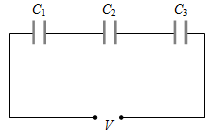
In the figure, three capacitors each of capacitance $6\ pF$ are connected in series. The total capacitance of the combination will be
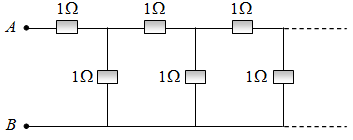
The equivalent resistance between points $A$ and $B$ of an infinite network of resistances each of $1 \Omega$ connected as shown, is
Ultraviolet light of wavelength $300\ nm$ and intensity $1.0\ watt/m^2$ falls on the surface of a photosensitive material. If $1\%$ of the incident photons produce photoelectrons, then the number of photoelectrons emitted from an area of $1.0 \ cm^2$ of the surface is nearly
Curie is a unit of(a) Length(b) It is not any unit(c) Activity(d) Atomic number
       
In the absence of other conductors, the surface charge density(a) Is proportional to the charge on the conductor and its surface area(b) Inversely proportional to the charge and directly proportional to the surface area(c) Directly proportional to the charge and inversely proportional to the surface area(d) Inversely proportional to the charge and the surface area


If a unit positive charge is taken from one point to another over an equipotential surface, then:
Which principle suggests that the intensity of light determines its amplitude?