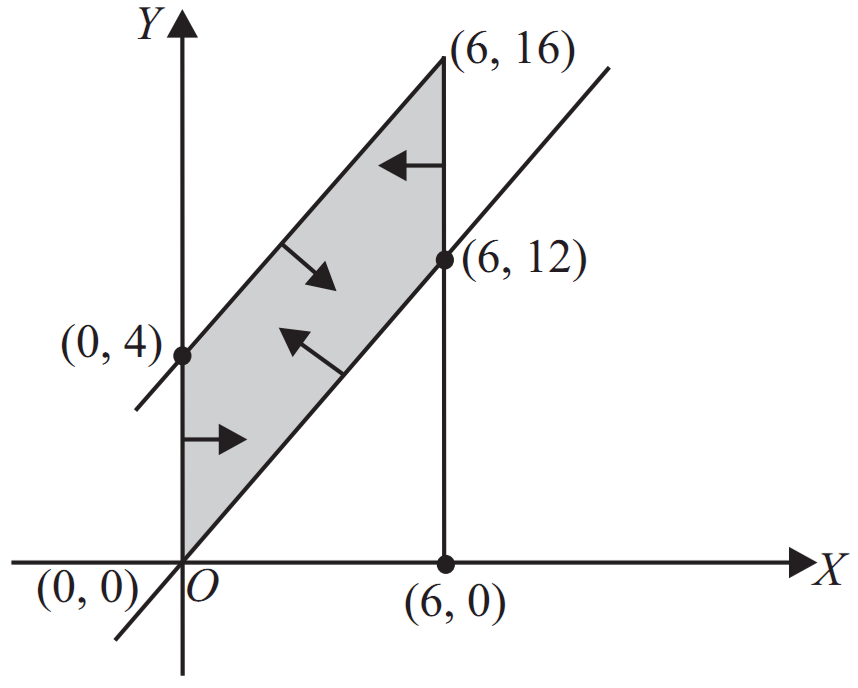
Question types

Linear Programming question types

418 questions across 7 question groups — pick any mix to generate a Maths paper with step-by-step answer keys.

418
Questions
7
Question groups
5
Question types
Sample Questions

Linear Programming questions

One sample from each question group in this chapter. Select any group above to see the full set with answer keys.

The corner points of the feasible region determined by the system of linear inequalities are (0, 0), (4, 0), (2, 4) and (0, 5). If the maximum value of z = ax + by, where a, b > 0 occurs at both (2, 4) and (4, 0), then:
  1. a = 2b
  2. 2a = b
  3. a = b
  4. 3a = b
View full solution
The corner points of the feasible region determined by the system of linear inequalities are (0, 0), (4, 0), (2, 4) and (0, 5). If the maximum value of z = ax + by, where a, b > 0 occurs at both (2, 4) and (4, 0), then:
  1. a = 2b
  2. 2a = b
  3. a = b
  4. 3a = b
View full solution
The corner points of the feasible region determined by the system of linear inequalities are (0, 0), (4, 0), (2, 4) and (0, 5). If the maximum value of z = ax + by, where a, b > 0 occurs at both (2, 4) and (4, 0), then:
  1. a = 2b
  2. 2a = b
  3. a = b
  4. 3a = b
View full solution
The objective function of a linear programming problem is:
  1. A constraint
  2. Function to be optimised
  3. A relation between the variables
  4. None of these
View full solution
Maximize Z = 7x + 11y, subject to $3\text{x}+5\text{y}\leq26,5\text{x}+3\text{y}\leq30,\text{x}\geq0,\text{y}\geq0.$
  1. 59 at$\Big(\frac{9}{2},\frac{5}{2}\Big)$
  2. 42 at (6, 0)
  3. 49 at (7, 0)
  4. 57.2 at (0, 5.2)
View full solution
Directions: In the following questions, the Assertions (A) and Reason(s) (R) have been put forward. Read both the statements carefully and choose the correct alternative from the following:
Assertion (A): The region represented by the set $\{(\text{x},\text{y}):4\leq\text{x}^2+\text{y}^2\leq9\}$ is a convex set.
Reason (R): The set $\{(\text{x},\text{y}):4\leq\text{x}^2+\text{y}^2\leq9\}$ represents the region between two concentric circles of radii 2 and 3.
  1. Both A and R are true and R is the correct explanation of A
  2. Both A and R are true but R is NOT the correct explanation of A
  3. A is true but R is false.
  4. A is false but R is true.
View full solution
Directions: In the following questions, the Assertions (A) and Reason(s) (R) have been put forward. Read both the statements carefully and choose the correct alternative from the following:
Assertion: Maximum value of z = 11x + 7y, subjectto constraints $2\text{x}+\text{y}\leq6,\text{x}\leq2,\text{x}\geq0,\text{y}\geq0$ will be obtained at (0, 6).
Reason: In a bounded feasible region, it always exist a maximum and minimum value.
  1. A is true, R is true: R is a correct explanation for A.
  2. A is true,R is true; R is not a correct explanation for A.
  3. A is true: R is false.
  4. A is false: R is true.
View full solution
Directions: In the following questions, the Assertions (A) and Reason(s) (R) have been put forward. Read both the statements carefully and choose the correct alternative from the following:
Assertion (A): The linear programming problem, maximize Z = x + 2y subject to constraints $\text{x}-\text{y}\leq10,2\text{x}+3\text{y}\leq20$ and $\text{x}\geq0; \text{y}\geq0.$ It gives the maximum value of Z as $\frac{40}{3}.$
Reason (R): To obtain maximum value of Z, we need to compare value of Z at all the corner points of the shaded region.
  1. Both A and R are true and R is the correct explanation of A
  2. Both A and R are true but R is NOT the correct explanation of A
  3. A is true but R is false.
  4. A is false but R is true.
View full solution
Directions: In the following questions, the Assertions (A) and Reason(s) (R) have been put forward. Read both the statements carefully and choose the correct alternative from the following

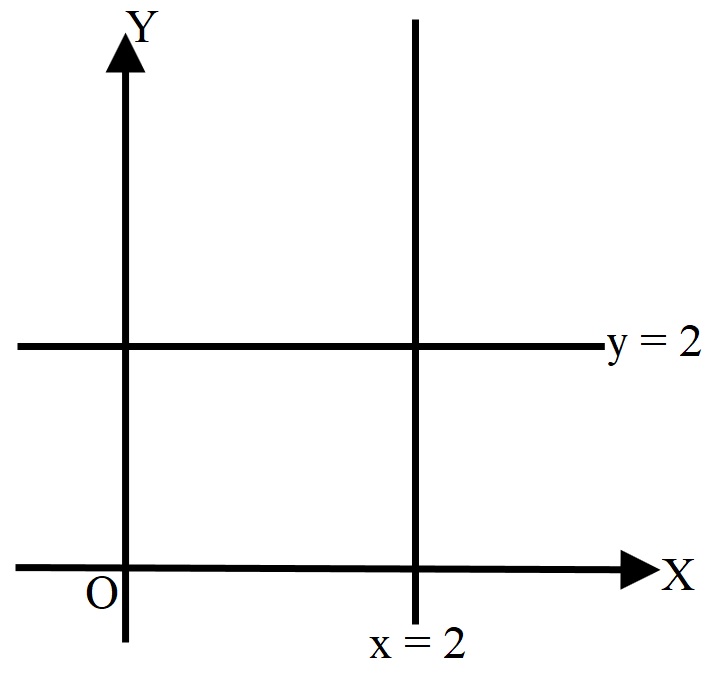
Assertion (A): The graph of $\text{x}\leq2$ and $\text{y}\geq2$ will be situated in the first and second quadrants.

Reason (R):

  1. Both A and R are true and R is the correct explanation of A
  2. Both A and R are true but R is NOT the correct explanation of A
  3. A is true but R is false.
  4. A is false but R is true.
View full solution
Directions: In the following questions, the Assertions (A) and Reason(s) (R) have been put forward. Read both the statements carefully and choose the correct alternative from the following:
Assertion: The linear programming problem,maximize z = 2x + 3y subject to constraints $\text{x}+\text{y}\leq4,\text{x}\geq0,\text{y}\geq0$ It gives the maximum value of Z as 8 .
Reason: To obtain maximum value of Z, we need to compare value of Zat all the corner points of the feasible region.
  1. A is true, R is true: R is a correct explanation for A.
  2. A is true,R is true; R is not a correct explanation for A.
  3. A is true: R is false.
  4. A is false: R is true.
View full solution
Q 111 Marks1 Mark
Maximise the function $\text{Z}=11\text{x}+7\text{y},$ subject to the constraints: $\text{x}\leq3,\text{y}\leq2,\text{x}\geq0,\text{y}\geq0.$
View full solution
Q 131 Marks1 Mark
Directions: In the following questions, the Assertions (A) and Reason(s) (R) have been put forward. Read both the statements carefully and choose the correct alternative from the following:
Assertion (A): It is necessary to find objective function value at every point in the feasible region to find optimum value of the objective function.
Reason(R): For the constrains $2\text{x}+3\text{y}\leq6,5\text{x}+3\text{y}\leq15,\text{x}\geq0$ and $\text{y}\geq0$ cornner points of the feasible region are (0, 2), (0, 0) and (3, 0).
  1. Both A and R are true and R is the correct explanation of A
  2. Both A and R are true but R is NOT the correct explanation of A
  3. A is true but R is false.
  4. A is false but R is true.
View full solution
Q 142 Marks2 Marks
Two tailors, A and B, earn ₹ 300 and ₹ 400 per day respectively. A can stitch 6 shirts and 4 pairs of trousers while B can stitch 10 shirts and 4 pairs of trousers per day. To find how many days should each of them work and if it is desired to produce at least 60 shirts and 32 pairs of trousers at a minimum labour cost, formulate this as an LPP.
View full solution
Q 152 Marks2 Marks
Two tailors, A and B, earn ₹ 300 and ₹ 400 per day respectively. A can stitch 6 shirts and 4 pairs of trousers while B can stitch 10 shirts and 4 pairs of trousers per day. To find how many days should each of them work and if it is desired to produce at least 60 shirts and 32 pairs of trousers at a minimum labour cost, formulate this as an LPP.
View full solution
Q 162 Marks2 Marks
Two tailors, A and B, earn ₹ 300 and ₹ 400 per day respectively. A can stitch 6 shirts and 4 pairs of trousers while B can stitch 10 shirts and 4 pairs of trousers per day. To find how many days should each of them work and if it is desired to produce at least 60 shirts and 32 pairs of trousers at a minimum labour cost, formulate this as an LPP.
View full solution
Q 172 Marks2 Marks
A company produces two types of goods A and B, that require gold and silver. Each unit of type A requires 3 g of silver and 1 g of gold while that of type B requires 1 g of silver and 2 g of gold. The company can procure a maximum of 9 g of silver and 8 g of gold. If each unit of type A brings a profit of ₹ 40 and that of type B ₹ 50, formulate LPP to maximize profit.
View full solution
Q 182 Marks2 Marks
A company produces two types of goods A and B, that require gold and silver. Each unit of type A requires 3 g of silver and 1 g of gold while that of type B requires 1 g of silver and 2 g of gold. The company can procure a maximum of 9 g of silver and 8 g of gold. If each unit of type A brings a profit of ₹ 40 and that of type B ₹ 50, formulate LPP to maximize profit.
View full solution
Q 193 Marks3 Marks
A bill for Rs. 7650 was drawn on 8th March 2005 at 7 months. It was discounted on 18 May 2005 and the holder of the bill received Rs. 7497. What rate of interest did the banker charge?
View full solution
Q 203 Marks3 Marks
Find the face value of a bill, discounted at 6% per annum 146 days before the legal due date, if the banker's gain is Rs. 36.
View full solution
Q 244 Marks4 Marks
A trust invested some money in two type of bonds. The first bond pays 10% interest and bond pays 12% interest. The trust received 2,800 as interest. However, if trust had interchanged money in bonds, they would have got 100 less as interest. Using matrix method, find the amount invested by the trust. Which value is reflected in this question?
View full solution
Q 254 Marks4 Marks
There are two types of fertilisers 'A' and 'B'. 'A' consists of 12 % nitrogen and 5 % phosphoric acid whereas 'B' consists of 4 % nitrogen and 5 % phosphoric acid. After testing the soil conditions, farmer finds that he needs at least 12 kg of nitrogen and 12 kg of phosphoric acid for his crops. If 'A' costs 10 per kg and 'B' cost 8 per kg, then graphically determine how much of each type of fertiliser should be used so that nutrient requirements are met at a minimum cost.
View full solution
Q 264 Marks4 Marks
There are 2 families A and B. There are 4 men, 6 women and 2 children in family A, and 2 men, 2 women and 4 children in family B. The recommended daily amount of calories is 2400 for men, 1900 for women, 1800 for children and 45 grams of proteins for men, 55 grams for women and 33 grams for children. Represent the above information using matrices. Using matrix multiplication, calculate the total requirement of calories and proteins for each of the 2 families. What awareness can you create among people about the balanced diet from this question?
View full solution
Q 274 Marks4 Marks
Solve the following linear programming problem graphically.Minimise $\text{z = 3x + 5y}$
subject to the constraints
$\text{x + 2y}\geq 10$
$\text{x + y}\geq 6$
$\text{3x + y}\geq 8$
$\text{x, y}\geq 0.$
View full solution
Q 284 Marks4 Marks
Solve the following linear programming problem graphically:
Maximise Z = 7x + 10y
subject to the constraints
4x + 6y $\leq$ 240
6x + 3y $\leq$ 240
x $\geq$ 10
x $\geq$ 0, y $\geq$ 0
View full solution
Let R be the feasible region (convex polygon) for a linear programming problem and let Z = ax + by be the objective function. When Z has an optimal value (maximum or minimum), where the variables x and y are subject to constraints described by linear inequalities, this optimal value must occur at a corner point (vertex) of the feasible region.

Based on the above information, answer the following questions.

  1. Objective function of a L.P.P. is:
  1. A constant.
  2. A function to be optimised.
  3. A relation between the variables.
  4. None of these.
  1. Which of the following statement is correct?
  1. Every LPP has at least one optimal solution.
  2. Every LPP has a unique optimal solution.
  3. If an LPP has two optimal solutions, then it has infinitely many solutions.
  4. None of these.
  1. In solving the LPP: "minimize f = 6x + 10y subject to constraints $\text{x}\geq6,\text{ y}\geq2,\text{ 2x}+\text{y}\geq10,\text{ x}\geq0,\text{ y}\geq0"$ redundant constraints are:
  1. $\text{x}\geq6,\text{ y}\geq2$

  2. $\text{2x}+\text{y}\geq10,\text{ x}\geq0,\text{ y}\geq0$

  3. $\text{x}\geq6$

  4. None of these
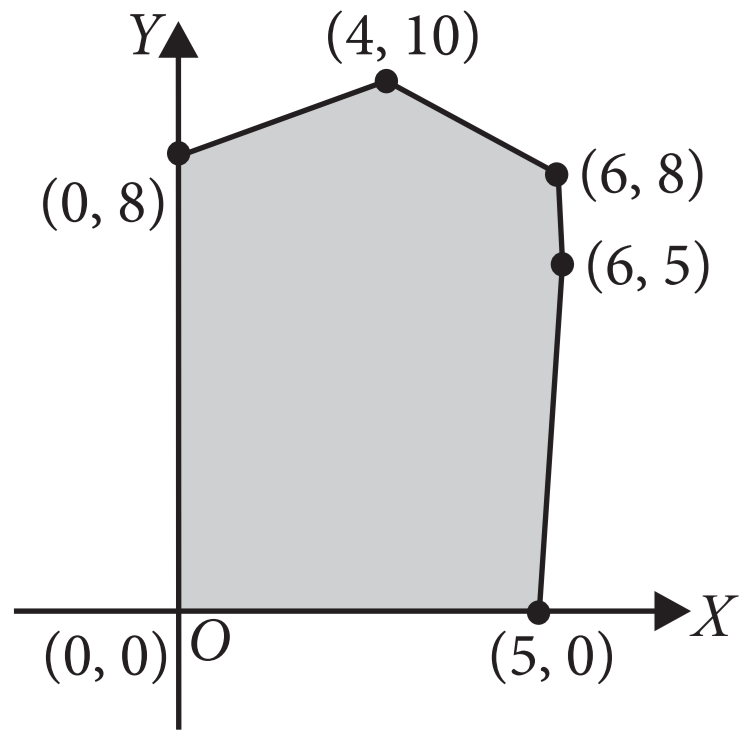
  1. The feasible region for a LPP is shown shaded in the figure. Let Z = 3x - 4y be the objective function. Minimum of Z occurs at:

  1. (0, 0)
  2. (0, 8)
  3. (5, 0)
  4. (4, 10)
  1. The feasible region for a LPP is shown shaded in the figure. Let F = 3x - 4y be the objective function. Maximum value of F is:

  1. 0
  2. 8
  3. 12
  4. -18
View full solution
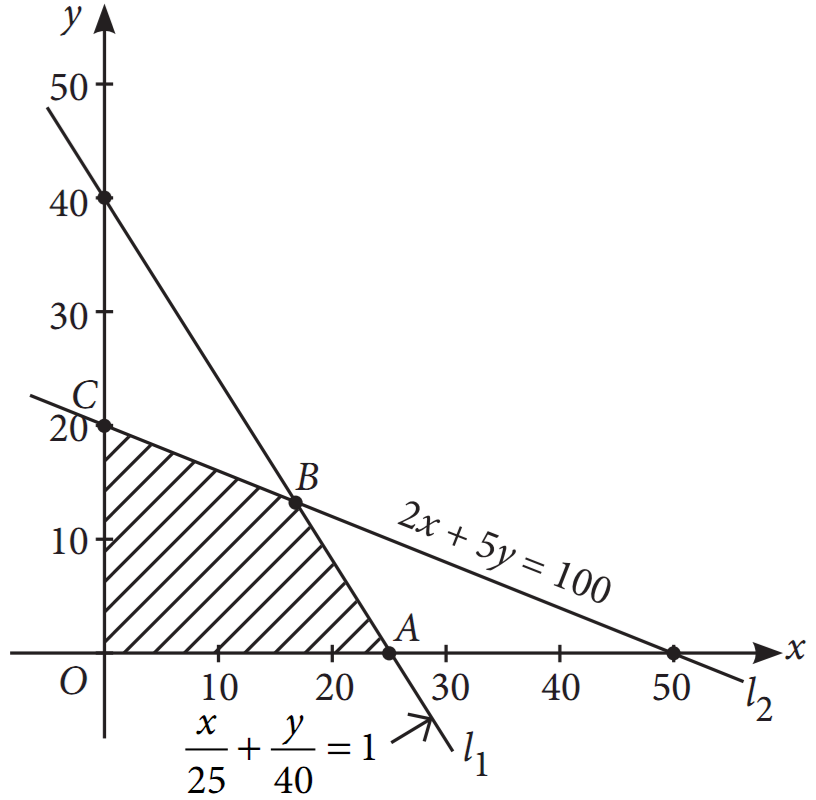
Deepa rides her car at 25 km/ hr. She has to spend ₹ 2 per km on diesel and if she rides it at a faster speed of 40 km/ hr, the diesel cost increases to ₹ 5 per km. She has ₹ 100 to spend on diesel. Let she travels x kms with speed 25 km/ hr and y kms with speed 40 km/ hr. The feasible region for the LPP is shown below:

Based on the above information, answer the following questions.
  1. What is the point of intersection of line l1 and l2?
  1. $\Big(\frac{40}{3},\frac{50}{3}\Big)$

  2. $\Big(\frac{50}{3},\frac{40}{3}\Big)$

  3. $\Big(\frac{-50}{3},\frac{40}{3}\Big)$

  4. $\Big(\frac{-50}{3},\frac{-40}{3}\Big)$

  1. The comer points of the feasible region shown in above graph are:
  1. $(0,25),(20,0),\Big(\frac{40}{3},\frac{50}{3}\Big)$

  2. $(0, 0), (25, 0), (0, 20) $

  3. $(0,0),\Big(\frac{40}{3},\frac{50}{3}\Big),(0,20)$

  4. $(0,0),(25,0),\Big(\frac{50}{3},\frac{40}{3}\Big),(0,20)$

  1. If Z = x + y be the objective function and max Z = 30. The maximum value occurs at point:
  1. $\Big(\frac{50}{3},\frac{40}{3}\Big)$
  2. (0, 0)
  3. (25, 0)
  4. (0, 20)
  1. If Z = 6x - 9y be the objective function, then maximum value of Z is:
  1. -20
  2. 150
  3. 180
  4. 20
  1. If Z = 6x + 3y be the objective function, then what is the minimum value of Z?
  1. 120
  2. 130
  3. 0
  4. 150
View full solution
Suppose a dealer in rural area wishes to purpose a number of sewing machines. He has only ₹ 5760 to invest and has space for at most 20 items for storage. An electronic sewing machine costs him ₹ 360 and a manually operated sewing machine ₹ 240. He can sell an electronic sewing machine at a profit of ₹ 22 and a manually operated sewing machine at a profit of ₹ 18.

Based on the above information, answer the following questions.
  1. Let x and y denotes the number of electronic sewing machines and manually operated sewing machines purchased by the dealer. If it is assume that the dealer purchased atleast one of the the given machines, then:
  1. $\text{x}+\text{y}\geq0$
  2. $\text{x}+\text{y}<0$
  3. $\text{x}+\text{y}>0$
  4. $\text{x}+\text{y}\leq0$
  1. Let the constraints in the given problem is represented by the following inequalities.

$\text{x}+\text{y}\leq20$

$360\text{x}+240\text{y}\leq5760$

$\text{x},\text{y}\geq0$

Then which of the following point lie in its feasible region.

  1. (0, 24)
  2. (8, 12)
  3. (20, 2)
  4. None of these
  1. If the objective function of the given problem is maximise z = 22x + 18y, then its optimal value occur at:
  1. (0, 0)
  2. (16, 0)
  3. (8, 12)
  4. (0, 20)
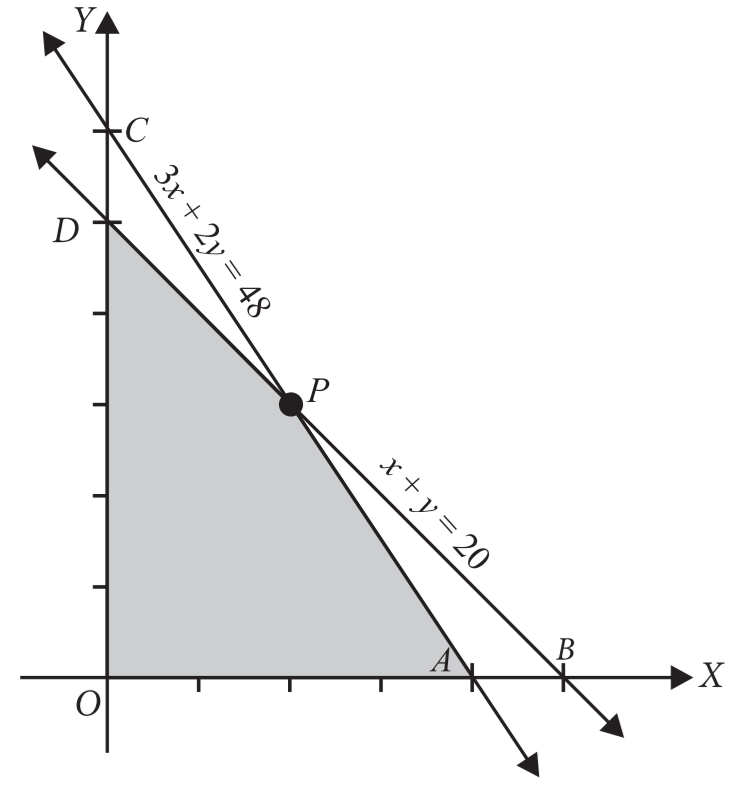
  1. Suppose the following shaded region APDO, represent the feasible region corresponding to mathematical formulation of given problem.

Then which of the following represent the coordinates of one of its corner points

  1. (0, 24)
  2. (12, 8)
  3. (8, 12)
  4. (6, 14)
  1. If an LPP admits optimal solution at two consecutive vertices of a feasible region, then:
  1. The required optimal solution is at the midpoint of the tine joining two points.
  2. The optimal solution occurs at every point on the tine joining these two points.
  3. The LPP under consideration is not solvable.
  4. The LPP under consideration must be reconstructed.
View full solution
Linear programming is a method for finding the optimal values (maximum or minimum) of quantities subject to the constraints when relationship is expressed as linear equations or inequations.

Based on the above information, answer the following questions.
  1. The optimal value of the objective function is attained at the points:
  1. On X-axis.
  2. On Y-axis.
  3. Which are comer points of the feasible region.
  4. None of these.
  1. The graph of the inequality 3x + 4y < 12 is:
  1. Half plane that contains the origin.
  2. Half plane that neither contains the origin nor the points of the line 3x + 4y = 12.
  3. Whole XOY-plane excluding the points on line 3x + 4y = 12.
  4. None of these.
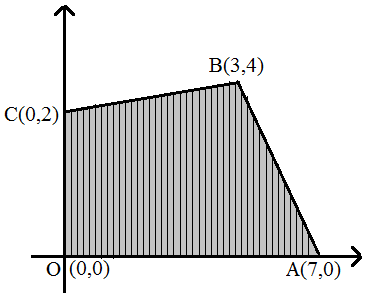
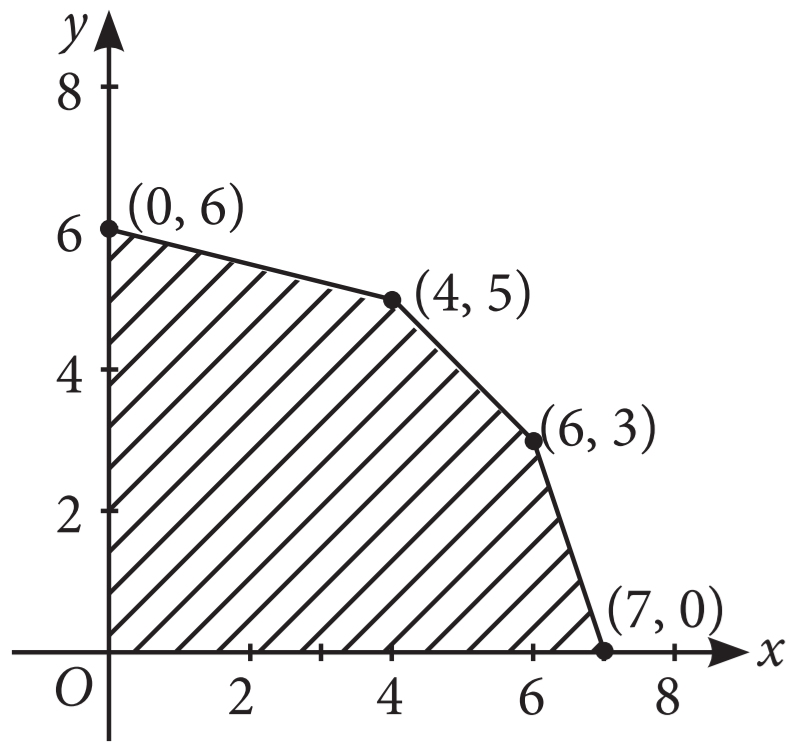
  1. The feasible region for an LPP is shown in the figure. Let Z = 2x + 5y be the objective function. Maximum of Z occurs at:

  1. (7, 0)
  2. (6, 3)
  3. (0, 6)
  4. (4, 5)
  1. The corner points of the feasible region determined by the system of linear constraints are (0, 10), (5, 5), (15, 15), (0, 20). Let Z = px + qy, where p, q > 0. Condition on p and q so that the maximum of Z occurs at both the points ( 15, 15) and (0, 20) is:
  1. p = q
  2. p = 2q
  3. q = 2p
  4. q = 3p
  1. The comer points of the feasible region determined by the system of linear constraints are (0, 0), (0, 40), (20, 40), (60, 20), (60, 0). The objective function is Z = 4x + 3y.

Compare the quantity in Column A and Column B

Column A
Column B
Maximum of Z
325
  1. The quantity in column A is greater.
  2. The quantity in column Bis greater.
  3. The two quantities are equal.
  4. The relationship cannot be determined on the basis of the information supplied.
View full solution
Corner points of the feasible region for an LPP are (0, 3), (5, 0), (6, 8), (0, 8). Let Z = 4x - 6y be the objective function.

Based on the above information, answer the following questions.

  1. The minimum value of Z occurs at:
  1. (6, 8)
  2. (5, 0)
  3. (0, 3)
  4. (0, 8)
  1. Maximum value of Z occurs at:
  1. (5, 0)
  2. (0, 8)
  3. (0, 3)
  4. (6, 8)
  1. Maximum of Z - Minimum of Z =
  1. 58
  2. 68
  3. 78
  4. 88
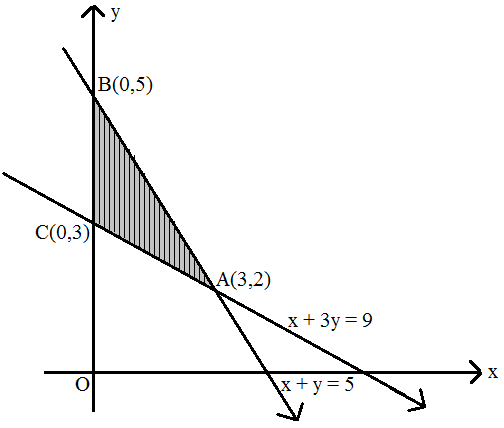
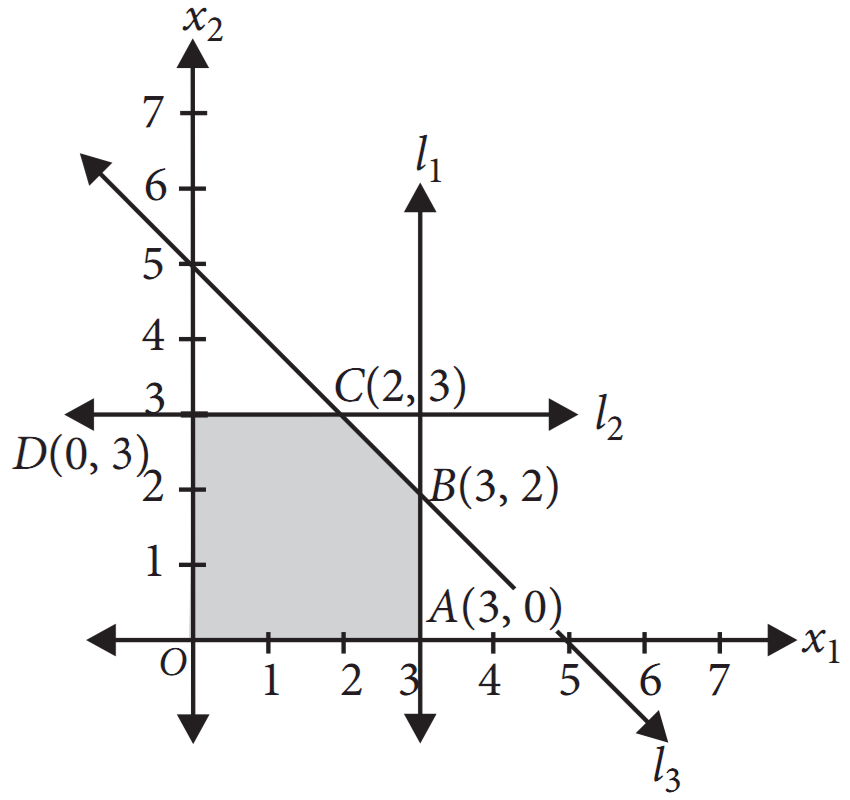
  1. The corner points of the feasible region determined by the system of linear inequalities are:

  1. (0, 0), (-3, 0), (3, 2). (2, 3)
  2. (3, 0), (3, 2), (2, 3), (0, -3)
  3. (0, 0), (3, 0), (3, 2), (2, 3), (0, 3)
  4. None of these
  1. The feasible solution of LPP belongs to:
  1. First and second quadrant.
  2. First and third quadrant.
  3. Only second quadrant.
  4. Only first quadrant.
View full solution

Generate a Linear Programming paper free

Pick question groups from the list above, set marks and difficulty, and export a branded PDF with step-by-step answer keys. First 3 chapters free — no signup.

Download App