MCQ
Lines of force:
- AAre not imaginary lines.
- BCannot be mapped on paper.
- CDo not intersect each other.
- DAlways intersect each other.
Explanation:
lines of force do not intersect each other because at the point of intersection we will have two different direction of the force, as their will be two tangential direction corresponding to the two intersecting lines.
Generate a complete, print-ready paper with questions like this in minutes — across 16+ boards, with answer keys.
In the Young's double slit experiment, the ratio of intensities of bright and dark fringes is 9. This means that
|
(a) The intensities of individual sources are 5 and 4 units respectively |
|
(b) The intensities of individual sources are 4 and 1 units respectively |
|
(c) The ratio of their amplitudes is 2 |
|
(d) b, c |
Consider the situation shown in the figure. The wire AB is sliding on the fixed rails with a constant velocity. If the wire AB is replaced by semicircular wire, the magnitude of the induced current will
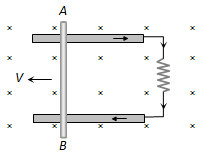
| (a) Increase |
|
(b) Remain the same |
|
(c) Decrease |
|
(d) Increase or decrease depending on whether the semicircle bulges towards the resistance or away from it |
The resistance of a galvanometer is 90 ohms. If only 10 percent of the main current may flow through the galvanometer, in which way and of what value, a resistor is to be used
|
(a) 10 ohms in series |
(b) 10 ohms in parallel |
|
(c) 810 ohms in series |
(d) 810 ohms in parallel |
Two identical thin bar magnets each of length l and pole strength m are placed at right angle to each other with north pole of one touching south pole of the other. Magnetic moment of the system is
|
(a) ml |
(b) 2ml |
(c) |
(d) |
$\text{y}=\text{a}_1\sin\omega\text{t}$
$\text{y}=\text{a}_2\sin(\omega\text{t}+\in)$
$\text{y}=\text{a}_1\sin2\omega\text{t}$
$\text{y}=\text{a}_2\sin2(\omega\text{t}+\in)$
Interference fringes may be observed due to superposition of:

