Question
List gases which are responsible for greenhouse effect.

Answer

Gases responsible for greenhouse effect are:
$\mathrm{CO}_2, \mathrm{CH}_4, \mathrm{~N}_2 \mathrm{O}, \mathrm{H}_2 \mathrm{O}_{(\mathrm{g})}, \mathrm{CFCs}$ and $\mathrm{O}_3$. Carbon dioxide molecules trap heat as they are transparent to sunlight but not to the heat radiations. Carbon dioxide is, thus, the major contributor to global warming. Methane is produced naturally when vegetation is burnt, digested or rotted in the absence of oxygen. Large amounts of methane are released in paddy fields, coal mines from rotting garbage dumps and fossil fuels.
Chlorofluorocarbons (CFCs) are man-made industrial chemicals used in air conditioning, etc. CFCs are also damaging the ozone layer. These gases together are responsible for greenhouse effect.

Need a full question paper?

Generate a complete, print-ready paper with questions like this in minutes — across 16+ boards, with answer keys.
Start Generating Free

Similar questions

Derive the formula to find the ionization constant of weak acids and bases and how will you obtain the value of [H] to find their pH?
The drain cleaner, Drainex contains small bits of aluminum which react with caustic soda to produce dihydrogen. What volume of dihydrogen at $20^\circ C$ and one bar will be released when $0.15g$ of aluminum reacts?
Distinguish between a sigma and a pi bond.
Explain the following orders of compounds on the basis of hydrogen bonding:
(i) Boiling point
(ii) Solubility
(iii) Physical state
(iv) Density
Explain why alkyl groups act as electron donors when attached to a $\pi$ system.
What is called electrovalent bond? Describe the circumstances necessary for the formation of ionic bond.
Using van der Waal's equation, calculate the constant 'a' when two moles of gas confined in a four litre flask exerts a pressure of 11.0 atm at a temperature of 300K. The value of 'b' is 0.05 litre per mole.
In terms of Charles’ law explain why –273 °C is the lowest possible temperature.
Attempt any five of the following:
1. Convert methane into ethane.
2. Write IUPAC name of the following: $CH _3\left( CH _2\right)_4 CH \left( CH _2\right)_3 CH _3 CH _2- CH \left( CH _3\right)_2$
3. To which category of compounds does cyclohexane belong?
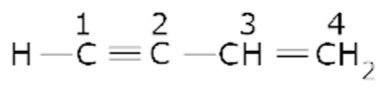
4. Name the type of hybridization in C (2) and C (3) in the following molecule
Image

5. What are Arenes?
6. n-propylmagnesium bromide on hydrolysis gives propane. Is there any other Grignard reagent which also gives propane? If so, give its name, structure and equation for the reaction.
7. How will you distinguish between acetylene and ethylene?
Write down the products of ozonolysis of 1,2-dimethylbenzene (o-xylene). How does the result support Kekulé structure for benzene?