Question
List the advantages of recombinant insulin.

Answer

Insulin used for diabetes was earlier extracted from pancreas of slaughtered cattle and pigs. Insulin from an animal source, though caused some patients to develop allergy or other types of reactions to the foreign protein. Insulin consists of two short polypeptide chains: chain A and chain B, that are linked together by disulphide bridges. In mammals, including humans, insulin is synthesised as a pro-hormone (like a pro-enzyme, the pro-hormone also needs to be processed before it becomes a fully mature and functional hormone) which contains an extra stretch called the C peptide. This C peptide is not present in the mature insulin and is removed during maturation into insulin. The main challenge for production of insulin using rDNA techniques was getting insulin assembled into a mature form. In 1983, Eli Lilly an American company prepared two DNA sequences corresponding to A and B, chains of human insulin and introduced them in plasmids of E. coli to produce insulin chains. Chains A and B were produced separately, extracted and combined by creating disulfide bonds to form human insulin.
Need a full question paper?

Generate a complete, print-ready paper with questions like this in minutes — across 16+ boards, with answer keys.

Start Generating Free

Similar questions

Give an account of the methods used in sequencing the human genome.
Draw a diagrammatic sketch of the sectional view of a typical anatropous ovule.
OR
Draw a labelled diagram of the sectional view of a typical anatropous ovule.
What are the changes in the oogonia during the transition of a primary follicle to Graafian follicle?
A child has blood group O. If the father has blood group A and mother blood group B, work out the genotypes of the parents and the possible genotypes of the other offsprings.
  1. A primary succession start on a bare rock and reach a climax community
A child suffering from thalassemia is born to a normal couple. But the mother is being blamed by the family for delivering a sick baby.
  1. What is Thalassemia?
  2. How would you counsel the family not to blame the mother for delivering a child suffering from this disease? Explain.
  3. List the values your counselling can propagate in the families.
Illustrate the design of a bioreactor. Highlight the difference between a flask in your laboratory and a bioreactor which allows cells to grow in a continuous culture system.
Describe the steps involved in the sequencing of genome of an organism.

The above diagram shows a simplified biogeochemical cycle.
  1. Name the compound whose cycle is depicted.
  2. In what way do vehicles add this compound to atmosphere?
  3. What adverse effect does its excess have on the environment?
  4. Cite an event which depicts this effect in the modern times.
  5. Suggest two ways of reducing this effect.
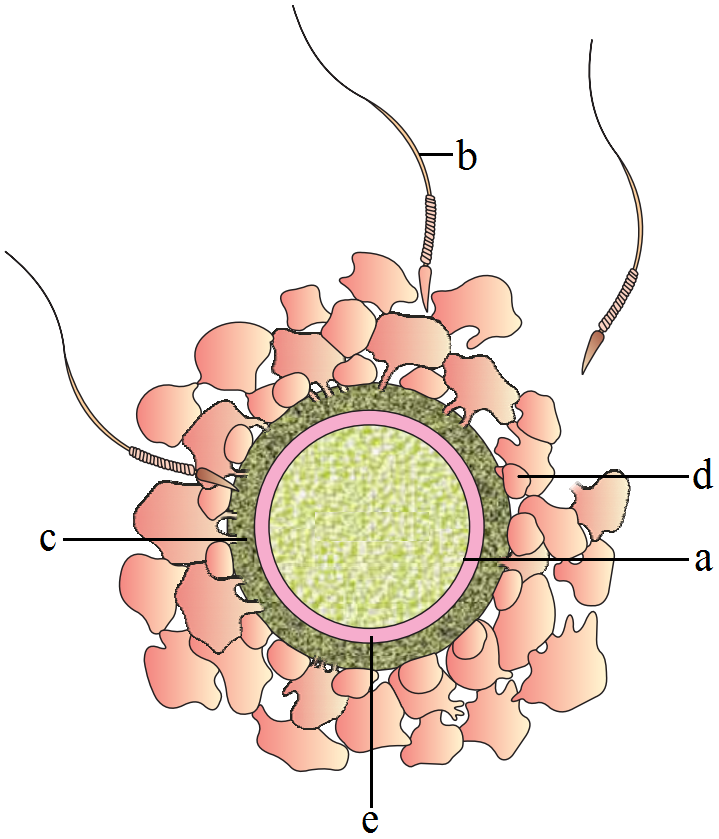
Study the illustration given and answer the questions that follow:
Explain the role of hormones in the formation and release of ‘a’.