Question
List the attributes that populations but not individuals possess.

Answer

A population can be defined as a group of individuals of the same species residing in a particular geographical area at a particular time and functioning as a unit. For example, all human beings living at a particular place at a particular time constitute the population of humans. The main attributes or characteristics of a population residing in a given area are:
  1. Birth rate (Natality): It is the ratio of live births in an area to the population of an area. It is expressed as the number of individuals added to the population with respect to the members of the population.
  2. Death rate (Mortality): It is the ratio of deaths in an area to the population of an area. It is expressed as the loss of individuals with respect to the members of the population.
  3. Sex ratio: It is the number of males or females per thousand individuals.
  4. Age Distribution: It is the percentage of individuals of different ages in a given population. At any given time, the population is composed of individuals that are present in various age groups. The age distribution pattern is commonly represented through age pyramids.
  5. Population density: It is defined as the number of individuals of a population present per unit area at a given time.

Need a full question paper?

Generate a complete, print-ready paper with questions like this in minutes — across 16+ boards, with answer keys.
Start Generating Free

Similar questions

There is only one possible sequence of amino acids when deduced from a given nucleotide. But multiple nucleotide sequences can be deduced from a single amino acid sequence. Explain this phenomenon.
In the medium where E. coli was growing, lactose was added, which induced the lac operon. Then, why does lac operon shut down some time after addition of lactose in the medium?
What are the various advantages of using genetically modified plants to increase the overall yield of the crop?
Does apiculture offer multiple advantages to farmers? List its advantages if it is located near a place of commercial flower cultivation.
A tall pea plant with yellow seeds (heterozygous for both the traits) is crossed with a dwarf pea plant with green seeds. Using a Punnett square work out the cross to show the phenotypes and the genotypes of $F_1$ generation.
Draw a picture of viral replication. Write the full name of AIDS pathogen. How does hybridization occur? Explain the symptoms of AIDS in human body.
List three strategies that a bisexual chasmogamous flower can evolve to prevent self pollination (autogamy).
Describe Miller and Urey’s experiment, along with the product obtained. What is the significance of this experiment?
What are sexually transmitted diseases? Write the names of these diseases. Also describe the two diseases with special reference on their mode of transmission symptoms and the preventive measures against them.
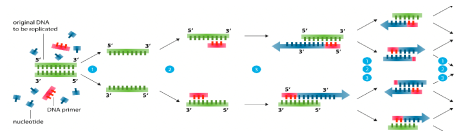
Polymerase chain reaction (PCR) is a laboratory technique used to amplify DNA sequences. The method involves using short DNA sequences called primers to select the portion of the genome to be amplified. The temperature of the sample is repeatedly raised and lowered to help a DNA replication enzyme copy the target DNA sequence. The technique can produce a billion copies of the target sequence in just a few hours.
Image
i. List the three steps involved in Polymerase Chain Reaction (PCR).
ii. Name the source organism of Taq polymerase.
iii. Explain the specific role of this enzyme in PCR.