Question
There is only one possible sequence of amino acids when deduced from a given nucleotide. But multiple nucleotide sequences can be deduced from a single amino acid sequence. Explain this phenomenon.

Answer

Some amino acids are coded by more than one codon (known as degeneracy of codon), hence on deducing a nucleotide sequence from an amino acid sequence, multiple nucleotide sequences will be obtained.
For example: isoleucine has three codons AUU, AUC and AUA. Hence a dipeptide Met-Ile can have any of the following nucleotide sequences:
  1. AUG - AUU
  2. AUG - AUC
  3. AUG - AUA
If we deduce amino acid sequences of the above nucleotide sequences, all the three will code for Met-Ile.

Need a full question paper?

Generate a complete, print-ready paper with questions like this in minutes — across 16+ boards, with answer keys.

Start Generating Free

Similar questions

  1. Describe the characteristics a cloning vector must possess.
  2. Why DNA cannot pass through the cell membrane? Explain. How is a bacterial cell made ‘competent’ to take up recombinant DNA from the medium?
Compare the life style of people living in the urban areas with those of rural areas and briefly describe how the life style affects their health.
Answer the following questions:
Why is haemophilia generally observed in human males? Explain the conditions under which a human female can be haemophilic.
Enumerate the points that have to be considered for successful bee-keeping.
What is Implantation? Describe the process of implantation with diagram.
  1. Explain with the help of Griffith’s experiment how the search for genetic material was conducted and what was the conclusion drawn?
  2. How did MacLeod, McCarty and Avery establish the biochemical nature of the so called ‘genetic material’ identified by Griffith in his experiment.
Compare and contrast the advantages and disadvantages of production of genetically modified crops.
Match the items in Column I with those in Column II
S.No.
Column I
S.No.
Column II
(A)
Standing crop
(i)
The amount of mineral nutrients in the soil at a given time
(B)
Standing state
(ii)
Sedementary cycle
(C)
Climax community
(iii)
Herbivores and carnivores
(D)
Primary producers
(iv)
In near equilibrium with the environment
(E)
Phosporus cycle
(v)
Mass of living matter in a trophic level at a given time
(F)
Secondary producers
(vi)
Phytoplanktons
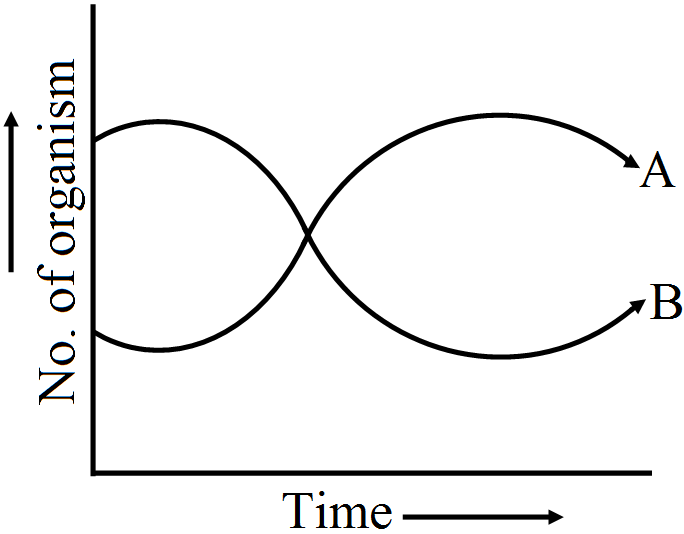
  1. The graph below represents the growth patterns of two types of aquatic organisms over a brief period of time in a water body, surrounded by agricultural land, extensively supplied with fertilisers. Identify the organisms that would represent: (i) A and (ii) B.
  2. State the reason for such a change in the water body and also write the term given to it.
No evidence was found on a crime scene, other than only a few hair strands. The inspector wants to proceed for DNA fingerprinting, but the amount of DNA is very less.
  1. In your opinion what could be the solution to this problem?
  2. Write the basic steps of this technique.
  3. Name the scientist who developed this technique.
  4. What values shown by the inspector?