MCQ
lmage formed by a convex mirror is
  • Virtual
  • B
    Real
  • C
    Enlarged
  • D
    Inverted

Answer

Correct option: A.
Virtual
Image formed by convex mirror is virtual for real object placed anywhere.

Need a full question paper?

Generate a complete, print-ready paper with questions like this in minutes — across 16+ boards, with answer keys.
Start Generating Free

Similar questions

One pico Farad is equal to
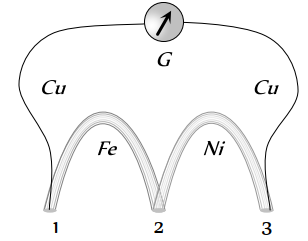
Three wires of copper, iron and nickel are joined to form three junctions as shown in Fig. When the temperature of junction 1 is kept $50^{\circ} C$ with the other two junctions at $0^{\circ} C$, the sensitive galvanometer gives a deflection of 14 divisions. When the temperature of junction 3 is kept $50^{\circ} C$, with the other two junctions at $0^{\circ} C$, the galvanometer gives a deflection of 11 divisions. Then the deflection given by the galvanometer, when temperature of the junction 2 is kept at $50^{\circ} C$, with the other two junctions at $0^{\circ} C$, will be

Image

One mole of a perfect gas in a cylinder fitted with a piston has a pressure $P$, volume $V$ and temperature $T$. If the temperature is increased by $1 K$ keeping pressure constant, the increase in volume is
Lenz's law gives
If particles are moving with same velocity, then maximum de-Broglie wavelength will be for
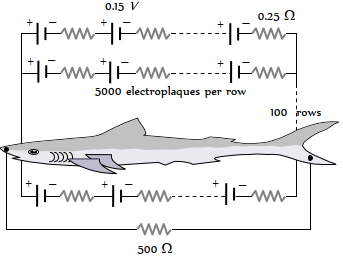
Eels are able to generate current with biological cells called electroplaques. The electroplaques in an eel are arranged in 100 rows, each row stretching horizontally along the body of the fish containing 5000 electroplaques. The arrangement is suggestively shown below. Each electroplaques has an emf of $0.15 \mathrm{~V}$ and internal resistance of $0.25 \Omega$

Image
The water surrounding the eel completes a circuit between the head and its tail. If the water surrounding it has a resistance of $500 \Omega$ the current an eel can produce in water is about

The layers of atmosphere are heated through
If the equation of transverse wave is $Y=2 \sin (k x-2 t)$, then the maximum particle velocity is
The source producing sound and an observer both are moving along the direction of propagation of sound waves. If the respective velocities of sound, source and an observer are $v, v_s$ and $v_o$, then the apparent frequency heard by the observer will be ( $n=$ frequency of sound)
A body of mass $5 \mathrm{~kg}$ moving with a velocity $10 \mathrm{~m} / \mathrm{s}$ collides with another body of the mass $20 \mathrm{~kg}$ at, rest and comes to rest. The velocity of the second body due to collision is