MCQ
If particles are moving with same velocity, then maximum de-Broglie wavelength will be for
  • A
    Neutron
  • B
    Proton
  • $\beta$-particle
  • D
    $\alpha$-particle

Answer

Correct option: C.
$\beta$-particle
$\lambda=\frac{h}{m v} \Rightarrow \lambda \propto \frac{1}{m}$

Need a full question paper?

Generate a complete, print-ready paper with questions like this in minutes — across 16+ boards, with answer keys.
Start Generating Free

Similar questions

Maximum useable frequency (MUF) in $F$-region layer is $x$, when the critical frequency is $60 \mathrm{MHz}$ and the angle of incidence is $70^{\circ}$. Then $x$ is
A motor boat is travelling with a speed of $3.0 \mathrm{~m} / \mathrm{sec}$. If the force on it due to water flow is $500 \mathrm{~N}$, the power of the boat is
A biconvex lens forms a real image of an object placed perpendicular to its principal axis. Suppose the radii of curvature of the lens tend to infinity. Then the image would
A particle is performing simple harmonic motion with amplitude $A$ and angular velocity $\omega$. The ratio of maximum velocity to maximum acceleration is
When a current of $5\ mA$ is passed through a galvanometer having a coil of resistance $15\ \Omega$, it shows full scale deflection. The value of the resistance to be put in series with the galvanometer to convert it into to voltmeter of range $0 - 10\ V$ is
If the radius of the earth were to shrink by $1 \%$ its mass remaining the same, the acceleration due to gravity on the earth's surface would
Which of the accompanying $P V$, diagrams best represents an isothermal process
A neutron makes a head-on elastic collision with a stationary deuteron. The fractional energy loss of the neutron in the collision is
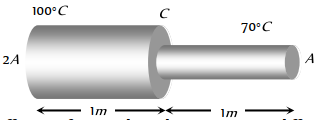
A metal rod of length $2 m$ has cross sectional areas $2 A$ and $A$ as shown in figure. The ends are maintained at temperatures $100^{\circ} \mathrm{C}$ and $70^{\circ} \mathrm{C}$. The temperature at middle point $C$ isImage
A body of mass $m$ having an initial velocity $v$, makes head on collision with a stationary body of mass $M$. After the collision, the body of mass $m$ comes to rest and only the body having mass $M$ moves. This will happen only when