Question
Locate the points $A (1, 2), B (4, 2)$ and $C (1, 4)$ on a graph sheet taking suitable axes. Write the coordinates of the fourth point $D$ to complete the rectangle $ABCD.$
Answer

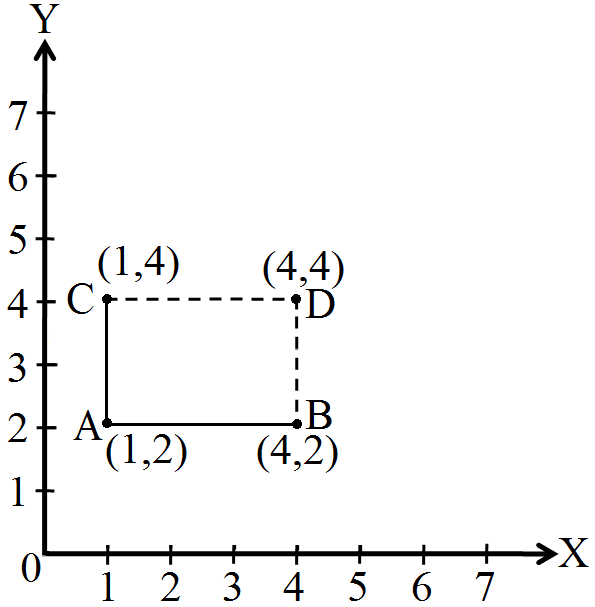
Given, points are $A (1, 2), B (4, 2)$ and $C (1, 4).$ Location of given points on the graph given below.
To complete the rectangle $ABCD$, the coordinates of the fourth point $D$ will be $(4, 4)$, i,e. $D (4, 4)$

Need a full question paper?

Generate a complete, print-ready paper with questions like this in minutes — across 16+ boards, with answer keys.

Start Generating Free

Similar questions

Write five numbers for which you cannot decide whether they are squares.
$1200$ men can finish a stock of food in $35$ days. How many more men should join them so that the same stock may last for $25$ days?
The weekly wages (in rupees) of 28 workers of a factory are given below: $668, 610, 642, 658, 668, 620, 719, 720, 700, 690, 710, 642, 672, 654, 692, 706, 718, 702, 704, 678, 615, 640, 680, 716, 705, 615, 636, 656$. Construct a frequency table with equal class intervals, taking the first of the class intervals as $610-630$, where $630$ is not included.
A swimming pool is $260\ m$ long and $140\ m$ wide. If $54600$ cubic metres of water is pumped into it, find the height of the water level in it.
How many bricks of size $22\ cm \times 10\ cm \times 7\ cm$ are required to construct a wall $11\ m$ long, $3.5\ m$ high and $40\ cm$ thick, if the cement and sand used in the construction occupy $\Big(\frac{1}{10}\Big)\text{th}$ part of the wall?
Find the square root of the following correct to three places of decimal: $5$
Write the prime factorization of the following numbers and hence find their square roots. $9604$
Multiply the following:

$\Big(\frac{3}{4}\text{x}-\frac{4}{3}\text{y}\Big),\Big(\frac{2}{3}\text{x}+\frac{3}{2}\text{y}\Big)$
Find a number that leaves a remainder of 2 when divided by 3, a remainder of 3 when divided by 4, and a remainder of 4 when divided by 5. What is the smallest such number? Can you give a simple explanation of why it is the smallest?
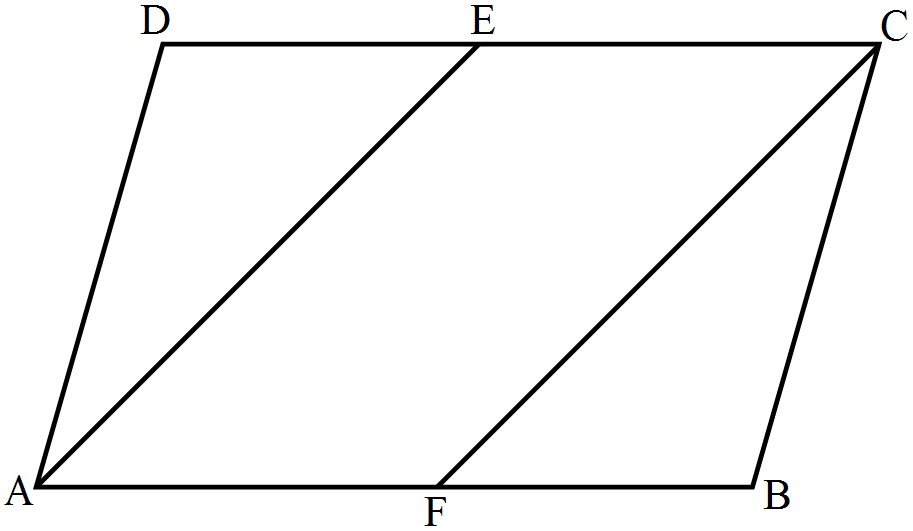
In the adjacent figure, $ABCD$ is a parallelogram and line segments $AE$ and $CF$ bisect the angles $A$ and $C$ respectively. Show that $AE\ ||\ CF$.