Question
Logarithmic differentiation is a powerful technique to differentiate functions of the form $\text{f}(\text{x})=[\text{u}(\text{x})]^{\text{v}(\text{x})},$ where both u(x) and v(x) are differentiable functions and f and u need to be positive functions. Let function $\text{y}=\text{f}(\text{x})=(\text{u}(\text{x}))^{\text{v}(\text{x})},$ then $\text{y}'=\text{y}\Big[\frac{\text{v}(\text{x})}{\text{u}(\text{x})}\text{u}'(\text{x})+\text{v}'(\text{x})\cdot\log[\text{u}(\text{x})]\Big]$ On the basis of above information, answer the following questions.
  1. Differentiate $x^x w.r.t. x.$
  1. $\text{x}^\text{x}(1+\log\text{x})$
  2. $\text{x}^\text{x}(1-\log\text{x})$
  3. $-\text{x}^\text{x}(1+\log\text{x})$
  4. $\text{x}^\text{x}\log\text{x}$
  1. Differentiate $x^x + a^{x }+ x^a + a^a w.r.t. x.$
  1. $(1+\log\text{x})+(\text{a}^\text{x}\log\text{a}+\text{ax}^{\text{a}-1})$
  2. $\text{x}^\text{x}(1+\log\text{x})+\log\text{a}+\text{ax}^{\text{a}-1}$
  3. $\text{x}^\text{x}(1+\log\text{x})+\text{x}^\text{a}\log\text{x}+\text{ax}^{\text{a}-1}$
  4. $\text{x}^\text{x}(1+\log\text{x})+\text{a}^\text{x}\log\text{a}+\text{ax}^{\text{a}-1}$
  1. If $\text{x}=\text{e}^\frac{\text{x}}{\text{y}},$ then find $\frac{\text{dy}}{\text{dx}}.$
  1. $-\frac{(\text{x}+\text{y})}{\text{x}\log\text{x}}$
  2. $-\frac{(\text{x}-\text{y})}{\text{x}\log\text{x}}$
  3. $\frac{(\text{x}+\text{y})}{\text{x}\log\text{x}}$
  4. $\frac{\text{x}-\text{y}}{\text{x}\log\text{x}}$
  1. If $y = (2 - x)^3(3 + 2x)^5,$ then find $\frac{\text{dy}}{\text{dx}}.$
  1. $(2-\text{x})^3(3+2\text{x})^5\Big[\frac{15}{3+2\text{x}}-\frac{8}{2-\text{x}}\Big]$
  2. $(2-\text{x})^3(3+2\text{x})^5\Big[\frac{15}{3+2\text{x}}+\frac{3}{2-\text{x}}\Big]$
  3. $(2-\text{x})^3(3+2\text{x})^5\Big[\frac{10}{3+2\text{x}}-\frac{3}{2-\text{x}}\Big]$
  4. $(2-\text{x})^3(3+2\text{x})^5\cdot\Big[\frac{10}{3+2\text{x}}+\frac{3}{2-\text{x}}\Big]$
  1. If $\text{y}=\text{x}^\text{x}\cdot\text{e}^{(2\text{x}+5)},$ then find $\frac{\text{dy}}{\text{dx}}.$
  1. $\text{x}^\text{x}\text{e}^{2\text{x}+5}$
  2. $\text{x}^\text{x}\text{e}^{2\text{x}+5}(3-\log\text{x})$
  3. $\text{x}^\text{x}\text{e}^{2\text{x}+5}(1-\log\text{x})$
  4. $\text{x}^\text{x}\text{e}^{2\text{x}+5}\cdot(3+\log\text{x})$
Answer

  1. $(a) \text{x}^\text{x}(1+\log\text{x})$
Let $\text{y}=\text{x}^\text{x}\Rightarrow\log\text{y}=\text{x}\log\text{x}$
$\Rightarrow\frac{1}{\text{y}}\frac{\text{dy}}{\text{dx}}=\frac{\text{d}}{\text{dx}}(\text{x}\log\text{x})$
$\Rightarrow\frac{\text{dy}}{\text{dx}}=\text{x}^\text{x}[1\times\log\text{x}+\text{x}\times\frac{1}{\text{x}}]$
$=\text{x}^\text{x}[1+\log\text{x}]$
  1. $(d) \text{x}^\text{x}(1+\log\text{x})+\text{a}^\text{x}\log\text{a}+\text{ax}^{\text{a}-1}$
  1. $(d) \frac{\text{x}-\text{y}}{\text{x}\log\text{x}}$
Given $\text{x}=\text{e}^\frac{\text{x}}{\text{y}}\Rightarrow\log\text{x}=\frac{\text{x}}{\text{y}}\log\text{e}\Rightarrow\text{y}\log\text{x}=\text{x}$
$\Rightarrow\text{y}\frac{1}{\text{x}}+(\log\text{x})\frac{\text{dy}}{\text{dx}}=1$
$\Rightarrow\frac{\text{dy}}{\text{dx}}=\Big(1-\frac{\text{y}}{\text{x}}\Big)\frac{1}{\log\text{x}}\Rightarrow\frac{1}{\text{x}\log\text{x}}(\text{x}-\text{y})$
  1. $(c) (2-\text{x})^3(3+2\text{x})^5\Big[\frac{10}{3+2\text{x}}-\frac{3}{2-\text{x}}\Big]$
$\text{y}=(2-\text{x})^3(3+2\text{x})^5$
$\Rightarrow\log\text{y}=\log(2-\text{x})^3+\log(3+2\text{x})^5$
$=3\log(2-\text{x})+5\log(3+2\text{x})$
$\Rightarrow\frac{1}{\text{y}}\frac{\text{dy}}{\text{dx}}=\frac{3\times(-1)}{2-\text{x}}+\frac{5}{3+2\text{x}}\times(2)$
$\Rightarrow\frac{\text{dy}}{\text{dx}}=(2-\text{x})^3(3+2\text{x})^5\Big[\frac{10}{3+2\text{x}}-\frac{3}{2-\text{x}}\Big]$
  1. $(d) \text{x}^\text{x}\text{e}^{2\text{x}+5}\cdot(3+\log\text{x})$

$\text{y}=\text{x}^\text{x}\cdot\text{e}^{(2\text{x}+5)}$
$\Rightarrow\log\text{y}=\text{x}\log\text{x}+(2\text{x}+5)$
$\Rightarrow\frac{1}{\text{y}}\cdot\frac{\text{dy}}{\text{dx}}=\Big(\text{x}\cdot\frac{1}{\text{x}}+\log\text{x}\Big)+2$
$\Rightarrow\frac{\text{dy}}{\text{dx}}=\text{x}^\text{x}\cdot\text{e}^{2\text{x}+5}\cdot(3+\log\text{x})$
Need a full question paper?

Generate a complete, print-ready paper with questions like this in minutes — across 16+ boards, with answer keys.

Start Generating Free

Similar questions

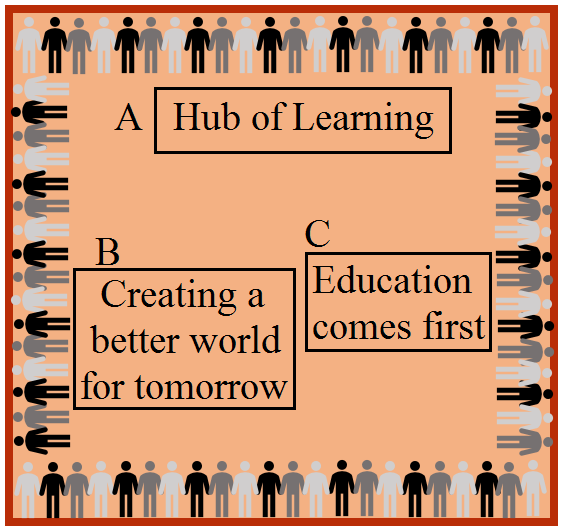
Three slogans on chart papers are to be placed on a school bulletin board at the points A, Band C displaying A (Hub of Learning), B (Creating a better world for tomorrow) and C (Education comes first). The coordinates of these points are (1, 4, 2), (3, -3, -2) and (-2, 2, 6) respectively.

Based on the above information, answer the following questions.
  1. Let $\vec{\text{a}},\vec{\text{b}}$ and $\vec{\text{c}}$ be the position vectors of points A, B and C respectively, then $\vec{\text{a}}+\vec{\text{b}}+\vec{\text{c}}$ is equal to:
  1. $2\hat{\text{i}}+3\hat{\text{j}}+6\hat{\text{k}}$
  2. $2\hat{\text{i}}-3\hat{\text{j}}-6\hat{\text{k}}$
  3. $2\hat{\text{i}}+8\hat{\text{j}}+3\hat{\text{k}}$
  4. $2(7\hat{\text{i}}+8\hat{\text{j}}+3\hat{\text{k}})$
  1. Which of the following is not true?
  1. $\overline{\text{AB}}+\overline{\text{BC}}+\overline{\text{CA}}=\vec{0}$
  2. $\overline{\text{AB}}+\overline{\text{BC}}-\overline{\text{AC}}=\vec{0}$
  3. $\overline{\text{AB}}+\overline{\text{BC}}-\overline{\text{CA}}=\vec{0}$
  4. $\overline{\text{AB}}-\overline{\text{CB}}+\overline{\text{CA}}=\vec{0}$
  1. Area of $\triangle\text{ABC}$ is:
  1. 19 sq. units
  2. $\sqrt{1937}\text{sq}.\text{units}$
  3. $\frac{1}{2}\sqrt{1937}\text{sq}.\text{units}$
  4. $\sqrt{1837}\text{sq}.\text{units}$
  1. Suppose, if the given slogans are to be placed on a straight line, then the value of $|\vec{\text{a}}\times\vec{\text{b}}+\vec{\text{b}}\times\vec{\text{c}}+\vec{\text{c}}\times\vec{\text{a}}|$ will be equal to:
  1. -1
  2. -2
  3. 2
  4. 0
  1. If $\vec{\text{a}}=2\hat{\text{i}}+3\hat{\text{j}}+6\hat{\text{k}},$ then unit vector in the direction of vector $\vec{\text{a}}$ is:
  1. $\frac{2}{7}\hat{\text{i}}-\frac{3}{7}\hat{\text{j}}-\frac{6}{7}\hat{\text{k}}$
  2. $\frac{2}{7}\hat{\text{i}}+\frac{3}{7}\hat{\text{j}}+\frac{6}{7}\hat{\text{k}}$
  3. $\frac{3}{7}\hat{\text{i}}+\frac{2}{7}\hat{\text{j}}+\frac{6}{7}\hat{\text{k}}$
  4. None of these
A differential equation is said to be in the variable separable form if it is expressible in the form $f(x) dx = g(y) dy.$
The solution of this equation is given by
$\int\text{f(x)dx}=\int\text{g(y)dy}+\text{c},$ where $c$ is the constant of integration.
Based on the above information, answer the following questions.
  1. If the solution of the differential equation $\frac{\text{dy}}{\text{dx}}=\frac{\text{ax+3}}{\text{2y+f}}$ represents a circle, then the value of $'a\ '$ is:
  1. $2$
  2. $-2$
  3. $3$
  4. $-4$
  1. The differential equation $\frac{\text{dy}}{\text{dx}}=\frac{\sqrt{1-\text{y}^2}}{\text{y}}$ determines a family of circle with.
  1. Variable radii and fixed centre $(0, 1)$
  2. Variable radii and fixed centre $(0, -1)$
  3. Fixed radius $1$ and variable centre on $x-$ axis
  4. Fixed radius $1$ and variable centre on $y-$ axis
  1. If $= y'+ 1, y(0) = 1,$ then $y (In 2) =$
  1. $1$
  2. $2$
  3. $3$
  4. $4$
  1. The solution of the differential equation $\frac{\text{dy}}{\text{dx}}=\text{e}^\text{x-y}+\text{x}^2\text{e}^\text{-y}$ is:
  1. $\text{e}^\text{x}=\frac{\text{y}^3}{3}+\text{e}^\text{y}+\text{c}$
  2. $\text{e}^\text{y}=\frac{\text{x}^2}{3}+\text{e}^\text{x}+\text{c}$
  3. $\text{e}^\text{y}=\frac{\text{x}^3}{3}+\text{e}^\text{x}+\text{c}$
  4. None of these
  1. If $\frac{\text{dy}}{\text{dx}}=\text{y}\sin2\text{x},\ \text{y}(0)=1,$ then its solution is:
  1. $\text{y}=\text{e}^{\sin^2}\text{x}$
  2. $\text{y}={\sin^2}\text{x}$
  3. $\text{y}={\cos^2}\text{x}$
  4. $\text{y}=\text{e}^{\cos^2}\text{x}$
A student is preparing for the competitive examinations LIC AAO, SSC CGL and Bank P.O. The probabilities that the student is selected independently in competitive examination of LIC AAO, SSC CGL and Bank P.O. are a, band c respectively. Of these examinations, students has 50% chance of selection in at least one, 40% chance of selection in at least two and 30% chance of selection in exactly two examinations.

Based on the above information, answer the following questions.
  1. The value of a+ b + e - ab - be - ca + abe is:
  1. 0.3
  2. 0.5
  3. 0.7
  4. 0.6
  1. The value of ab + be + ae - 2abe is:
  1. 0.5
  2. 0.3
  3. 0.4
  4. 0.6
  1. The value of abe is:
  1. 0.1
  2. 0.5
  3. 0.7
  4. 0.3
  1. The value of ab + be + ae is:
  1. 0.1
  2. 0.6
  3. 0.5
  4. 0.3
  1. The value of a + b + e is:
  1. 1
  2. 1.5
  3. 1.6
  4. 1.4
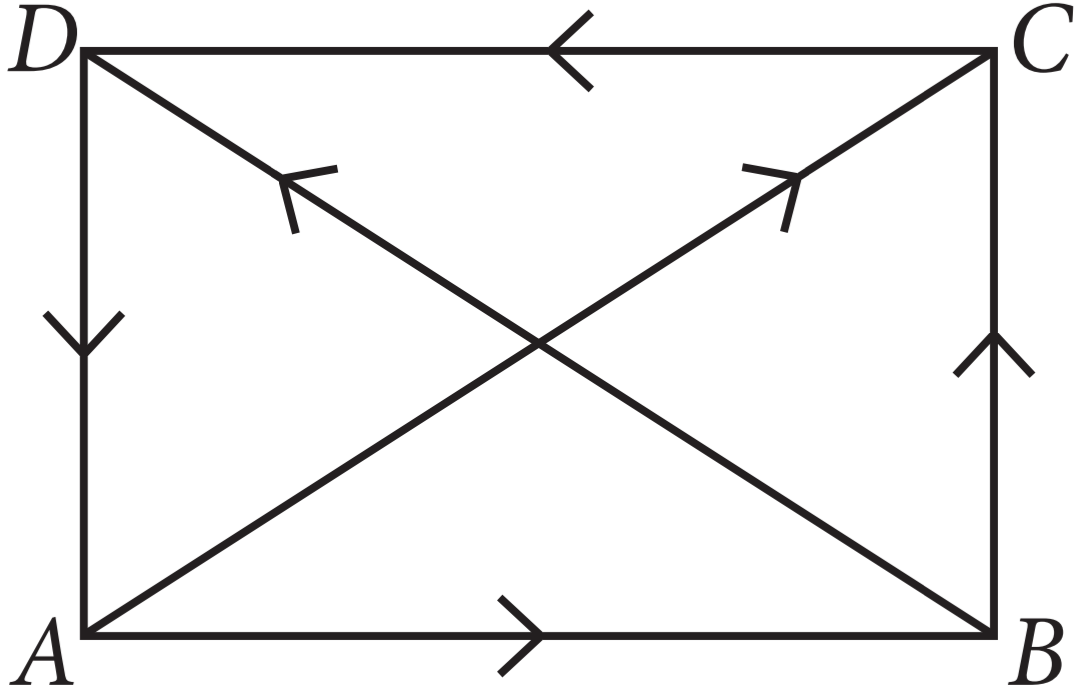
If two vectors are represented by the two sides of a triangle taken in order, then their sum is represented by the third side of the triangle taken in opposite order and this is known as triangle law of vector addition. Based on the above information, answer the following questions.
  1. If $\vec{\text{p}},\vec{\text{q}},\vec{\text{r}}$ are the vectors represented by the sides of a triangle taken in order, then $\vec{\text{q}},+\vec{\text{r}}=$
  1. $\vec{\text{p}}$
  2. $2\vec{\text{p}}$
  3. $-\vec{\text{p}}$
  4. None of these
  1. If ABCD is a parallelogram and AC and BD are its diagonals, then $\overline{\text{AC}}+\overline{\text{BD}}=$
  1. $2\overline{\text{DA}}$
  2. $2\overline{\text{AB}}$
  3. $2\overline{\text{BC}}$
  4. $2\overline{\text{BD}}$
  1. If ABCD is a parallelogram, where $\overline{\text{AB}}=2\vec{\text{a}}$ and $\overline{\text{BC}}=2\vec{\text{b}},$ then $\overline{\text{AC}}-\overline{\text{BD}}=$
  1. $3\vec{\text{a}}$
  2. $4\vec{\text{a}}$
  3. $2\vec{\text{b}}$
  4. $4\vec{\text{b}}$
  1. If ABCD is a quadrilateral whose diagonals are $\overline{\text{AC}}$ and $\overline{\text{BD}},$ then $\overline{\text{BA}}+\overline{\text{DC}}=$
  1. $\overline{\text{AC}}+\overline{\text{DB}}$
  2.  $\overline{\text{AC}}+\overline{\text{BD}}$
  3. $\overline{\text{BC}}+\overline{\text{AD}}$
  4. $\overline{\text{BD}}+\overline{\text{CA}}$
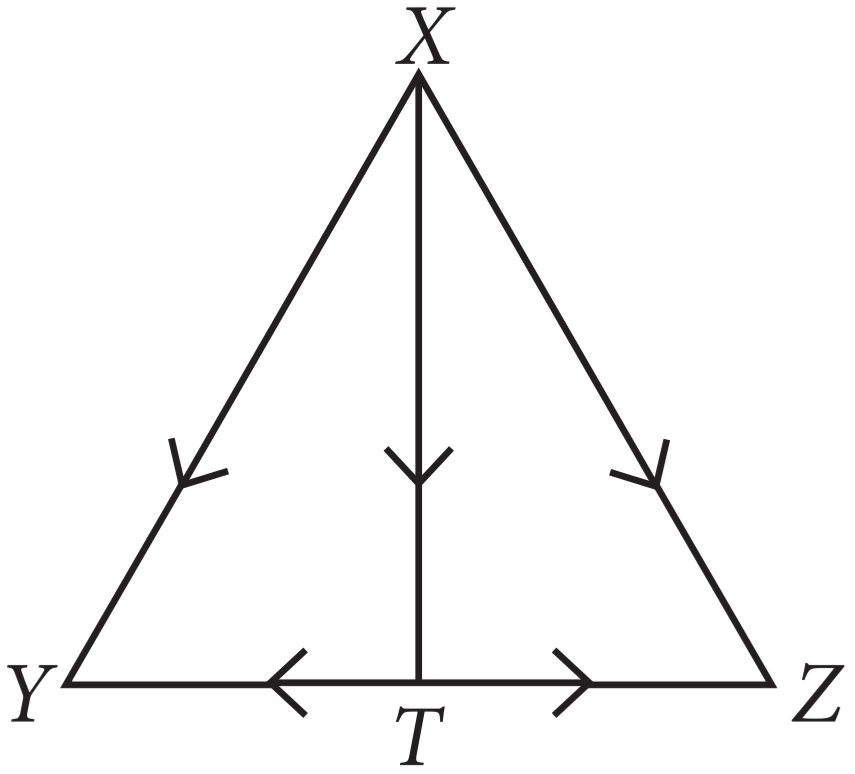
  1. If T is the mid point of side YZ of $\triangle\text{XYZ},$ then $\overline{\text{XY}}+\overline{\text{XZ}}=$
  1. $2\overline{\text{YT}}$
  2. $2\overline{\text{XT}}$
  3. $2\overline{\text{TZ}}$
  4. None of these
Three car dealers, say A, B and C, deals in three types of cars, namely Hatchback cars, Sedan cars, SUV cars. The sales figure of 2019 and 2020 showed that dealer A sold 120 Hatchback, 50 Sedan, 10 SUV cars in 2019 and 300 Hatchback, 150 Sedan, 20 SUV cars in 2020; dealer B sold 100 Hatchback, 30 Sedan, 5 SUV cars in 2019 and 200 Hatchback, 50 Sedan, 6 SUV cars in 2020; dealer C sold 90 Hatchback, 40 Sedan, 2 SUV cars in 2019 and 100 Hatchback, 60 Sedan, 5 SUV cars in 2020.

Image

(i) Write the matrix summarizing sales data of 2019 and 2020.

(ii) Find the matrix summarizing sales data of 2020.

(iii) Find the total number of cars sold in two given years, by each dealer?

OR

If each dealer receives a profit of ₹ 50000 on sale of a Hatchback, ₹100000 on sale of a Sedan and ₹200000 on sale of an SUV, then find the amount of profit received in the year 2020 by each dealer.

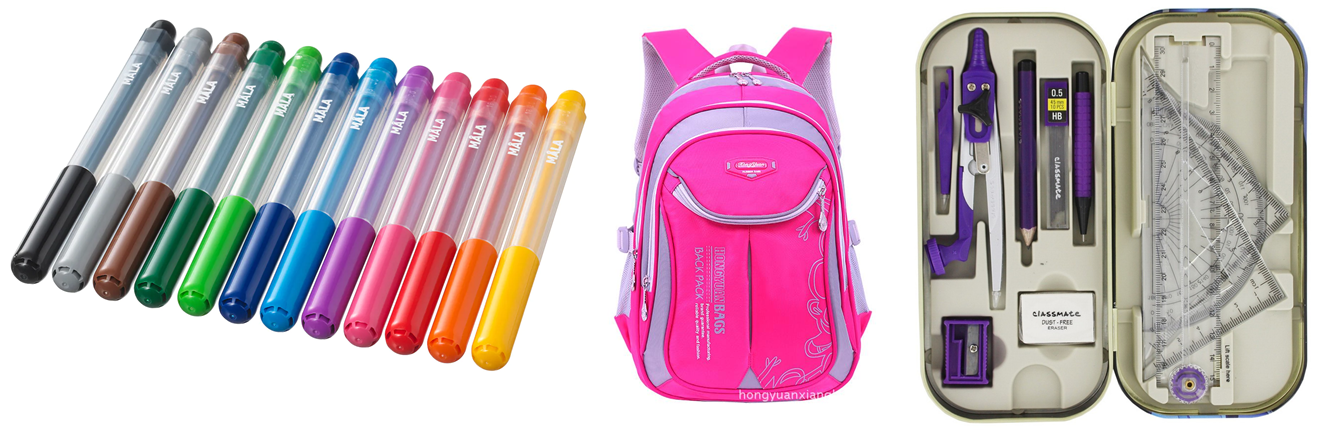
Gaurav purchased $5$ pens, $3$ bags and $1$ instrument box and pays $₹ \ 16.$ From the same shop, Dheeraj purchased $2$ pens, 1 bag and $3$ instrument boxes and pays $₹ \ 19,$ while Ankur purchased $1$ pen, $2$ bags and $4$ instrument boxes and pays $₹ \ 25.$

Using the concept of matrices and determinants, answer the following questions.
  1. The cost of one pen is:
  1. $₹ \ 2$
  2. $₹ \ 5$
  3. $₹ \ 1$
  4. $₹ \ 3$
  1. What is the cost of one pen and one bag?
  1. $₹ \ 3$
  2. $₹ \ 5$
  3. $₹ \ 7$
  4. $₹ \ 8$
  1. What is the cost of one pen and one instrument box?
  1. $₹ \ 7$
  2. $₹ \ 6$
  3. $₹ \ 8$
  4. $₹ \ 9$
  1. Which of the following is correct?
  1. Determinant is a square matrix.
  2. Determinant is a number associated to a matrix.
  3. Determinant is a number associated to a square matrix.
  4. All of the above.
  1. From the matrix equation $AB = AC,$ it can be concluded that $B = C$ provided:
  1. $A$ is singular.
  2. $A$ is non$-$singular.
  3. $A$ is symmetric.
  4. $A$ is square.
Read the following passage and answer the questions given below. 

Image

The temperature of a person during an intestinal illness is given by $f(x)=-0.1 x^2+m x+98.6,0 \leq x \leq 12, \mathrm{~m}$ being a constant, where $\mathrm{f}(\mathrm{x})$ is the temperature in ${ }^{\circ} \mathrm{F}$ at $x$ days.

(i) Is the function differentiable in the interval $(0,12)$ ? Justify your answer.

(ii) If 6 is the critical point of the function, then find the value of the constant $\mathrm{m}$.

(iii) Find the intervals in which the function is strictly increasing/strictly decreasing.
OR
(iii) Find the points of local maximum/local minimum, if any, in the interval (0, 12) as well as the points of absolute maximum/absolute minimum in the interval [0, 12]. Also, find the corresponding local maximum/local minimum and the absolute maximum/absolute minimum values of the function. 

To hire a marketing manager, it's important to find a way to properly assess candidates who can bring radical changes and has leadership experience. Ajay, Ramesh and Ravi attend the interview for the post of a marketing manager.
Ajay, Ramesh and Ravi chances of being selected as the manager of a firm are in the ratio $4: 1: 2$ respectively. The respective probabilities for them to introduce a radical change in marketing strategy are $0.3,0.8$, and 0.5 . If the change does take place.

Image

(i) Find the probability that it is due to the appointment of Ajay (A).

(ii) Find the probability that it is due to the appointment of Ramesh (B).

An organization conducted bike race under $2$ different categories$-$boys and girls. In all, there were $250$ participants. Among all of them finally three from Category $1$ and two from Category $2$ were selected for the final race. Ravi forms two sets $B$ and $G$ with these participants for his college project.
Let $B =\left\{b_1, b_2, b_3\right\}, G =\left\{g_1, g_2\right\}$ where $B$ represents the set of boys selected and $G$ the set of girls who were selected for the final race.
Ravi decides to explore these sets for various types of relations and functions.
On the basis of the above information, answer the following questions:
$(i)$ Ravi wishes to form all the relations possible from $B$ to $G$. How many such relations are possible?
$(ii)$ Among these relations, how many are functions from $B$ to $G$ ?
$OR$
$(iii) (b)$ If the track of the final race $($for the biker $b_1)$ follows the curve
$x^2=4 y ;($ where $0 \leq x \leq 20 \sqrt{2} \ 0 \leq y \leq 200)$,then state whether the track represents a one$-$one and onto function or not. $($Justify$).$
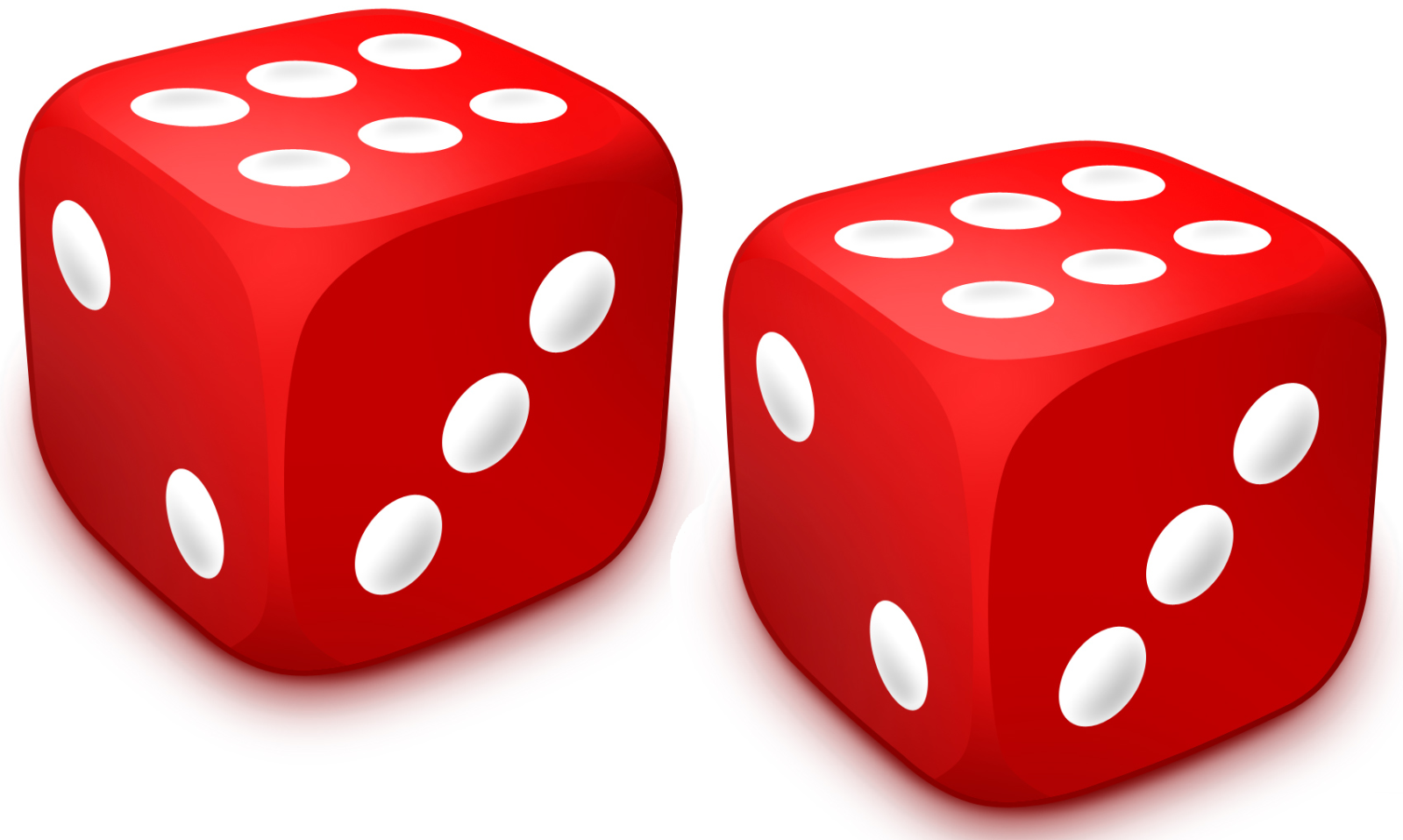
Varun and Jsha decided to play with dice to keep themselves busy at home as their schools are closed due to coronavirus pandemic. Varun throw a dice repeatedly until a six is obtained. He denote the number of throws required by X.
Based on the above information, answer the following questions.
  1. The probability that X = 2 equals.
  1. $\frac{1}{6}$
  2. $\frac{5}{6^2}$
  3. $\frac{5}{3^6}$
  4. $\frac{1}{6^3}$
  1. The probability that X = 4 equals.
  1. $\frac{1}{6^4}$
  2. $\frac{1}{6^6}$
  3. $\frac{5^3}{6^4}$
  4. $\frac{5}{6^4}$
  1. The probability that $\text{X}\geq2$ equals.
  1. $\frac{25}{216}$
  2. $\frac{1}{36}$
  3. $\frac{5}{6}$
  4. $\frac{25}{36}$
  1. The value of $\text{P}(\text{X}\geq6)$ is:
  1. $\frac{5^5}{6^5}$
  2. $1-\frac{5^3}{6^5}$
  3. $\frac{5^3\times61}{6^5}$
  4. $\frac{5^3}{6^4}$
  1. The probability that X > 3 equals.
  1. $\frac{36}{25}$
  2. $\frac{5^2}{6^2}$
  3. $\frac{5}{6}$
  4. $\frac{5^3}{6^3}$