Question
Logarithmic differentiation is a powerful technique to differentiate functions of the form $\text{f}(\text{x})=[\text{u}(\text{x})]^{\text{v}(\text{x})},$ where both u(x) and v(x) are differentiable functions and f and u need to be positive functions. Let function $\text{y}=\text{f}(\text{x})=(\text{u}(\text{x}))^{\text{v}(\text{x})},$ then $\text{y}'=\text{y}\Big[\frac{\text{v}(\text{x})}{\text{u}(\text{x})}\text{u}'(\text{x})+\text{v}'(\text{x})\cdot\log[\text{u}(\text{x})]\Big]$ On the basis of above information, answer the following questions.
  1. Differentiate $x^x$ w.r.t. x.
  1. $\text{x}^\text{x}(1+\log\text{x})$
  2. $\text{x}^\text{x}(1-\log\text{x})$
  3. $-\text{x}^\text{x}(1+\log\text{x})$
  4. $\text{x}^\text{x}\log\text{x}$
  1. Differentiate $x^x + a^x+ x^a + a^a$ w.r.t. x.
  1. $(1+\log\text{x})+(\text{a}^\text{x}\log\text{a}+\text{ax}^{\text{a}-1})$
  2. $\text{x}^\text{x}(1+\log\text{x})+\log\text{a}+\text{ax}^{\text{a}-1}$
  3. $\text{x}^\text{x}(1+\log\text{x})+\text{x}^\text{a}\log\text{x}+\text{ax}^{\text{a}-1}$
  4. $\text{x}^\text{x}(1+\log\text{x})+\text{a}^\text{x}\log\text{a}+\text{ax}^{\text{a}-1}$
  1. If $\text{x}=\text{e}^\frac{\text{x}}{\text{y}},$ then find $\frac{\text{dy}}{\text{dx}}.$
  1. $-\frac{(\text{x}+\text{y})}{\text{x}\log\text{x}}$
  2. $-\frac{(\text{x}-\text{y})}{\text{x}\log\text{x}}$
  3. $\frac{(\text{x}+\text{y})}{\text{x}\log\text{x}}$
  4. $\frac{\text{x}-\text{y}}{\text{x}\log\text{x}}$
  1. If $y = (2 - x)^3(3 + 2x)^5$, then find $\frac{\text{dy}}{\text{dx}}.$
  1. $(2-\text{x})^3(3+2\text{x})^5\Big[\frac{15}{3+2\text{x}}-\frac{8}{2-\text{x}}\Big]$
  2. $(2-\text{x})^3(3+2\text{x})^5\Big[\frac{15}{3+2\text{x}}+\frac{3}{2-\text{x}}\Big]$
  3. $(2-\text{x})^3(3+2\text{x})^5\Big[\frac{10}{3+2\text{x}}-\frac{3}{2-\text{x}}\Big]$
  4. $(2-\text{x})^3(3+2\text{x})^5\cdot\Big[\frac{10}{3+2\text{x}}+\frac{3}{2-\text{x}}\Big]$
  1. If $\text{y}=\text{x}^\text{x}\cdot\text{e}^{(2\text{x}+5)},$ then find $\frac{\text{dy}}{\text{dx}}.$
  1. $\text{x}^\text{x}\text{e}^{2\text{x}+5}$
  2. $\text{x}^\text{x}\text{e}^{2\text{x}+5}(3-\log\text{x})$
  3. $\text{x}^\text{x}\text{e}^{2\text{x}+5}(1-\log\text{x})$
  4. $\text{x}^\text{x}\text{e}^{2\text{x}+5}\cdot(3+\log\text{x})$
Answer

  1. (a) $\text{x}^\text{x}(1+\log\text{x})$
Solution:
Let $\text{y}=\text{x}^\text{x}\Rightarrow\log\text{y}=\text{x}\log\text{x}$
$\Rightarrow\frac{1}{\text{y}}\frac{\text{dy}}{\text{dx}}=\frac{\text{d}}{\text{dx}}(\text{x}\log\text{x})$
$\Rightarrow\frac{\text{dy}}{\text{dx}}=\text{x}^\text{x}[1\times\log\text{x}+\text{x}\times\frac{1}{\text{x}}]$
$=\text{x}^\text{x}[1+\log\text{x}]$
  1. (d) $\text{x}^\text{x}(1+\log\text{x})+\text{a}^\text{x}\log\text{a}+\text{ax}^{\text{a}-1}$
  1. (d) $\frac{\text{x}-\text{y}}{\text{x}\log\text{x}}$
Solution:
Given $\text{x}=\text{e}^\frac{\text{x}}{\text{y}}\Rightarrow\log\text{x}=\frac{\text{x}}{\text{y}}\log\text{e}\Rightarrow\text{y}\log\text{x}=\text{x}$
$\Rightarrow\text{y}\frac{1}{\text{x}}+(\log\text{x})\frac{\text{dy}}{\text{dx}}=1$
$\Rightarrow\frac{\text{dy}}{\text{dx}}=\Big(1-\frac{\text{y}}{\text{x}}\Big)\frac{1}{\log\text{x}}\Rightarrow\frac{1}{\text{x}\log\text{x}}(\text{x}-\text{y})$
  1. (c) $(2-\text{x})^3(3+2\text{x})^5\Big[\frac{10}{3+2\text{x}}-\frac{3}{2-\text{x}}\Big]$
Solution:
$\text{y}=(2-\text{x})^3(3+2\text{x})^5$
$\Rightarrow\log\text{y}=\log(2-\text{x})^3+\log(3+2\text{x})^5$
$=3\log(2-\text{x})+5\log(3+2\text{x})$
$\Rightarrow\frac{1}{\text{y}}\frac{\text{dy}}{\text{dx}}=\frac{3\times(-1)}{2-\text{x}}+\frac{5}{3+2\text{x}}\times(2)$
$\Rightarrow\frac{\text{dy}}{\text{dx}}=(2-\text{x})^3(3+2\text{x})^5\Big[\frac{10}{3+2\text{x}}-\frac{3}{2-\text{x}}\Big]$
  1. (d) $\text{x}^\text{x}\text{e}^{2\text{x}+5}\cdot(3+\log\text{x})$
Solution:
$\text{y}=\text{x}^\text{x}\cdot\text{e}^{(2\text{x}+5)}$
$\Rightarrow\log\text{y}=\text{x}\log\text{x}+(2\text{x}+5)$
$\Rightarrow\frac{1}{\text{y}}\cdot\frac{\text{dy}}{\text{dx}}=\Big(\text{x}\cdot\frac{1}{\text{x}}+\log\text{x}\Big)+2$
$\Rightarrow\frac{\text{dy}}{\text{dx}}=\text{x}^\text{x}\cdot\text{e}^{2\text{x}+5}\cdot(3+\log\text{x})$
Need a full question paper?

Generate a complete, print-ready paper with questions like this in minutes — across 16+ boards, with answer keys.

Start Generating Free

Similar questions

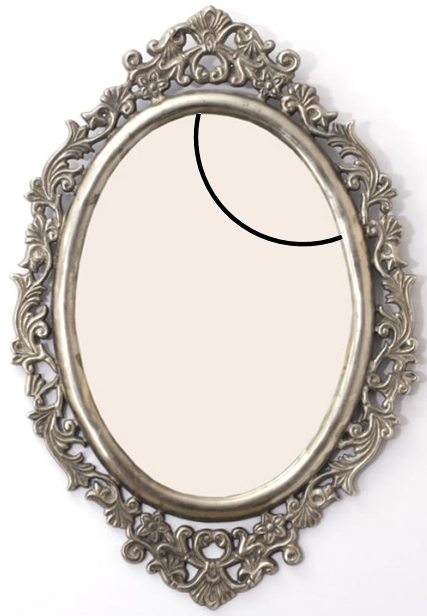
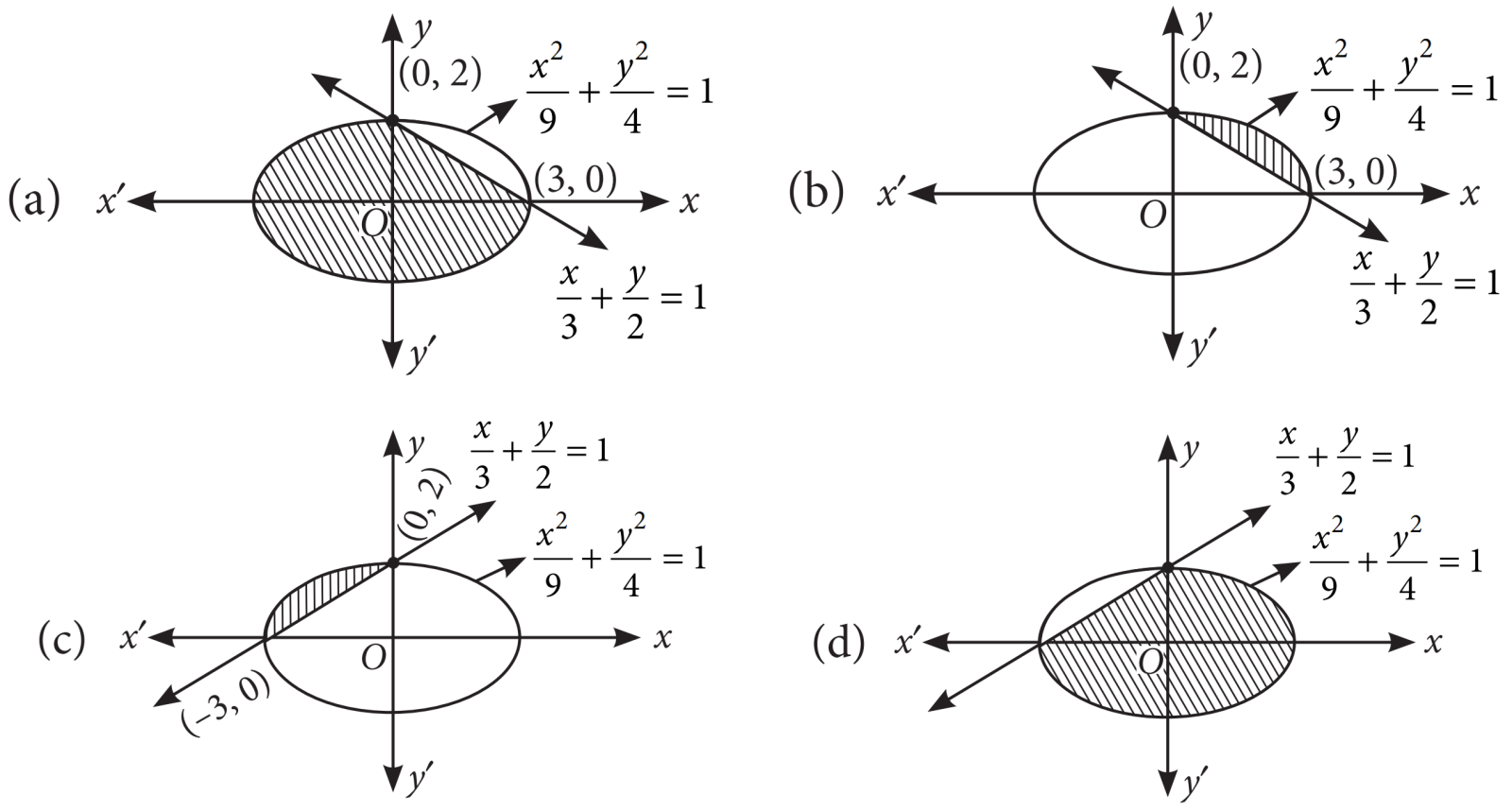
A mirror in the shape of an ellipse represented by $\frac{\text{x}^2}{9}+-\frac{\text{y}^2}{4}=1$ was hanging on the wall. Arun and his sister were playing with ball inside the house, even their mother refused to do so. All of sudden, ball hit the mirror and got a scratch in the shape of line represented by $\frac{\text{x}}{3}+\frac{\text{y}}{2}=1$

Based on the above information, answer the following questions.
  1. Point(s) of intersection of ellipse and scratch (straight line) is (are).
  1. (0, 2), (3, 0)
  2. (2, 0), (3, 0)
  3. (2, 3), (0, 0)
  4. (0, 3), (3, 0)
  1. Area of smaller region bounded by the ellipse and line is represented by.
  1. The value of $\frac{2}{3}\int\limits_{0}^{3}\sqrt{9-\text{x}^2}\text{dx}$ is.
    1. $\frac{\pi}{2}$
    2. $\pi$
    3. $\frac{3\pi}{2}$
    4. $\frac{\pi}{4}$
  1. The value of $2\int\limits_{0}^{3}\bigg(1-\frac{\text{x}}{3}\bigg)\text{dx}$ is.
    1. 0
    2. 1
    3. 2
    4. 3
  1. Area of the smaller region bounded by the mirror and scratch is.
  1. $3\Big(\frac{\pi}{2}+1\Big)\text{ sq.units}$
  2. $\Big(\frac{\pi}{2}+1\Big)\text{ sq.units}$
  3. $\Big(\frac{\pi}{2}-1\Big)\text{ sq.units}$
  4. $3\Big(\frac{\pi}{2}-1\Big)\text{ sq.units}$
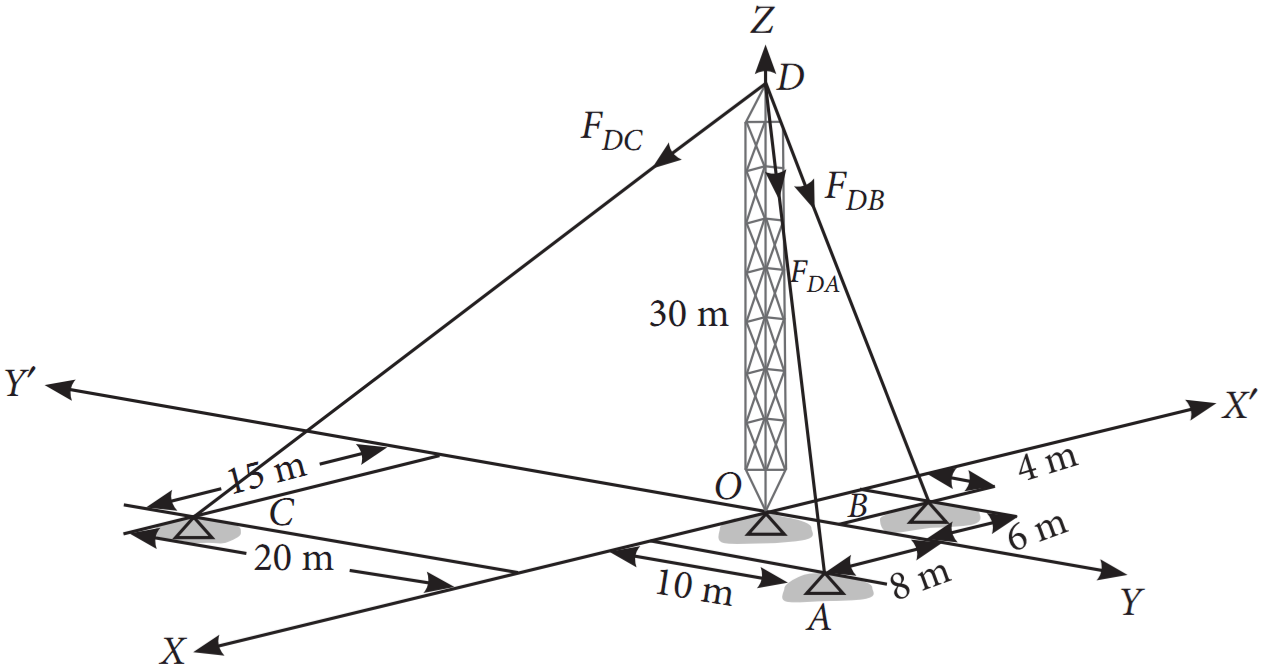
Consider the following diagram, where the forces in the cable are given. Based on the above information, answer the following questions.
  1. The equation of line along the cable AD is:
  1. $\frac{\text{x}}{5}=\frac{\text{y}}{4}=\frac{\text{z}-30}{15}$
  2. $\frac{\text{x}}{4}=\frac{\text{y}}{5}=\frac{\text{z}-30}{15}$
  3. $\frac{\text{x}}{5}=\frac{\text{y}}{4}=\frac{30-\text{z}}{15}$
  4. $\frac{\text{x}}{4}=\frac{\text{y}}{5}=\frac{30-\text{z}}{15}$
  1. The length of cable DC is:
  1. $4\sqrt{61}\text{m}$
  2. $5\sqrt{61}\text{m}$
  3. $6\sqrt{61}\text{m}$
  4. $7\sqrt{61}\text{m}$
  1. The vector DB is:
  1. $-6\hat{\text{i}}+4\hat{\text{j}}-30\hat{\text{k}}$
  2. $6\hat{\text{i}}-4\hat{\text{j}}+30\hat{\text{k}}$
  3. $6\hat{\text{i}}+4\hat{\text{j}}+30\hat{\text{k}}$
  4. None of these
  1. The sum of vectors along the cables is:
  1. $17\hat{\text{i}}+6\hat{\text{j}}+90\hat{\text{k}}$
  2. $17\hat{\text{i}}-6\hat{\text{j}}-90\hat{\text{k}}$
  3. $17\hat{\text{i}}+6\hat{\text{j}}-90\hat{\text{k}}$
  4. None of these
  1. The sum of distances of points A, B and C from the origin, i.e., OA + OB + OC is:
  1. $\sqrt{164}+\sqrt{52}+\sqrt{625}$
  2. $\sqrt{52}+\sqrt{625}+\sqrt{48}$
  3. $\sqrt{164}+\sqrt{625}+\sqrt{49}$
  4. None of these
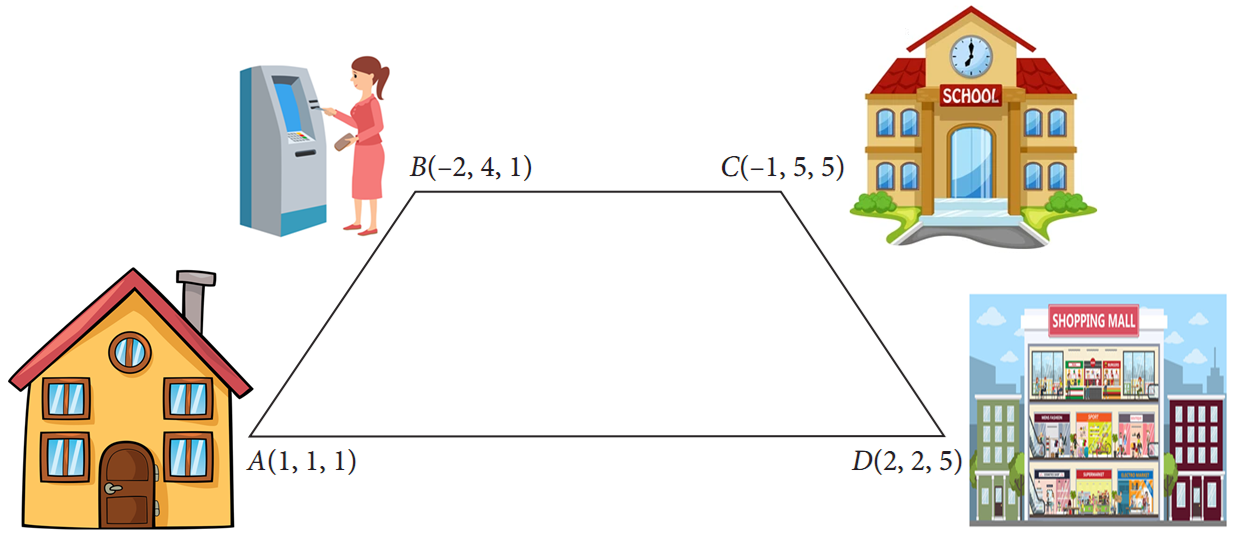
Ritika starts walking from his house to shopping mall. Instead of going to the mall directly, she first goes to a ATM, from there to her daughter's school and then reaches the mall. ln the diagram, A, B, C, and D represent the coordinates of House, ATM, School and Mall respectively.

Based on the above information, answer the following questions.
  1. Distance between House (A) and ATM (B) is:
  1. $3\text{ units}$
  2. $3\sqrt{2}\text{ units}$
  3. $\sqrt{2}\text{ units}$
  4. $4\sqrt{2}\text{ units}$
  1. Distance between ATM (B) and School (C) is:
  1. $\sqrt{2}\text{ units}$
  2. $2\sqrt{2}\text{ units}$
  3. $3\sqrt{2}\text{ units}$
  4. $4\sqrt{2}\text{ units}$
  1. Distance between School (C) and Shopping mall (D) is:
  1. $3\sqrt{2}\text{ units}$
  2. $5\sqrt{2}\text{ units}$
  3. $7\sqrt{2}\text{ units}$
  4. $10\sqrt{2}\text{ units}$
  1. What is the total distance travelled by Ritika:
  1. $4\sqrt{2}\text{ units}$
  2. $6\sqrt{2}\text{ units}$
  3. $8\sqrt{2}\text{ units}$
  4. $9\sqrt{2}\text{ units}$
  1. What is the extra distance travelled by Ritika in reaching the shopping mall?
  1. $3\sqrt{2}\text{ units}$
  2. $5\sqrt{2}\text{ units}$
  3. $6\sqrt{2}\text{ units}$
  4. $7\sqrt{2}\text{ units}$
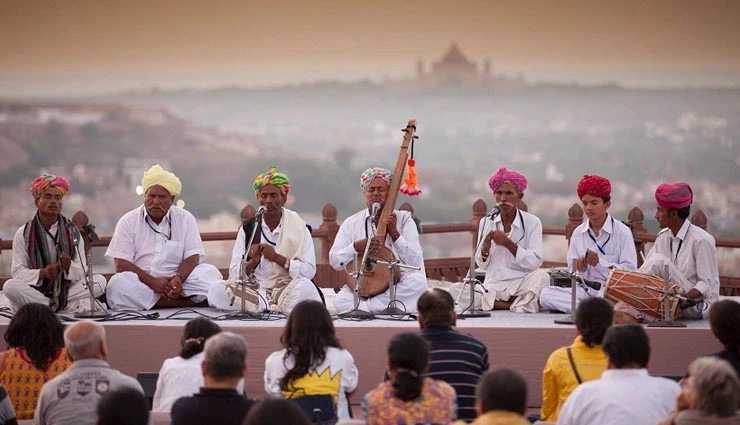
One day, a sangeet mahotsav is to be organised in an open area of Rajasthan. ln recent years, it has rained only $6$ days each year. Also, it is given that when it actually rains, the weatherman correctly forecasts rain 80% of the time. When it doesn't rain, he incorrectly forecasts rain $20\%$ of the time.

If leap year is considered, then answer the following questions.
  1. The probability that it rains on chosen day is:
  1. $\frac{1}{366}$
  2. $\frac{1}{73}$
  3. $\frac{1}{60}$
  4. $\frac{1}{61}$
  1. The probability that it does not rain on chosen day is:
  1. $\frac{1}{366}$
  2. $\frac{5}{366}$
  3. $\frac{360}{366}$
  4. None of these.
  1. The probability that the weatherman predicts correctly is:
  1. $\frac{5}{6}$
  2. $\frac{7}{8}$
  3. $\frac{4}{5}$
  4. $\frac{1}{5}$
  1. The probability that it will rain on the chosen day, if weatherman predict rain for that day, is:
  1. $0.0625$
  2. $0.0725$
  3. $0.0825$
  4. $0.0925$
  1. The probability that it will not rain on the chosen day, if weatherman predict rain for that day, is:
  1. $0.94$
  2. $0.84$
  3. $0.74$
  4. $0.64$
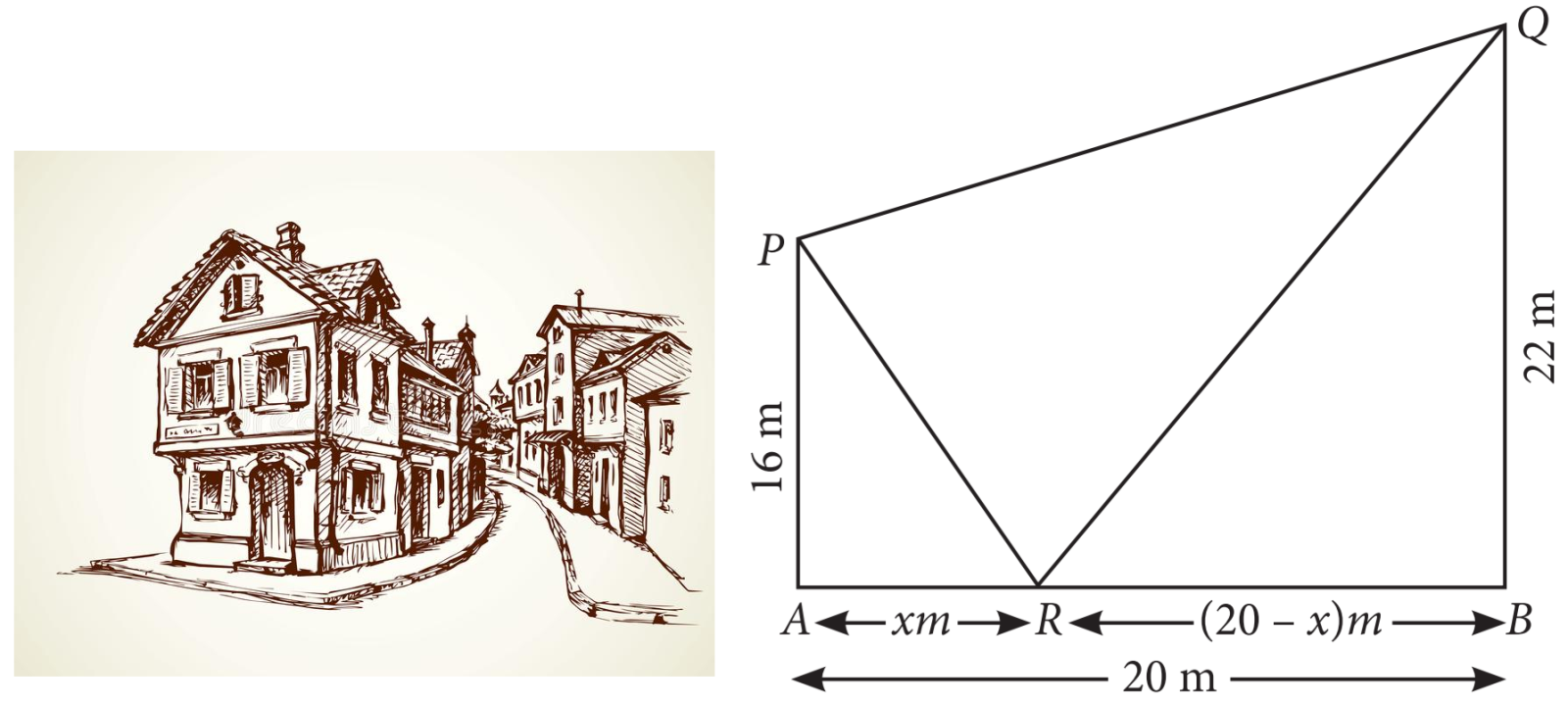
Two multi-storey buildings $($represented by $AP$ and $BQ)$ are on opposite side of a $20m$ wide road at point $A$ and $B$ respectively. There is a point $R$ on road as shown in figure.

Based on the above information, answer the following questions.

  1. Area of trapezium $ABQP$ is.
  1. $380$ sq. m
  2. $280$ sq. m
  3. $320$ sq. m
  4. $430$ sq. m
  1. The length $PQ$ is.
  1. $20.5m$
  2. $19.80m$
  3. $20.88m$
  4. $21m$
  1. Let there be a quantity $S$ such that $S = RP^2 + RQ^2,$ then $S$ is given by.
  1. $2x^2 - 40x - 1140$
  2. $2x^2 + 40x + 1140$
  3. $2x^2 - 40x + 1140$
  4. $2x^2 + 40x - 1140$
  1. Find the value of $x$ for which value of $S$ is minimum.
  1. $10$
  2. $0$
  3. $4$
  4. $-10$
  1. For minimum value of S, find the value of $PR$ and $RQ.$
  1. $18.50\ m,  19.36\ m$
  2. $18.86\ m, 24.17\ m$
  3. $17.56\ m, 23.29\ m$
  4. None of these
Suman was doing a project on a school survey, on the average number of hours spent on study by students selected at random. At the end of survey, Suman prepared the following report related to the data. Let X denotes the average number of hours spent on study by students. The probability that X can take the values x, has the following form, where k is some unknown constant.$\text{P(X}=\text{x})\begin{cases}0.2,\text{if x}= 0\\\text{kx},\text{if}\text{ x}=1\text{ or }2\\\text{k}(6-\text{x}),\text{if}\text{ x}=3\text{ or }4\\0,\text{odherwise}\end{cases}$
Based on the above information, answer the following questions.

  1. Find the value of k.
  1. 0.1
  2. 0.2
  3. 0.3
  4. 0.05
  1. What is the probability that the average study time of students is not more than 1 hour?
  1. 0.4
  2. 0.3
  3. 0.5
  4. 0.1
  1. What is the probability that the average study time of students is at least 3 hours?
  1. 0.5
  2. 0.9
  3. 0.8
  4. 0.1
  1. What is the probability that the average study time of students is exactly 2 hours?
  1. 0.4
  2. 0.5
  3. 0.7
  4. 0.2
  1. What is the probability that the average study time of students is at least 1 hour?
  1. 0.2
  2. 0.4
  3. 0.8
  4. 0.6
On her birthday, Seema decided to donate some money to the children of an orphanage home. If there were $8$ children less, everyone would have got $₹10$ more. However, if there were $16$ children more, everyone would have got $₹10$ less. Let the number of children be $\mathrm{x}$ and the amount distributed by Seema for one child be $\mathrm{y} \ ($in $₹)$.Image
$(i)$ Represent given information in matrix algebra.
$(ii)$ Find the adjoint of Matrix containing information about of number of children and amount she paid?
$(iii)$ Find the number of children who were given some money by Seema?
OR
How much amount does Seema spend in distributing the money to all the students of the Orphanage?
Derivative of y = f(x) w.r.t. x (if exists) is denoted by $\frac{\text{dy}}{\text{dx}}$ or f'(x) and is called the first order derivative of y. If we take derivative of $\frac{\text{dy}}{\text{dx}}$ again, then we get $\frac{\text{d}}{\text{dx}}\Big(\frac{\text{dy}}{\text{dx}}\Big)=\frac{\text{d}^2\text{y}}{\text{dx}^2}$ or f''(x) and is called the second order derivative of y. Similarly, $\frac{\text{d}}{\text{dx}}\Big(\frac{\text{d}^2\text{y}}{\text{dx}^2}\Big)$ is denoted and defined as $\frac{\text{d}^3\text{y}}{\text{dx}^3}$ or f'''(x) and is known as third order derivative of y and so on.
Based on the above information, answer the following questions.
  1. If $\text{y}=\tan^{-1}\Big(\frac{\log(\frac{\text{e}}{\text{x}^2})}{\log(\text{ex}^2)}\Big)+\tan^{-1}\Big(\frac{3+2\log\text{x}}{1-6\log\text{x}}\Big),$ then $\frac{\text{d}^2\text{y}}{\text{dx}^2}$ is equal to:
  1. 2
  2. 1
  3. 0
  4. -1
  1. If $u = x^2 + y^2$ and $x = s + 3t, y = 2s - t$, then $\frac{\text{d}^2\text{u}}{\text{ds}^2}$ is equal to:
  1. 12
  2. 32
  3. 36
  4. 10
  1. If $\text{f}(\text{x})=2\log\sin\text{x},$ then f''(x) is equal to:
  1. $2\text{cosec}^3\text{x}$
  2. $2\cot^2\text{x}-4\text{x}^2\text{cosec}^2\text{x}^2$
  3. $2\text{x}\cot\text{x}^2$
  4. $-2\text{cosec}^2\text{x}$
  1. If $\text{f}(\text{x})=\text{e}^\text{x}\sin\text{x},$ then f'''(x) =
  1. $2\text{e}^\text{x}(\sin\text{x}+\cos\text{x})$
  2. $2\text{e}^\text{x}(\cos\text{x}-\sin\text{x})$
  3. $2\text{e}^\text{x}(\sin\text{x}-\cos\text{x})$
  4. $2\text{e}^\text{x}\cos\text{x}$
  1. If $\text{y}^2=\text{ax}^2+\text{bx}+\text{c},$ then $\frac{\text{d}}{\text{dx}}(\text{y}^3\text{y}_2)=$
  1. 1
  2. -1
  3. $\frac{4\text{ac}-\text{b}^2}{\text{a}^2}$
  4. 0
If the equation is of the form $\frac{\text{dy}}{\text{dx}}=\text{py}=\text{Q},$ where P, Q are functions of x, then the solution of the differential equation is given by $\text{ye}^{\int\text{pdx}}=\int\text{Q e}^{\int\text{pdx}}\text{dx}+\text{c},$ where $\text{e}^{\int\text{pdx}}$ is called the integrating factor (I.F.).
Based on the above information, answer the following questions.
  1. The integrating factor of the differential equation $\sin\text{x}\frac{\text{dy}}{\text{dx}}+2\text{y}\cos\text{x}=1$ is $(\sin\text{x})^\lambda,$ where $\lambda=$
  1. 0
  2. 1
  3. 2
  4. 3
  1. Integrating factor of the differential equation $(1-\text{x}^2)\frac{\text{dy}}{\text{dx}}-\text{xy}=1$ is:
  1. $-\text{x}$
  2. $\frac{\text{x}}{1+\text{x}^2}$
  3. $\sqrt{1-\text{x}^2}$
  4. $\frac{1}{2}\log(1-\text{x}^2)$
  1. The solution of $\frac{\text{dy}}{\text{dx}}+\text{y}=\text{e}^{-\text{x}},\text{ y}(0)=0,$ is:
  1. $\text{y}=\text{e}^\text{x}(\text{x}-1)$
  2. $\text{y}=\text{xe}^{-\text{x}}$
  3. $\text{y}=\text{xe}^{-\text{x}}+1$
  4. $\text{y}=(\text{x}+1)\text{e}^{-\text{x}}$
  1. General solution of $\frac{\text{dy}}{\text{dx}}+\text{y}\tan\text{x}=\sec\text{x}$ is:
  1. $\text{y}\sec\text{y}=\tan\text{x}+\text{c}$
  2. $\text{y}\tan\text{x}=\sec\text{x}+\text{c}$
  3. $\tan\text{x}=\text{y}\tan\text{x}+\text{c}$
  4. $\text{x}\sec\text{x}=\tan\text{y}+\text{c}$
  1. The integrating factor of differential equation $\frac{\text{dy}}{\text{dx}}-3\text{y}=\sin2\text{x}$ is:
  1. $\text{e}^{3\text{x}}$
  2. $\text{e}^{-2\text{x}}$
  3. $\text{e}^{-3\text{x}}$
  4. $\text{xe}^{-3\text{x}}$
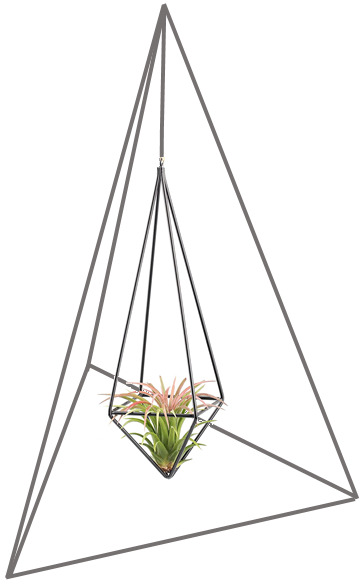
Ginni purchased an air plant holder which is in the shape of a tetrahedron.
Let A, B, C, and Dare the coordinates of the air plant holder where $\text{A}\equiv(1,1,1),\text{B}\equiv(2,1,3),\text{C}\equiv(3,2,2)$ and $\text{D}\equiv(3,3,4).$

Based on the above information, answer the following questions.
  1. Find the position vector of $\overline{\text{AB}}.$
  1. $-\hat{\text{i}}-2\hat{\text{k}}$
  2. $2\hat{\text{i}}+\hat{\text{k}}$
  3. $\hat{\text{i}}+2\hat{\text{k}}$
  4. $-2\hat{\text{i}}-\hat{\text{k}}$
  1. Find the position vector of $\overline{\text{AC}}.$
  1. $2\hat{\text{i}}-\hat{\text{j}}-\hat{\text{k}}$
  2. $2\hat{\text{i}}+\hat{\text{j}}+\hat{\text{k}}$
  3. $-2\hat{\text{i}}-\hat{\text{j}}+\hat{\text{k}}$
  4. $\hat{\text{i}}+2\hat{\text{j}}+\hat{\text{k}}$
  1. Find the position vector of $\overline{\text{AD}}.$
  1. $2\hat{\text{i}}-2\hat{\text{j}}-3\hat{\text{k}}$
  2. $\hat{\text{i}}+\hat{\text{j}}-3\hat{\text{k}}$
  3. $3\hat{\text{i}}+2\hat{\text{j}}+2\hat{\text{k}}$
  4. $2\hat{\text{i}}+2\hat{\text{j}}+3\hat{\text{k}}$
  1. Area of $\triangle\text{ABC}=$
  1. $\frac{\sqrt{11}}{2}\text{sq}.\text{units}$
  2. $\frac{\sqrt{14}}{2}\text{sq}.\text{units}$
  3. $\frac{\sqrt{13}}{2}\text{sq}.\text{units}$
  4. $\frac{\sqrt{17}}{2}\text{sq}.\text{units}$
  1. Find the unit vector along $\overline{\text{AD}}.$
  1. $\frac{1}{\sqrt{17}}(2\hat{\text{i}}+2\hat{\text{j}}+3\hat{\text{k}})$
  2. $\frac{1}{\sqrt{17}}(3\hat{\text{i}}+3\hat{\text{j}}+2\hat{\text{k}})$
  3. $\frac{1}{\sqrt{11}}(2\hat{\text{i}}+2\hat{\text{j}}+3\hat{\text{k}})$
  4. $(2\hat{\text{i}}+2\hat{\text{j}}+3\hat{\text{k}})$