Question
Look at the pictures given below and write about the picture.
Image
Image
Image
Image

Answer

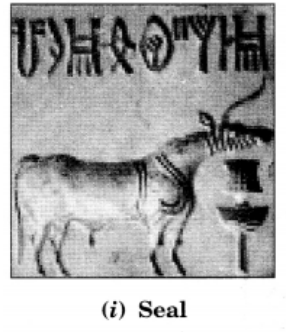
Picture (i) :
The object is a seal and found in the Harappan cities. This seal contains script and picture of animal. Script is still unreadable. This seal was used to stamp bags or packets containing goods that were sent from one place to another. Mouth of the bag was tied and a layer of wet clay was applied on knot and seal was pressed on it. Sealing on any object assured about safety of goods. Today also we seal the goods, articles, parcels etc.

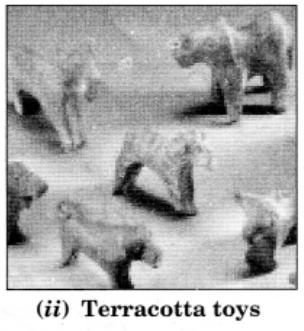
Picture (ii) :
Shown objects in the picture are terracotta toys and found in the Harappan cities. These were made by baking the clay after making the designs on the clay. All terracotta toys are animals of that time which refer that the Harappan people were closely concerned with animals. Perhaps the Harappan children played with these toys. In present day, we also find Terracotta things. Many type of decorative vessels, articles, animals, birds etc., are available in the market.

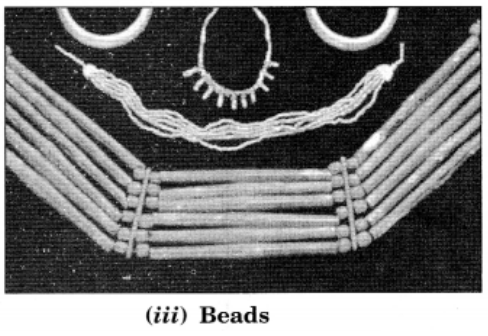
Picture (iii) :
Shown objects in the picture are ornaments such as garland, earring etc., made by beads and these were found in the Harappan cities. Many of the beads were made of carnelian, a beautiful red stone. The stone was cut, shaped, polished and finally a hole was bored through the centre so that a string could be passed through it. These type of the ornaments are available in the present market too and these are very much liked by the women particularly outsiders.

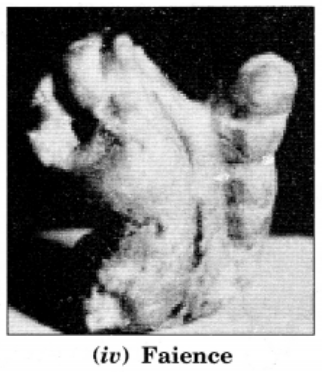
Picture (iv) :
An artificial object faience has been shown in the picture. Faience was used to make beads, bangles, earrings and tiny vessels.

Need a full question paper?

Generate a complete, print-ready paper with questions like this in minutes — across 16+ boards, with answer keys.

Start Generating Free

Similar questions

Compare and contrast the philosophies of Jainism and Buddhism in terms of their views on the self and the path to liberation.
In the stories of Shalini and Tenzing, we see examples of joint families. What do you think are the aspects of modern living that make some couples opt for a nuclear family (i.e. living apart from older generations or other relatives)? What could be some advantages as well as disadvantages of the two kinds of families?
How do family roles and responsibilities differ between joint and nuclear families in India?
Read the following paragraph and answer the questions that follow Mountains with tall and sharp peaks, like the Himalayas, are relatively ‘young’, which means that they were formed recently in the Earth’s history-but that is still millions of years ago! Shorter and more rounded mountains and hills, like the Aravalli Range, are much older and have been rounded by erosion. Sometimes, as with the Himalayas, upliftment as well as erosion continue to this day.

(i) Himalayas are tall and have sharp peaks because they are _________.
(a) ancient mountains
(b) young mountains
(c) eroded hills
(d) coastal ranges

(ii) The Aravalli Range is an example of old mountain because of _________.
(a) tall and sharp
(b) recently formed
(c) erosion
(d) continually uplifting

(iii) The statement “some mountains of the world, like the Himalayas, are still growing in height implies that these mountains are
(a) Eroding rapidly
(b) Forming new valleys
(c) Experiencing upliftment
(d) Located in coastal regions

(iv) The erosion affects the appearance of older mountain ranges like the Aravalli Range by
(a) making them taller
(b) sharpening their peaks
(c) making them shorter and more rounded
(d) adding volcanic features
Around 1900 BCE, the Indus Valley Civilisation, began to fall apart. Examine the statement.
The best means of measuring time is by the movement of the Earth, the Moon and the planets. The Sun regularly rises and sets every day and naturally, it is the best time-keeper throughout the world. Local time can be reckoned by the shadow cast by the Sun, which is the shortest at noon and longest at sunrise and sunset. When the Prime Meridian of Greenwich has the Sun at the highest point in the sky, all the places along this meridian will have mid-day or noon.
As the Earth rotates from West to East, those places East of Greenwich will be ahead of Greenwich time and those to the West will be behind it. The rate of difference can be calculated as follows. The Earth rotates 360° in about 24 hours, which means 15° an hour or 1° in four minutes. Thus, when it is 12 noon at Greenwich, the time at 15° East of Greenwich will be 15 × 4 = 60 minutes, i.e., 1 hour ahead of Greenwich time, which means 1 pm but at 15° West of Greenwich, the time will be behind Greenwich time by 1 hour, i.e., it will be 11.00 am Similarly, at 180°, it will be mid-night when it is 12 noon at Greenwich.

(i) How is local time affected in places East of Greenwich ?
(a) Local time is behind Greenwich time.
(b) Local time is ahead of Greenwich time.
(c) Local time is the same as Greenwich time.
(d) Local time is not affected.

(ii) How is local time determined according to the passage ?
(a) By the movement of the Moon.
(b) By the shadow cast of the Sun.
(c) By the rotation of the planets.
(d) By the position of the Prime Meridian.

(iii) How does the Earth’s rotation affect time in different places ?
(a) It causes variations in local time.
(b) It determines the length of the day.
(c) It influences the movement of the Moon.
(d) It creates differences in sunrise and sunset times.

(iv) How is the time difference calculated between two locations, according to the passage ?
(a) By the length of the day.
(b) By the Earth’s revolution around the Sun.
(c) By multiplying the distance by 4 minutes.
(d) By calculating the Moon’s position.
Discuss the three main economic sectors and their roles in the economy. Provide examples of activities within each sector and explain how they contribute to the overall economic system.
Discuss the importance of women’s participation in Panchayati Raj institutions and provide examples of successful female leaders in this system.
Illustrate about earlier and later levels of earth, How is this study useful for archaeologists?
Describe major landforms.