Question
Lorentz force is given by the formula:

Answer

  1. F = q(v × B + E)
Explanation:
Lorentz force is given by the formula F= q(v × B + E)

Need a full question paper?

Generate a complete, print-ready paper with questions like this in minutes — across 16+ boards, with answer keys.
Start Generating Free

Similar questions

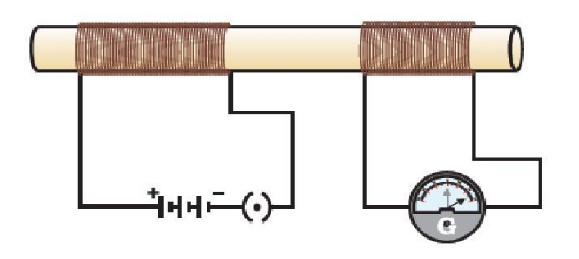
In the arrangement shown in given Figure, there are two coils wound on a non-conducting cylindrical rod. Initially the key is not inserted. Then the key is inserted and later removed. Then,
A diode, a resistor and a 50Hz AC source are connected in series. The number of current pulses per second through the resistor is:
The rays of different colours fail to converge at a point after going through a converging lens. This defect is called:
  1. Spherical aberration.
  2. Distortion.
  3. Coma.
  4. Chromatic aberration.
What is the correct order in which the listed atomic models were advanced and accepted, earliest first?
The molar heat capacity of oxygen gas at STP is nearly 2.5R. As the temperature is increased, it gradually increases and approaches 3.5R. The most appropriate reason for this behaviour is that at high temperatures:
  1. Oxygen does not behave as an ideal gas.
  2. Oxygen molecules dissociate in atoms.
  3. The molecules collide more frequently.
  4. Molecular vibrations gradually become effective.
An antenna behaves as resonant circuit only when its length is
A rocket is going towards moon with a speed $v.$ The astronaut in the rocket sends signals of frequency $v$  towards the moon and receives them back on reflection from the moon. What will be the frequency of the signal received by the astronaut $($Take $v << c)$
Thermionic emission from a heated filament varies with its temperature $T$ as
The susceptibility of a paramagnetic material is $\chi$ at $27^{\circ} C$. At what temperature will its susceptibility be $\frac{\chi}{2}$ ?
The mass number of sulfur atom is:
(Given: Atomic number = 16 and number of neutrons = 16)