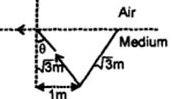
MCQ
Lux is a unit of
  • A
    Luminous intensity of a source
  • Illuminance on a surface
  • C
    Transmission coefficient of a surface
  • D
    Luminous efficiency of source of light

Answer

Correct option: B.
Illuminance on a surface
b
( b)

Need a full question paper?

Generate a complete, print-ready paper with questions like this in minutes — across 16+ boards, with answer keys.

Start Generating Free

Similar questions

Given below are two statements:

$Statement$ $(I)$ : The limiting force of static friction depends on the area of contact and independent of materials.

$Statement$ $(II)$ : The limiting force of kinetic friction is independent of the area of contact and depends on materials.

In the light of the above statements, choose the most appropriate answer from the options given below:
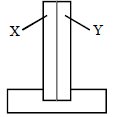
A bimetallic strip consists of metals $X$ and $Y$. It is mounted rigidly at the base as shown. The metal $X$ has a higher coefficient of expansion compared to that for metal $Y$. When the bimetallic strip is placed in a cold bath:
The true statement is
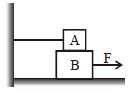
A block $A$ of mass $100\, kg$ rests on another block $B$ of mass $200\, kg$ and is tied to a wall as shown in the figure. The coefficient of friction between $A$ and $B$ is $0.2$ and that between $B$ and the ground is $0.3$. The minimum force $F$ required to move the block $B$ is........ $N$ . $(g = 10\, m/s^2)$
Magnetic field intensity is defined as
A flask contains Hydrogen and Argon in the ratio $2: 1$ by mass. The temperature of the mixture is $30^{\circ} C$. The ratio of average kinetic energy per molecule of the two gases ( $K$ argon/ $K$ hydrogen) is: (Given: Atomic Weight of $Ar = 39.9$)
A proton (mass $ = 1.67 \times {10^{ - 27}}\,kg$ and charge $ = 1.6 \times {10^{ - 19}}\,C)$ enters perpendicular to a magnetic field of intensity $2$ $weber/{m^2}$ with a velocity $3.4 \times {10^7}\,m/\sec $. The acceleration of the proton should be
A block of mass $1\,\, kg$ is hanging vertically from a string of length $1\,\, m$ and mass /length $= 0.001\,\, Kg/m$. A small pulse is generated at its lower end. The pulse reaches the top end in approximately .... $\sec$
At any instant the velocity of a particle of mass $500\,g$ is $\left(2 t \hat{ i }+3 t ^2 \hat{ j }\right)\,ms ^{-1}$. If the force acting on the particle at $t=1 s$ is $(\hat{i}+x \hat{j}) N$. Then the value of $x$ will be:
refractive index of medium is