$m x^{2}-b x+k=0$
Find time after which to the energy will become half of initial maximum value in damped force oscillation.
AIIMS 2019, Diffcult
Download our app for free and get started
The time after which the energy will become half of initial maximum value in damped forced oscillation is calculated as,
$\frac{1}{\sqrt{2}}=e^{-b t / m}$
$\ln \sqrt{2}=\frac{b t}{m}$
$t=\frac{m}{b} \times \frac{1}{2} \ln 2$

Download our appand get started for free
Experience the future of education. Simply download our apps or reach out to us for more information. Let's shape the future of learning together!No signup needed.*
Similar Questions
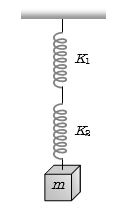
- 1View SolutionThe frequency of oscillation of the springs shown in the figure will be
- 2A particle moves in space according to equationView Solution
$\vec r = (\sin \,t\,\hat i\, + \,\cos \,t\,\hat j\, + \,t\,\hat k)m$
Find time $'t'$ when position vector and acceleration vector are perpendicular to each other
- 3If the displacement of a particle executing $SHM $ is given by $y = 0.30\sin (220t + 0.64)$ in metre, then the frequency and maximum velocity of the particle isView Solution
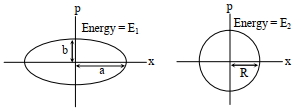
- 4Two independent harmonic oscillators of equal mass are oscillating about the origin with angular frequencies $\omega_1$ and $\omega_2$ and have total energies $E_1$ and $E_2$, respectively. The variations of their momenta $p$ with positions $x$ are shown in the figures. If $\frac{a}{b}= n ^2$ and $\frac{ a }{ R }= n$, then the correct equation$(s)$ is(are) $Image$View Solution
$(A)$ $E_1 \omega_1=E_2 \omega_2$ $(B)$ $\frac{\omega_2}{\omega_1}=n^2$ $(C)$ $\omega_1 \omega_2= n ^2$ $(D)$ $\frac{E_1}{\omega_1}=\frac{E_2}{\omega_2}$
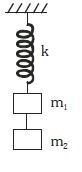
- 5Two masses $m_1$ and $m_2$ are supended together by a massless spring of constant $k$. When the masses are in equilibrium, $m_1$ is removed without disturbing the system; the amplitude of vibration isView Solution
- 6A simple harmonic oscillator has an amplitude a and time period $T$. The time required by it to travel from $x = a$ to $x = \frac{a }{2}$ isView Solution
- 7A simple pendulum oscillates in air with time period $T$ and amplitude $A$. As the time passesView Solution
- 8When an oscillator completes $100$ oscillations its amplitude reduced to $\frac{1}{3}$ of initial value. What will be its amplitude, when it completes $200$ oscillations?View Solution
- 9Two simple harmonic motions are represented by the equationsView Solution
${x}_{1}=5 \sin \left(2 \pi {t}+\frac{\pi}{4}\right)$ and ${x}_{2}=5 \sqrt{2}(\sin 2 \pi {t}+\cos 2 \pi {t})$
The amplitude of second motion is ....... times the amplitude in first motion.
- 10A particle performs simple harmonic motion with a period of $2$ second. The time taken by the particle to cover a displacement equal to half of its amplitude from the mean position is $\frac{1}{ a } s .$ The value of $'a'$ to the nearest integer is.........View Solution