MCQ
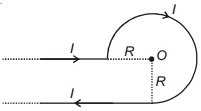
Magnetic field at the centre $O$ due to the given structure is
  • A
    $\frac{\mu_0 l}{4 R}\left[\frac{3}{2}+\frac{1}{\pi}\right] \odot$
  • B
    $\frac{\mu_0 I}{2 R}\left[3+\frac{1}{\pi}\right] \otimes$
  • $\frac{\mu_0 I}{4 R}\left[\frac{3}{2}+\frac{1}{\pi}\right] \otimes$
  • D
    $\frac{\mu_0 l}{4 R}\left[3+\frac{2}{\pi}\right] \odot$
Answer

Correct option: C.
$\frac{\mu_0 I}{4 R}\left[\frac{3}{2}+\frac{1}{\pi}\right] \otimes$
c
(c)

$B=B_{\text {due to circular arc }}+B_{\text {due to straight wires }}$

$=\frac{\mu_0 i}{2 R}\left(\frac{3 \pi}{2 \cdot(2 \pi)}\right)+\frac{\mu_0 i}{4 \pi R}$

$\Rightarrow B=\frac{\mu_0 i}{4 R}\left(\frac{3}{2}+\frac{1}{\pi}\right) \otimes$

Need a full question paper?

Generate a complete, print-ready paper with questions like this in minutes — across 16+ boards, with answer keys.

Start Generating Free

Similar questions

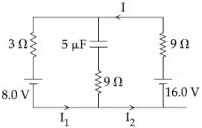
The circuit shown here has two batteries of $8.0\,V$ and $16.0\,V$ and three resistors $3\,\Omega ,\,9\,\Omega $ and $9\,\Omega $ and a capacitor of $5.0\,\mu F.$

How much is the current $I$ in the circuit in steady state? ................... $A$

The figure shows the electric field lines of three charges with charge $+1, +1$, and $-1$. The Gaussian surface in the figure is a sphere containing two of the charges. The total electric flux through the spherical Gaussian surface is
Potentiometer wire of length $1 \,m$ is connected in series with $490\,\Omega $ resistance and $2\,V$ battery. If $0.2\, mV/cm $ is the potential gradient, then resistance of the potentiometer wire is ................ $\Omega$
A galvanometer with a resistance of 12 W gives full scale deflection when a current of 3 mA is passed. It is required to convert it into a voltmeter which can read up to 18 V. the resistance to be connected is
The ratio of secondary to the primary turns in a transformer is 3 : 2. If the power output be P, then the input power neglecting all loses must be equal to
Which one of the following has the identical property for isotopes?
An electric wire of length ‘I’ and area of cross-section a has a resistance R ohms. Another wire of the same material having same length and area of cross-section 4a has a resistance of
Polarised glass is used in sun glasses because
The energy gaps $(E_g)$ between valence band and conduction band, for diamond, silicon and germanium are in the order
An electromagnetic wave travels along $z-$axis. Which of the following pairs of space and time varying fields would generate such a wave