MCQ
Magnification of an optical instrument is expressed in:
  • A
    $m$
  • B
    $m^{-1}$
  • C
    $D$
  • It has no unit

Answer

Correct option: D.
It has no unit

$\text{Magnification}=\frac{\text{Image Height}}{\text{Object Height}}​ $
because unit of image height and object height is same hence unit of magnification is none because it is a constant number. So, it has got to unit.

Need a full question paper?

Generate a complete, print-ready paper with questions like this in minutes — across 16+ boards, with answer keys.
Start Generating Free

Similar questions

If particles are moving with same velocity, then maximum de-Broglie wavelength will be for
Microscope is an optical instrument which
A cable of resistance $10\,\Omega $ carries electric power from a generator producing $250\, kW$ at $10000\, volt$. The current in the cable is ............. $A$
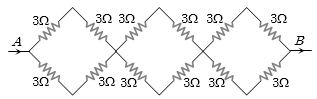
In the network of resistors shown in the adjoining figure, the equivalent resistance between $A$ and $B$ is ............ $ohm$
Consider the following statements regarding a charged particle in a magnetic field . Which of the statements are true :
A charge $+q$ is distributed over a thin ring of radius $r$ with line charge density $\lambda=q \sin ^{2} \theta /(\pi r)$. Note that the ring is in the $X Y$ - plane and $\theta$ is the angle made by $r$ with the $X$-axis. The work done by the electric force in displacing a point charge $+ Q$ from the centre of the ring to infinity is
The time period of a vibration magnetometer is $T_0$. Its magnet is replaced by another magnet whose moment of inertia is $3$ $times$ and magnetic moment is $1/3$ of the initial magnet. The time period now will be
Assertion : The possibility of an electric bulb fusing is higher at the time of switching ON and OFF
Reason : Inductive effects produce a surge at the time of switch ON and OFF
In a capacitor of capacitance 20 μF, the distance between the plates is 2mm. If a dielectric slab of width 1mm and dielectric constant 2 is inserted between the plates, then the new capacitance is
The relative atomic masses of many elements are not whole numbers because: