MCQ
Microscope is an optical instrument which
  • A
    Enlarges the object
  • Increases the visual angle formed by the object at the eye
  • C
     Decreases the visual angle formed by the object at the eye
  • D
     Brings the object nearer

Answer

Correct option: B.
Increases the visual angle formed by the object at the eye
 Increases the visual angle formed by the object at the eye

Need a full question paper?

Generate a complete, print-ready paper with questions like this in minutes — across 16+ boards, with answer keys.
Start Generating Free

Similar questions

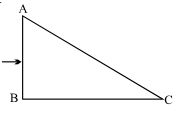
$A$ ray of light is incident normally on a prism of refractive index $1.5$, as shown. The prism is immersed in a liquid of refractive index $'\mu '$. The largest value of the angle $ACB$, so that the ray is totally reflected at the face $AC$, is $30^o$. Then the value of $\mu$ must be :
Electrons accelerated from rest by an electrostatic potential are collimated and sent through a Young's double slit experiment. The fringe width is $\omega$. If the accelerating potential is doubled, then the width is now close to ............. $\omega$
The speed of electromagnetic wave in a medium (whose dielectric constant is $2.25$ and relative permeability is $4$ ) is equal to .......... $\times 10^8 \,m / s$
The value of angle of dip is zero at the magnetic equator because on it
A transformer has turn ratio 100/1. If secondary coil has 4 amp current then current in primary coil is
A film projector magnifies a $100 \;cm^2$ film strip on a screen. If the linear magnification is $4,$ the area of magnified film on the screen is.....$cm^2$
If number of turns, area and current through a coil is given by $N, A$ and $I$ respectively then its magnetic moment will be
A photosensitive substance emits $........$ when illuminated by light:
An $X$-ray tube has a short wavelength end at $0.45 \mathring A$. The voltage of tube is ........ $V$
A current passes through a resistor. Let $\mathrm{K}_1$ and $\mathrm{K}_2$ represent the average kinetic energy of the conduction electrons and the metal ions, respectively :