MCQ
Magnitude of pursuit velocity does not depend on :
- Across-section of the wire
- ✓length of the wire
- Cthe number of free electrons
- Dmagnitude of current
Generate a complete, print-ready paper with questions like this in minutes — across 16+ boards, with answer keys.
What will be the equivalent resistance between the two points A and D

|
(a) 10 Ω |
(b) 20 Ω |
(c) 30 Ω |
(d) 40 Ω |
Two free parallel wires carrying currents in opposite direction
| (a) Attract each other |
| (b) Repel each other |
| (c) Neither attract nor repel |
| (d) Get rotated to be perpendicular to each other |
Light energy emitted by stars is due to
|
(a) Breaking of nuclei |
(b) Joining of nuclei |
|
(c) Burning of nuclei |
(d) Reflection of solar light |
A sinusoidal voltage of peak value 200 volt is connected to a diode and resistor R in the circuit shown so that half wave rectification occurs. If the forward resistance of the diode is negligible compared to R the rms voltage (in volt) across R is approximately
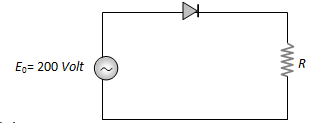
|
(a) 200 |
(b) 100 |
(c) |
(d) 280 |
Assertion : Silicon is preferred over germanium for making semiconductor devices.
Reason : The energy gap for germanium is more than the energy gap of silicon.
|
(a) If both assertion and reason are true and the reason is the correct explanation of the assertion. |
|
(b) If both assertion and reason are true but reason is not the correct explanation of the assertion. |
|
(c) If assertion is true but reason is false. |
|
(d) If the assertion and reason both are false. |
In given figure, the potentiometer wire AB has a resistance of 5 W and length 10 m. The balancing length AM for the emf of 0.4 V is

|
(a) 0.4 m |
(b) 4 m |
(c) 0.8 m |
(d) 8 m |
