MCQ
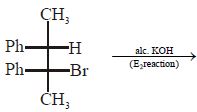
Major product of the reaction is
- A
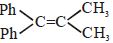
- B
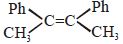
- ✓
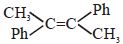
- D$\begin{array}{*{20}{c}}
{Ph - CH - CH - Ph}\\
{|\,\,\,\,\,\,\,\,\,\,\,\,\,\,|}\\
{\,\,\,\,\,C{H_3}\,\,\,\,\,\,\,\,OH}
\end{array}$
Generate a complete, print-ready paper with questions like this in minutes — across 16+ boards, with answer keys.
| List $-I$ | List $-II$ | ||
|
$(a)$ |
$\begin{array}{*{20}{c}} {O\,\,\,\,\,\,\,\,\,\,\,\,\,\,\,\,\,\,\,\,\,\,\,\,\,\,\,\,} \\ {||\,\,\,\,\,\,\,\,\,\,\,\,\,\,\,\,\,\,\,\,\,\,\,\,\,\,\,\,} \\ {R - C - Cl \to R - CHO} \end{array}$ |
$(i)$ |
$Br _{2} / NaOH$ |
| $(b)$ | $\begin{array}{*{20}{c}} {R - C{H_2} - COOH \to R - CH - COOH} \\ {\,\,\,\,\,\,\,\,\,\,\,\,\,\,\,\,\,\,\,\,\,\,\,\,\,\,\,\,\,\,|} \\ {\,\,\,\,\,\,\,\,\,\,\,\,\,\,\,\,\,\,\,\,\,\,\,\,\,\,\,\,\,\,\,\,\,Cl} \end{array}$ |
$(ii)$ | $H _{2} / Pd - BaSO _{4}$ |
| $(c)$ | $\begin{array}{*{20}{c}} {O\,\,\,\,\,\,\,\,\,\,\,\,\,\,\,\,\,\,\,\,\,\,\,\,\,\,\,\,\,\,} \\ {||\,\,\,\,\,\,\,\,\,\,\,\,\,\,\,\,\,\,\,\,\,\,\,\,\,\,\,\,\,\,\,} \\ {R - C - N{H_2} \to R - N{H_2}} \end{array}$ |
$(iii)$ | $Zn ( Hg ) /$ Conc. $HCl$ |
| $(d)$ | $\begin{array}{*{20}{c}} {O\,\,\,\,\,\,\,\,\,\,\,\,\,\,\,\,\,\,\,\,\,\,\,\,\,\,\,\,\,\,\,\,\,\,\,\,\,\,\,\,\,\,\,\,\,} \\ {||\,\,\,\,\,\,\,\,\,\,\,\,\,\,\,\,\,\,\,\,\,\,\,\,\,\,\,\,\,\,\,\,\,\,\,\,\,\,\,\,\,\,\,\,\,} \\ {R - C - C{H_3} \to R - C{H_2} - C{H_3}} \end{array}$ |
$(iv)$ | $Cl _{2}$ / Red $P , H _{2} O$ |
Choose the correct answer from the options given below:
