MCQ
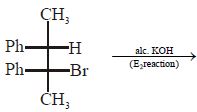
Major product of the reaction is
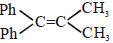
- A
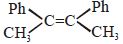
- B
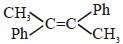
- ✓
- D$\begin{array}{*{20}{c}}
{Ph - CH - CH - Ph}\\
{|\,\,\,\,\,\,\,\,\,\,\,\,\,\,|}\\
{\,\,\,\,\,C{H_3}\,\,\,\,\,\,\,\,OH}
\end{array}$
Generate a complete, print-ready paper with questions like this in minutes — across 16+ boards, with answer keys.
At $300 \,K$, ozone is fifty percent dissociated. The standard free energy change at this temperature and $1\, atm$ pressure is $(-)$ $........\,J\, mol ^{-1}$ (Nearest integer)
[Given: $\ln 1.35=0.3$ and $R =8.3 J K ^{-1} mol ^{-1}$ ]
Assertion ($A$): Enthalpy of neutralisation of strong monobasic acid with strong monoacidic base is always $-57 \mathrm{~kJ} \mathrm{~mol}^{-1}$
Reason ($R$): Enthalpy of neutralisation is the amount of heat liberated when one mole of $\mathrm{H}^{+}$ions furnished by acid combine with one mole of ${ }^{-} \mathrm{OH}$ ions furnished by base to form one mole of water. In the light of the above statements, choose the correct answer from the options given below.
| List $-I$ (Molecule / Species) | List $-II$ |
| $(P)$ $NO_2$ (Unpaired electron in) | $(1)$ Vacant $p-$ orbital involved in hybridization |
| $(Q)$ $B_2H_6$ | $(2)$ $sp^2-$ orbital |
| $(R)$ $ClO_3$ (Unpaired electron in) | $(3)$ $sp^3-$orbital |
| $(S)$ $CH_3^+$ | $(4)$ $120^o$ Bond angle |