MCQ
Mark out the correct options.
  • A
    An ammeter should have small resistance.
  • B
    An ammeter should have large resistance.
  • C
    Avoltmeter should have large resistance.
  • Both $(A)$ and $(C)$

Answer

Correct option: D.
Both $(A)$ and $(C)$
d
Smaller the resistance of an ammeter more accurate will be its reading. An ammeter is said to be ideal if its resistance is zero, i.e. it shows actual (value of) current flowing through the circuit. Also, greater the resistance of voltmeter, more accurate will be its reading. A voltmeter is said to be ideal if its resistance is infinite, i.e, it draws no current from the circuit element for its operation. Hence, an ammeter should have small resistance and a voltmeter should have large resistance.

Need a full question paper?

Generate a complete, print-ready paper with questions like this in minutes — across 16+ boards, with answer keys.
Start Generating Free

Similar questions

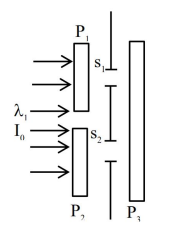
In a Young's double slit experiment, three polarizers are kept as shown in the figure. The transmission axes of $P_1$ and $P_2$ are orthogonal to each other. The polarizer $P_3$ covers both the slits with its transmission axis at $45^{\circ}$ to those of $P$ and $P_2$. An unpolarized light of wavelength $\lambda$ and intensity $I_0$ is incident on $P_1$ and $P_2$. The intensity at a point after $P_3$ where the path difference between the light waves from $s_1$ and $s_2$ is $\frac{\lambda}{3}$, is
Image
Two point charges $ + q$ and $ - q$ are held fixed at $( - d,\,0)$ and $(d,\,0)$ respectively of a $(X,\,Y)$ coordinate system. Then
A disc of mass $1\,kg$ and radius $R$ is free of rotate about a horizontal axis passing through its centre and perpendicular to the plane of disc. A body of same mass as that of disc is fixed at the highest point of the disc. Now the system is released, when the body comes to the lowest position, its angular speed will be $4 \sqrt{\frac{x}{3 R}}$ rad s$^{-1}$ where $x=$

$\left( g =10\,ms ^{-2}\right)$

The attenuation in optical fibre is mainly due to
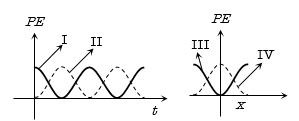
For a particle executing $S.H.M.$ the displacement $x$ is given by $x = A\cos \omega t$. Identify the graph which represents the variation of potential energy $(P.E.)$ as a function of time $t$ and displacement $x$
A ring of radius $0.5\, m$ and mass $10 \,kg$ is rotating about its diameter with an angular velocity of $20 \,rad/s.$  Its kinetic energy is .......... $J$
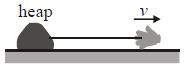
A heap of rope with mass density $\lambda $ (per unit length) lies on a table. You grab one end and pull horizontally with constant speed $v$ , as shown in figure. (Assume that the rope has no friction with itself in the heap.) The force that you must apply to maintain the constant speed $v$ is 
The density of a material $A$ is $1500 kg/m^3$ and that of another material $B$ is $2000 kg/m^3$. It is found that the heat capacity of $8$ volumes of $A$ is equal to heat capacity of $12$ volumes of $B$. The ratio of specific heats of $A$ and $B$ will be
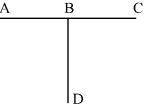
Three conducting rods of same material and cross-section are shown in figure. Temperatures of$ A, D$ and $C$ are maintained at $20^o C, 90^o C$ and $0^o C$. The ratio of lengths of $BD$ and $BC$ if there is no heat flow in $AB$ is:
Two bodies of masses $2\,kg$ and $4\,kg$ are moving with velocities $2\,m/s$ and $10\,m/s$ respectively towards each other due to mutual gravitational attraction. ....... $m/s$ is the velocity of their centre of mass (Bodies are at rest initially)