MCQ
The attenuation in optical fibre is mainly due to
  • A
    Absorption
  • B
    Scattering
  • C
    Neither absorption nor scattering
  • Both $(a)$ and $(b)$

Answer

Correct option: D.
Both $(a)$ and $(b)$
d
(d) A very small part of light energy is lost from an optical fibre due to absorption or due to light leaving the fibre as a result of scattering of light sideways by impurities in the glass fibre.

Need a full question paper?

Generate a complete, print-ready paper with questions like this in minutes — across 16+ boards, with answer keys.
Start Generating Free

Similar questions

The torque of a force $5 \hat{i}+3 \hat{j}-7 \hat{k}$ about the origin is $\tau$. If the force acts on a particle whose position vector is $2 \hat{i}+2 \hat{j}+\hat{k}$, then the value of $\tau$ will be.
The temperature of reservoir of Carnot's engine operating with an efficiency of $70\%$ is $1000K.$ The temperature of its sink is ...... $K$
To make a $PN$ junction conducting
Two discs of moment of inertia $I_1=4 \mathrm{~kg} \mathrm{~m}^2$ and $\mathrm{I}_2=2 \mathrm{~kg} \mathrm{~m}^2$ about their central axes & normal to their planes, rotating with angular speeds $10 \mathrm\ {rad} / \mathrm{s}$ & $4  \mathrm\ {rad} / \mathrm{s}$ respectively are brought into contact face to face with their axe of rotation coincident. The loss in kinetic energy of the system in the process is____ $\mathrm{J}$.
The distance of the Sun from earth is $1.5 \times 10^{11} \,m$ and its angular diameter is $(2000) \,s$ when observed from the earth. The diameter of the Sun will be ...........
A particle is moving with speed $v= b\sqrt x$ along positive $x-$ axis. Calculate the speed of the particle at time $t = \tau$ (assume that the particle is at origin at $t = 0$ ).
In $YDSE$, let $S_1$ and $S_2$ be the two slits, and $C$ be the centre of the screen. If $\theta$ is the angle $S_1CS_2$ and $\lambda$ is the wavelength, the fringe width will be 
Three observers $A, B$ and $C$ measure the speed of light coming from a source to be ${v_A}$, ${v_B}$ and ${v_C}$. The observer $A$ moves towards the source, the observer $C$ moves away from the source with the same speed. The observer $B$ stays stationary. the surrounding space is vacuum every where. Then
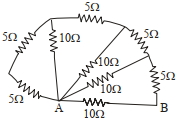
The equivalent resistance between points $A$ and $B$ in the given network is ............ $\Omega$
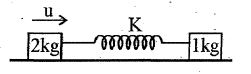
Two blocks of mass $2\ kg$ and $1\ kg$ are connected by an ideal spring on a rough surface. The spring in unstreched. Spring constant is $8\ N/m$ . Coefficient of friction is  $μ = 0.8$ . Now block $2\ kg$ is imparted a velocity $u$ towards $1\ kg$ block. Find the maximum value of velocity $'u'$ of block $2\ kg$ such that block of $1\ kg$ mass never move is