MCQ
Mark out the correct options.
  • A
    Diamagnetism occurs in all materials.
  • B
    Diamagnetism results from the partial alignment of permanent magnetic moment.
  • C
    The magnetizing field intensity H is always zero in free space.
  • The magnetic field of induced magnetic moment is opposite to the applied field.
Answer

Correct option: D.
The magnetic field of induced magnetic moment is opposite to the applied field.
$Þ$ Diamagnctism occurs in all materials.
$Þ$ The Magnetic field of Induced magnetic moment is opposite to the applied field.
Need a full question paper?

Generate a complete, print-ready paper with questions like this in minutes — across 16+ boards, with answer keys.

Start Generating Free

Similar questions

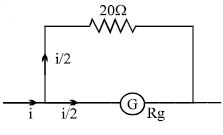
In a galvanometer, the deflection becomes one half when the galvanometer is shunted by a $20\,\,\Omega$ resistor. The galvanometer resistance is ............... $\Omega$
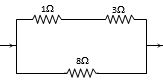
Power dissipated across the $8 \,\,\Omega$ resistor in the circuit shown here is $2\,\, watt.$ The power dissipated in watt units across the $3 \,\,\Omega$ resistor is 
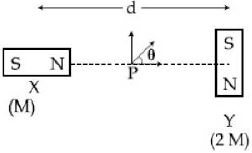
Two magnetic dipoles $X$ and $Y$ are placed at a separation $d$, with their axes perpendicular to each other. The dipole moment of $Y$ is twice that of $X$. A particle of charge $q$ is passing through their mid-point $P$, at angle $\theta  = 45^o$ with the horizontal line as shown in the figure. What would be the magnitude of force on the particle at that instant ? ($d$ is much larger than the dimensions of the dipole)
A galvanometer, whose resistance is $50\,ohm,$ has $25$ divisions in it. When a current of $4\times 10^{-4}\,A$ passes through it, its needle (pointer) deflects by one division. To use this galvanometer as a voltmeter of range $2.5\,V,$ it should be connected to a resistance of.......$ohm$
Two charged particles, having same kinetic energy, are allowed to pass through a uniform magnetic field perpendicular to the direction of motion. If the ratio of radii of their circular paths is $6: 5$ and their respective masses ratio is $9: 4$. Then, the ratio of their charges will be.
The ratio of the kinetic energy to the total energy of an electron in a Bohr orbit is
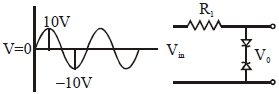
Take the breakdown voltage of the zener diode used in the given circuit as $6\, V$. For the input voltage shown in figure below, the time variation of the output voltage is : (Graphs drawn are schematic and not to scale)
A square of side $3\;cm$ is placed at a distance of $25\;cm$ from a concave mirror of focal length $10\;cm.$ The centre of the square is at the axis of the mirror and the plane is normal to the axis. The area enclosed by the image of the square is......$c{m^2}$
Assertion : $X-$ ray travel with the speed of light.

Reason : $X-$ rays are electromagnetic rays

Given below are two statements: One is labelled as Assertion $(A)$ and the other is labelled as Reason $(R).$

Assertion $(A)$ : In an uniform magnetic field, speed and energy remains the same for a moving charged particle.

Reason $(R)$ : Moving charged particle experiences magnetic force perpendicular to its direction of motion.