MCQ
Two charged particles, having same kinetic energy, are allowed to pass through a uniform magnetic field perpendicular to the direction of motion. If the ratio of radii of their circular paths is $6: 5$ and their respective masses ratio is $9: 4$. Then, the ratio of their charges will be.
  • A
    $8: 5$
  • $5: 4$
  • C
    $5: 3$
  • D
    $8: 7$

Answer

Correct option: B.
$5: 4$
b
Radius of circular path $R =\frac{\sqrt{2 mk }}{ qB }$

$q =\frac{\sqrt{2 mk }}{ RB }$

$\frac{ q _{1}}{ q _{2}}=\sqrt{\frac{ m _{1}}{ m _{2}}} \times \frac{ R _{2}}{ R _{1}}=\sqrt{\frac{9}{4}} \times \frac{5}{6}=\frac{5}{4}$

Need a full question paper?

Generate a complete, print-ready paper with questions like this in minutes — across 16+ boards, with answer keys.

Start Generating Free

Similar questions

A ray of light is incident on a transparent glass slab of refractive index $1.62$. The reflected and the refracted rays are mutually perpendicular. The angle of incidence is.......$^o$
Given below are two statements: one is labelled as Assertion $A$ and the other is labelled as

Reason $R$.

Assertion $A :$ An electron microscope can achieve better resolving power than an optical microscope.

Reason $R$ : The de Broglie's wavelength of the electrons emitted from an electron gun is much less than wavelength of visible light.

In the light of the above statements, choose the correct answer from the options given below

A beam of monoenergetic electrons, which have been accelerated from rest by a potential $U$, is used to form an interference pattern in a Young's double slit experiment. The electrons are now accelerated by potential $4 U$. Then, the fringe width
'Mirage' is a phenomenon due to
A moving coil type of galvanometer is based upon the principle that:
Light of wavelength is 700 Å in air. It has a wavelength in glass (μ = 1.5) equal to
Radius of the first orbit of the electron in a hydrogen atom is $0.53\;\mathring A$. So, the radius of the third orbit will be...........$\mathring A$
When ultraviolet rays are incident on metal plate, then photoelectric effect does not occurs. It occurs by the incidence of
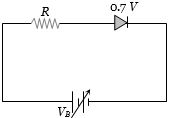
The junction diode in the following circuit requires a minimum current of $1 \,mA$ to be above the knee point $(0.7\, V)$ of its $I-V $ characteristic curve. The voltage across the diode is independent of current above the knee point. If $VB = 5 \,V$, then the maximum value of $ R$ so that the voltage is above the knee point, will be
A beam of monochromatic light is incident at $i = 50^o$ on one face of an equilateral prism, the angle of emergence is $40^o$, then the angle of minimum deviation is