MCQ
Mark out the incorrect statement:
- AA free neutron can transform itself into photon
- BA free proton can transform itself into neutron
- CIn beta minus decay, the electron originates from nucleus
- DAll of the above
Explanation:
In beta minus decay, a neutron decays into a proton, an electron.
A free neutron is unstable, decaying to a proton, electron and antineutrino.
Inside a nucleus, a proton can transform into a neutron via inverse beta.
Generate a complete, print-ready paper with questions like this in minutes — across 16+ boards, with answer keys.
The carrier frequency generated by a tank circuit containing 1 nF capacitor and 10 mH inductor is
|
(a) 1592 Hz |
(b) 1592 MHz |
(c) 1592 kHz |
(d) 159.2 Hz |
A achromatic combination is made with a lens of focal length f and dispersive power ω with a lens having dispersive power of 2ω. The focal length of second will be
|
(a) 2f |
(b) f/2 |
(c) -f/2 |
(d) – 2 f |
A thick wire is stretched so that its length become two times. Assuming that there is no change in its density, then what is the ratio of change in resistance of wire to the initial resistance of wire
|
(a) 2 : 1 |
(b) 4 : 1 |
(c) 3 : 1 |
(d) 1 : 4 |
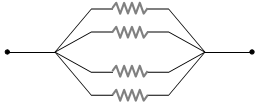
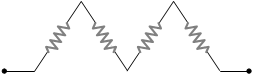
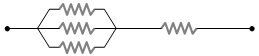
Which arrangement of four identical resistances should be used to draw maximum energy from a cell of voltage V
|
(a)
|
(b)
|
|
(c)
|
(d)
|
A light source approaches the observer with velocity 0.8 c. The doppler shift for the light of wavelength 5500 Å is
|
(a) 4400 Å |
(b) 1833 Å |
(c) 3167 Å |
(d) 7333 Å |