Question
Mark the correct alternative in the following question:
Suppose a random variable X follows the binomial distribution with parameters n and p, where 0 < p < 1. If $\frac{\text{P(X = r})}{\text{P(X = n} -\text{r})}$ is independent of n and r, then p equals:
Answer

  1. $\frac{1}{2}$
Solution:
Consider,
$\text{P(X = r) = kP(X = n}-\text{r})$
Using $\text{ }^{\text{n}}\text{C}_{\text{r}}=\text{ }^{\text{n}}\text{C}_{\text{n}-\text{r}},\text{q}=1-\text{p}$
$\text{p}^{\text{r}}\text{q}^{\text{n}-\text{r}}=\text{kp}^{\text{n}-\text{r}}\text{q}^{\text{r}}$
$\text{p}^{\text{r}}(1-\text{p})^{\text{n}-\text{r}}=\text{kp}^{\text{n}-\text{r}}(1-\text{p})^{\text{r}}$
$\text{p}^{2\text{r}-\text{n}}=\text{k}(1-\text{p})^{\text{2r}-\text{n}}$
$\big(\frac{\text{p}}{\text{q}}\big)^{\text{2r}-\text{n}}=\text{k}$
when p = q then k = 1
$\Rightarrow\text{p = q}=\frac{1}{2}$

Need a full question paper?

Generate a complete, print-ready paper with questions like this in minutes — across 16+ boards, with answer keys.

Start Generating Free

Similar questions

Let f : $R \rightarrow R$ be given by $\text{f(x)}=\tan {x}.$ Then, $f^{-1}(1)$ is:
For a binomial variate X, if $\text{n}=3$ and $\text{P(X}=1)=8\text{ P(X = 3}),$ then p =
  1. $\frac{4}{5}$
  2. $\frac{1}{5}$
  3. $\frac{1}{3}$
  4. $\frac{2}{3}$
The equation of a line is given by $\frac{4-x}{2}=\frac{y+3}{3}=\frac{z+2}{6}$, the direction cosines of line parallel to the given line is
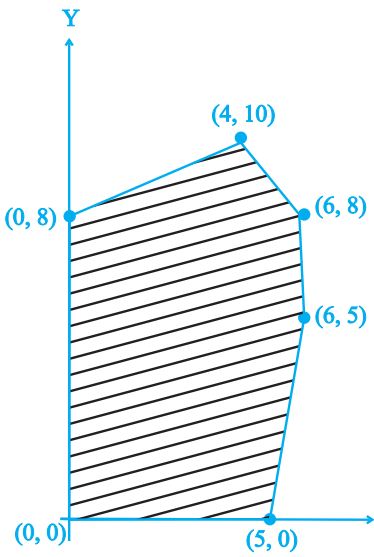
Choose the correct answer from the given four options. The feasible solution for a LPP is shown in. Let Z = 3x - 4y be the objective function.
Maximum of Z occurs at:
If the projection of $\vec{\text{a}}=\hat{\text{i}}-2\hat{\text{j}}+3\hat{\text{k}}$ on $\vec{\text{b}}=2\hat{\text{i}}+\lambda\hat{\text{k}}$ is zero, then the value of $\lambda$ is:
  1. $0$
  2. $1$
  3. $\frac{-2}{3}$
  4. $\frac{-3}{2}$
Which of the following statements is correct?
  1. Every LPP admits an optimal solution
  2. A LPP admits unique optimal solution
  3. If a LPP admits two optimal solution it has an infinite number of optimal solutions
  4. The set of all feasible solutions of a LPP is not a converse set
The solution of the differential equation $\frac{d y}{d x}+\frac{2 x y}{1+x^2}=\frac{1}{\left(1+x^2\right)^2}$ is:
Find the value of $\lambda$ so that the vectors $2 \hat{i}-4 \hat{j}+\hat{k}$ and $4 \hat{i}-8 \hat{j}+\lambda \hat{k}$ are perpendicular.
The region represented by the inequation system x, y ≥ 0, y ≤ 6, x + y ≤ 3 is:
$\int(\text{x}-1)\text{e}^{-\text{x}}\text{ dx}$ is equal to:
  1. $-\text{x}\text{e}^{\text{x}}+\text{C}$
  2. $\text{x}\text{e}^{\text{x}}+\text{C}$
  3. $-\text{x}\text{e}^{-\text{x}}+\text{C}$
  4. $\text{x}\text{e}^{-\text{x}}+\text{C}$